
I don’t trust myself when I’m looking at stocks.
That sounds like a strange thing to admit. But the more I’ve used AI to analyze my investment decisions, the more I’ve realized that the problem usually isn’t information — it’s me. My biases. My blind spots. My tendency to fall in love with a position and then rationalize staying in it long after I should have left.
So over the past several months, I’ve been building a set of free, browser-based tools. Nothing fancy. No login required, no data stored, no app to download. Just structured questions that force me to slow down and think clearly before I act.
Here are the five tools I use most, what each one does, and the specific moment in my investing process where I reach for it.
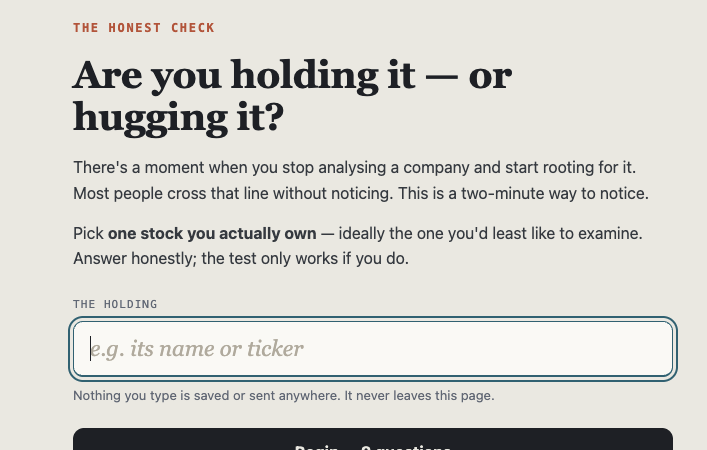
Tool 1: Are You in Love With This Stock?
When I use it: When I notice I’m defending a position in my head — or when someone points out a problem with a stock I hold and my first instinct is to argue.
This one is built around a specific idea: the biggest mistakes I’ve made as an investor weren’t about missing information. They were about being emotionally attached to a stock and letting that attachment filter what I was willing to see.
The tool walks you through a series of bias checks — things like whether you’ve updated your thesis in the last 90 days, whether you’d buy more at the current price, whether you can describe the actual bear case without dismissing it. It doesn’t make the decision for you. It just surfaces the emotional patterns that might be clouding your judgment.
→ Are You in Love With This Stock? (free tool)
Tool 2: Should I Sell This Stock?
When I use it: When I’m looking at a position that’s been disappointing and I can’t figure out whether I should cut it or wait it out.
Selling is the hardest thing in investing. Buying feels like action. Selling feels like admitting failure. And so most retail investors — myself included — hold on to losing positions for far too long, hoping they’ll come back.
The Sell Signal Checklist walks through a structured set of questions about the original thesis, what’s changed since, the fundamentals, and the opportunity cost. By the end, it doesn’t tell you what to do — but it forces you to articulate whether you still actually believe in the position, or whether you’re just waiting to break even.
I built this one after writing about two stocks I held for years that I should have sold much earlier. I wish I’d had it then.
→ Should I Sell This Stock? (free tool)
Tool 3: The 10× Stock Screener
When I use it: When I’m evaluating a new stock and want to know whether it even has the structural profile to become a multi-bagger.
Most stocks can’t 10× from here. That’s just math. They’re in the wrong industry, or they’re too big, or the market they serve isn’t growing fast enough, or the competitive moat is too shallow. The question isn’t whether you like the company — it’s whether the conditions for a 10× return actually exist.
This tool works through the key criteria: market size, competitive positioning, management quality, balance sheet, growth trajectory. It doesn’t spit out a score or a buy/sell signal. It gives you a structured picture of how a stock looks across the dimensions that tend to matter most for compounding over a long horizon.
→ The 10× Stock Screener (free tool)
Tool 4: The Grassroots Research Checklist
When I use it: Before I buy anything — as a reminder to actually go look at the business, not just the financials.
Peter Lynch had a phrase for this: kick the tires. Before you buy a stock, go to the store. Talk to employees. Check the shelves. See how busy the parking lot is. I’ve written about doing something like this every time I visit a supermarket — and it’s genuinely changed how I think about consumer businesses.
The Grassroots Research Checklist structures that kind of on-the-ground observation. It’s not about replacing financial analysis — it’s about adding the layer of reality that balance sheets can’t capture: whether a product people actually want, whether the brand still means something in daily life, whether the company’s growth story holds up when you look at it from street level.
→ The Grassroots Research Checklist (free tool)
Tool 5: AI Career Self-Assessment
When I use it: When a friend asks me for career advice — or when I’m trying to think clearly about my own professional direction.
This one is different from the others. It’s not about investing. It’s about something most of us find even harder to think about clearly: our careers.
A few months ago, a friend asked me what someone in their mid-40s working in IT should do next, given how fast the industry is moving. I spent several hours thinking through it with AI — and the process was genuinely useful. Not because AI has all the answers, but because structured questions force you to be honest about what you actually want and what’s realistic.
The AI Career Self-Assessment generates a prompt you can paste into any AI model. Based on your answers about experience, values, and constraints, it produces a tailored career analysis — what to lean into, what to let go of, where the opportunities are for someone in your specific situation.
→ AI Career Self-Assessment (free tool)
Why Free? Why No Login?
All five tools run entirely in your browser. Nothing is stored. No account required. I built them this way because the value isn’t in the data — it’s in the thinking process. The tools are just a way to structure your own reasoning.
I keep them free because I’m not trying to sell you a subscription. I’m trying to document what actually works. If a tool helps you avoid one bad decision, it’s done its job.
More tools are coming. If there’s something specific you wish existed — a structured way to think through a particular investing or career problem — let me know in the comments.
Leave a Reply