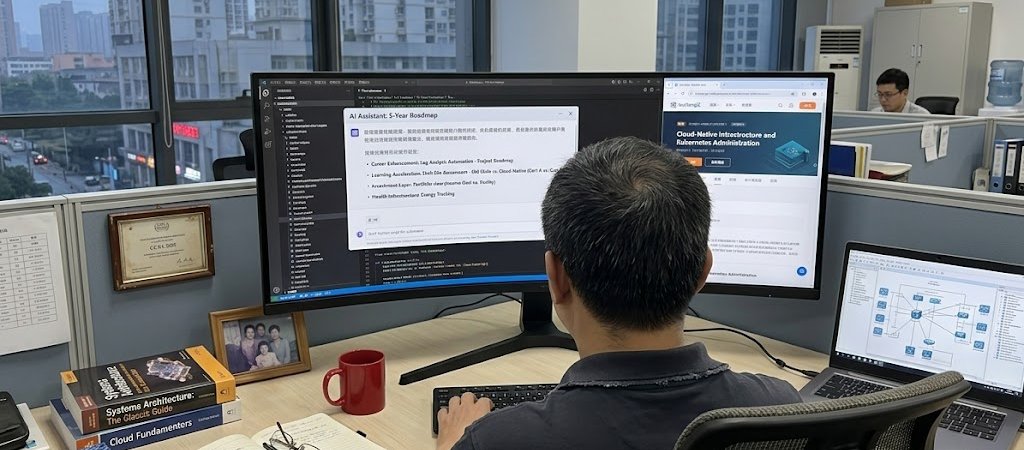

A friend of mine is 45. He works in IT in China.
A few weeks ago he came to me asking what he should do about the next five years. The anxiety he described was specific: Chinese tech companies have well-documented age bias in hiring. The industry’s internal slang for it is “35岁危机” — the 35-year-old crisis, the age at which many technical workers start to feel invisible in the job market. He was past that already.
He knows his systems well. He has been doing this for a long time. But the industry around him is changing faster than it ever has, and he wanted an honest assessment of what the next five years should look like.
I didn’t have a ready answer. So I did what I do now: I took his situation to AI and asked it to build him an honest roadmap. The first thing it said was what the goal was not.
What AI Said He Should Stop Trying to Become
My friend had arrived at the conversation with some assumptions about what “learning AI” meant. Deep learning. Model training. Algorithm engineering. The path that ambitious younger people take into the AI industry.
AI was direct: this is the wrong target.
Not because the skills aren’t valuable — they are. But because that path is designed for someone starting at 22 with the full runway of a technical career ahead of them, competing for roles inside AI companies where age works against them from day one.
The roadmap AI proposed had a different frame entirely. The goal was not to become an AI engineer. The goal was to become someone who uses AI to extend the useful life and quality of everything else he already does.
That reframe changed what the entire five years looked like.
The Actual Roadmap
AI built the plan around four areas working together, not as separate learning tracks but as an integrated system.
Career enhancement: Use AI to automate the repetitive parts of IT work — log analysis, incident classification, report writing, documentation. Not to replace the work, but to do it faster and shift time toward the higher-judgment parts that are harder to automate and more valuable to the organization. The argument was simple: if you can do in two hours what takes colleagues four, you are more useful at 45 than you were at 35.
Learning acceleration: Use AI as a permanent tutor for staying current. New certifications, new threat patterns, emerging infrastructure standards — AI can help you get up to speed faster than reading alone. The IT field doesn’t stop moving. A 45-year-old who updates their knowledge faster than a 30-year-old is still competitive.
Compounding investments: This was the part my friend hadn’t expected to appear in a career roadmap. AI’s argument was that financial stability is a career asset. An employee who doesn’t desperately need this specific job negotiates better, takes better risks, and can afford to walk away from situations that compromise their values. Building a passive income layer isn’t separate from career planning — it’s part of the same system.
Health as infrastructure: Again, not what he expected. But AI was explicit: a 45-year-old’s competitive advantage over a 25-year-old is judgment, experience, and systems thinking. Those advantages only compound if the person maintains the physical capacity to use them. Energy, focus, sleep, exercise — these are professional infrastructure, not personal lifestyle.
The Part That Landed Hardest
Of the four areas, the one AI spent the most time on was a warning about what it called “knowledge shelf life.”
The danger for someone at 45 in IT is not forgetting what they know. The danger is continuing to be expert in things that are becoming less important while the industry shifts toward things they haven’t learned yet.
AI’s advice: spend time each week specifically on what feels unfamiliar. Not to master it. Just to map it. Know enough about the new landscape to have an opinion. Know enough to ask the right questions. Know enough to hire or guide someone younger who goes deep in that area.
The model it described was not the “expert in one thing” model. It was closer to a systems architect — someone who understands enough of everything to integrate it, even if they don’t execute every component themselves.
When I passed this back to my friend, he went quiet for a moment. “That’s what a senior IT person should be,” he said. “I just hadn’t put it that way.”
The Five-Year Picture
By year five, the roadmap described someone who uses AI daily for automation, research, and decision support — not as a curiosity but as a workflow. Holds certifications that reflect current standards, not the standards of 2015. Has enough financial independence to choose their employer rather than accepting whoever will have them. Maintains the physical and cognitive health to work at full capacity, not to coast.
None of these are dramatic transformations. None of them require becoming someone else. They are all extensions and upgrades of what already exists.
That is probably why the advice landed. It wasn’t telling him to start over. It was telling him to be more intentional about what he was already doing.
What He’s Going to Do
He said he’d start treating his AI use at work as a trackable skill, not just a tool — documenting what he automates, how much time it saves, what he couldn’t do before that he can do now.
He’d start treating the financial part of the roadmap as infrastructure, not a hobby.
And he added one rule that AI didn’t suggest but that follows naturally from everything it said: ten minutes every morning on something in the industry he doesn’t yet understand. Not to master it. Just to be less unfamiliar with it by the end of the week than he was at the start.
At 45, that compounding is slow. But it’s real.
If you are navigating a technology career at the point where age starts to feel like a variable — or you have a friend who is — I am curious what approach you have taken.
In a similar position, or know someone who is? Leave a note below.
Facing your own career crossroads? Try the free AI Career Self-Assessment →
Related Reading
- I Spent ¥340 on a Mini PC to Run a Local AI Agent. The AI Chose the Hardware. The Software Was Already Obsolete.
- 10 Months Using AI as a Value Investing Tutor — What I Actually Learned
- I Asked AI to Read 10 Months of My Investment Conversations and Write a Second Opinion. It Found the Flaw I Was Hiding From Myself.

Leave a Reply