
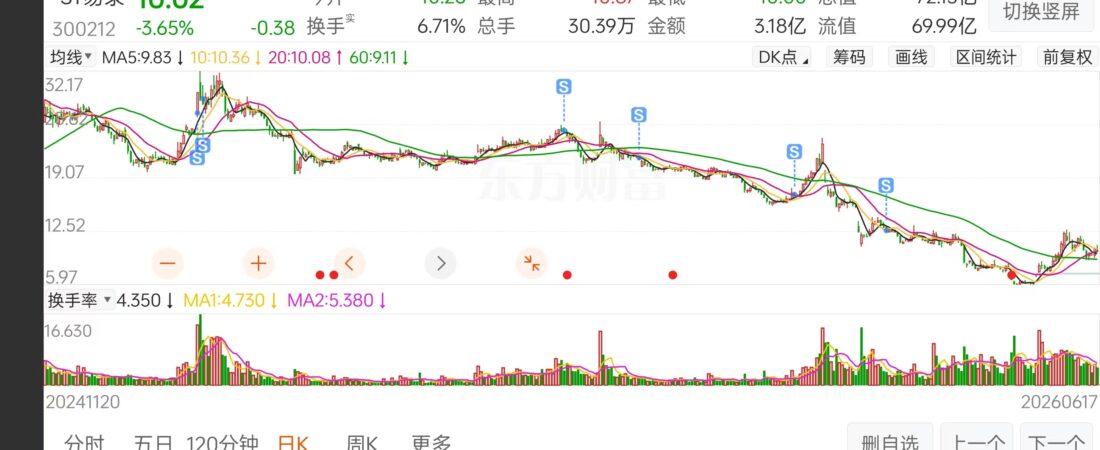
I want to tell you about two investments I held for a combined total of about five years that I probably should have exited within the first twelve months of each.
I’m not going to name them specifically, because the specific companies aren’t the point. One was in an industrial sector, one was in a tech-adjacent sector. Both were Chinese A-shares. Both had a logic when I bought them that I still think was reasonable at the time.
What wasn’t reasonable was why I kept holding them after that logic was clearly no longer working.
What “Waiting to Break Even” Actually Costs
Here’s what I told myself, many times, over many months: the stock is down, but if I sell now I lock in the loss. If I wait until it comes back up to what I paid, then I can sell and move on.
This sounds like patience. It isn’t. It’s a psychological trick we play on ourselves to avoid admitting we were wrong.
The problem isn’t the loss itself — every investor holds a position that goes against them at some point. The problem is that while I was “waiting to break even,” the money was sitting in a bad position instead of being redeployed into something better. That opportunity cost is invisible on a brokerage statement, so it’s easy to ignore. But it’s real.
When I finally talked through these positions with Gemini — not looking for validation, just explaining my logic out loud — it named what I was doing almost immediately. In behavioral finance it’s called the disposition effect: the tendency to hold losers too long and sell winners too early, because selling a loser feels like admitting a mistake, and selling a winner feels like taking a win.
Hearing it named didn’t make the feeling go away. But it made it easier to separate the emotional pull from the actual investment question: is this still the best place for this money?
The Investment Question vs. The Ego Question
There are two completely different questions hiding inside every “should I sell this?” decision.
The ego question is: how do I avoid feeling like I made a mistake? The answer to that question is always to hold — because as long as you haven’t sold, the loss isn’t “real” yet, at least not in a way that feels final.
The investment question is: if I had fresh cash today and no prior position in this stock, would I buy it?
For both of my long-held positions, the honest answer — once I stopped letting the ego question dominate — was no. The original thesis had weakened. Better alternatives existed. The only reason I was holding was to avoid crystallizing the loss.
Once I framed it that way, the decision became clearer. Not easy, but clearer.
What I Actually Did
I reduced both positions significantly — didn’t sell everything at once, but enough to free up capital for companies where I actually believed in the multi-year story. In one case I kept a small amount partly out of sentiment (I’d held it so long it felt like a weird tribute to the years I’d put in). That part I’m still not sure about.
The money I moved into companies with stronger fundamentals has performed better. That’s not a guarantee that I made the right call — markets are messy and past performance doesn’t prove anything forward — but the decision-making process feels cleaner now than the mental gymnastics I was doing to justify holding.
The rule I try to follow now: if the reason I’m holding a position is “waiting to get back to what I paid,” that’s not a reason. That’s the ego question dressed up as an investment thesis.
Have you ever held something — a stock, a project, a job — longer than you should have because stopping felt like admitting you were wrong? I’m curious what finally changed.
Share your experience or thoughts below.
Not sure whether to hold or exit? Use the free Sell Signal Checklist →
Leave a Reply