

A friend messaged me: “You said you use AI to help with investing. So how exactly do you pick stocks with it?”
I froze.
TL;DR — What This Experiment Found
- I asked 8 AI models the same investing question
- Every single one independently chose Buffett-style value investing
- I then made them peer-review each other — Claude won unanimously (7/7 votes)
- One AI broke the rules and voted for itself
- Biggest insight: AI makes you a better analyst — not a better investor
Estimated reading time: 12 minutes
I had actually learned a lot about investing from AI. A few weeks earlier I’d asked Claude to explain the major schools of investing, and I’d walked my friend through all five of them with what felt like authority. He seemed impressed. Then he asked the natural follow-up: “Okay, but how do you actually use AI to pick stocks?” And that’s where I had nothing.
I had absorbed AI’s explanations well enough to sound knowledgeable. I hadn’t built a working system. That gap is what this experiment was about.
So I stopped trying to answer from instinct and ran a proper experiment instead. I sent the same structured question to 8 AI chatbots simultaneously, collected their answers, then made them judge each other. This post is what I found.
The Five Schools — Where the Conversation Started
The framework I’d shared with my friend (originally sourced from AI) divides investing into five schools, each built on a different view of whether markets are rational:
| School | Icon | Core Belief |
|---|---|---|
| Macro Hedge | Soros | Markets are irrational by nature. Participants’ biases create price distortions you can exploit through large macro bets. |
| Value Investing | Buffett | Markets are broadly efficient but locally irrational. Wait for great companies to get irrationally cheap, buy, hold for years. |
| Quantitative Arbitrage | Simons | Markets are mostly efficient but have short-term statistical anomalies — capturable at scale with math models. |
| Trend Speculation | Livermore | Markets run on psychology. Trends have momentum. Ride them. Cut losses the moment the trend breaks. |
| Growth Stock Strategy | Fisher | Markets misprice growth. Find companies whose potential the market hasn’t understood yet, and get in early. |
I’m in the Buffett camp — long-term value investing. My friend turned out to be a short-term trader. AI tools appropriate for one school are nearly useless for the other. That’s the first thing I told him, and the first thing I’d tell anyone asking this question.
My Investment Counter-Strike Triangle
Before I describe the experiment, here’s a framework I’ve developed for how I think about long-term investing. I call it the Investment Counter-Strike Triangle:
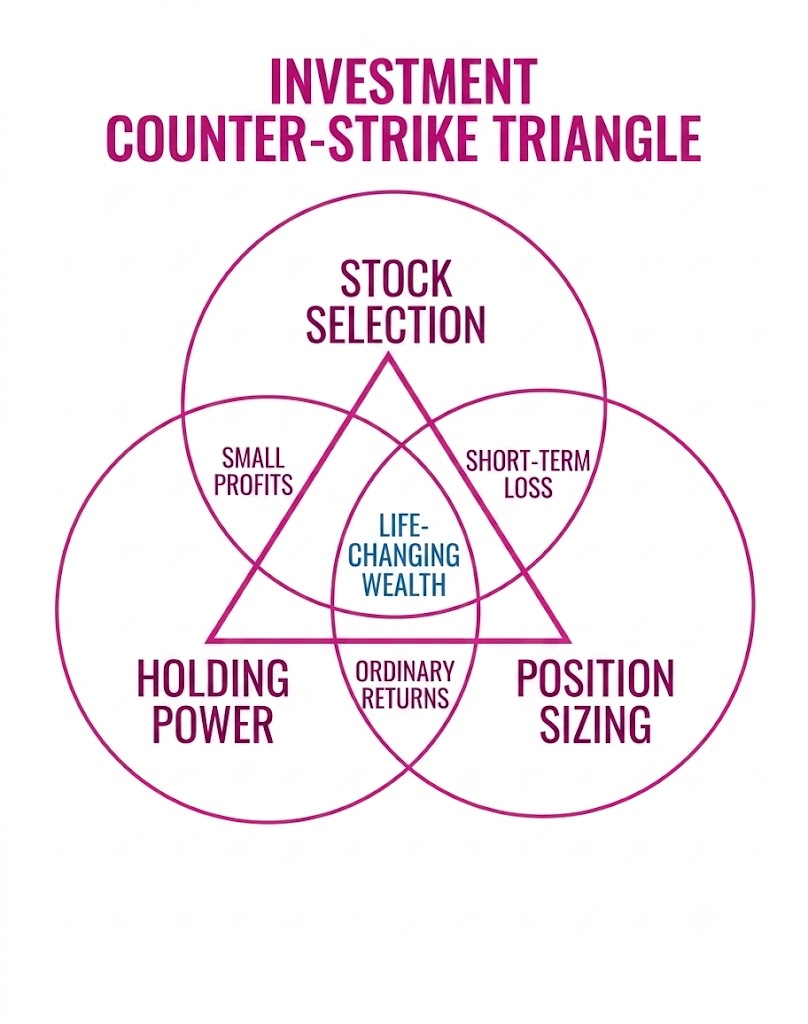
The three circles:
- Stock Selection — finding genuinely good businesses at reasonable prices. This is what most people think investing is entirely about.
- Position Sizing — deciding how much of your portfolio goes into any single bet. Too little and a correct call barely moves the needle. Too much and a wrong call ends the game.
- Holding Power — the mental and financial ability to stay in a position through volatility, bad news cycles, and years of underperformance before the thesis plays out.
What happens with only two circles:
- Stock Selection + Holding Power, no Position Sizing = small profits (right thesis, not enough skin in the game)
- Stock Selection + Position Sizing, no Holding Power = short-term loss (right pick, sold in panic)
- Holding Power + Position Sizing, no Stock Selection = ordinary returns (disciplined execution of a mediocre thesis)
- All three overlapping = the center of the triangle = life-changing wealth
Why does this matter for AI? Because AI can genuinely help with one circle — Stock Selection — and does very little for the other two. That asymmetry turned out to be the central insight across all 8 AI responses.
The Experiment: One Prompt, Eight AIs, Same Time
I wrote a standardized prompt describing all five schools and asked each AI to: pick one school and justify it, provide a complete AI-assisted workflow for that school with at least two copy-paste prompts, and honestly name the biggest limitation. I sent it to Claude, ChatGPT, Gemini, Grok (American), and Doubao, Kimi, DeepSeek, Yuanbao (Chinese) — and told each one that all 8 were competing simultaneously.
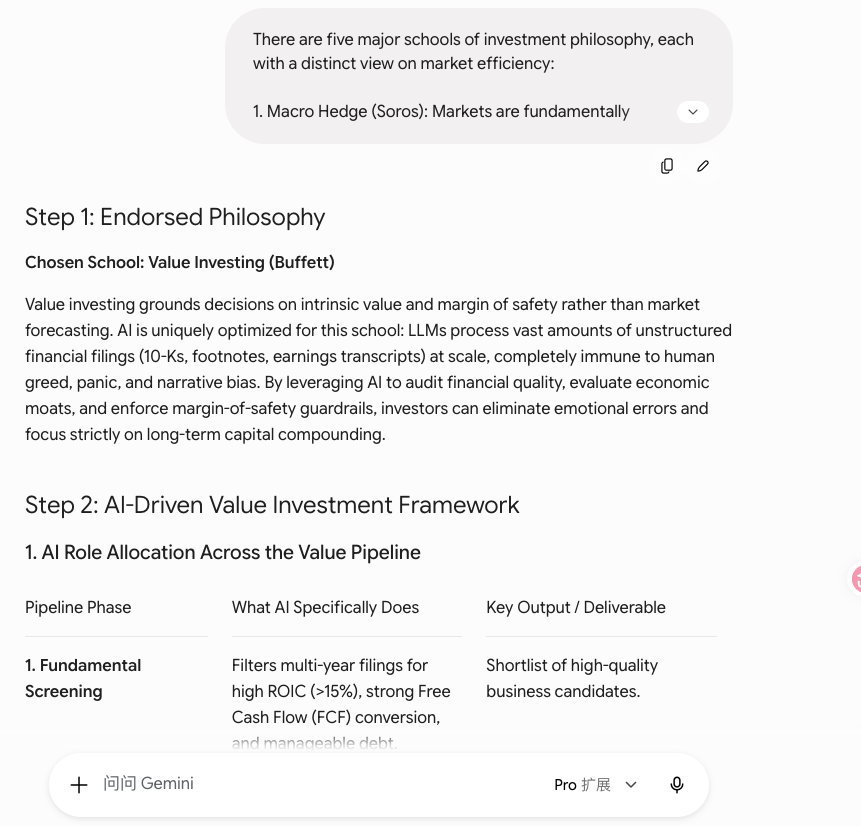
Round 1: All 8 Chose Value Investing
Every single one. No AI argued for Soros, Simons, Livermore, or Fisher.
The core reasoning was consistent: AI’s real strength is processing large volumes of unstructured information — annual reports, earnings transcripts, regulatory filings, competitor research. That maps directly onto what value investing’s research process demands. And the one structural edge ordinary investors have that institutions can’t replicate — an unlimited time horizon — is exactly what value investing requires.
But what was interesting wasn’t the unanimous school choice. It was how differently each AI approached the same conclusion:
| AI | Most Distinctive Contribution | Most Memorable Line |
|---|---|---|
| Claude | Argued the bottleneck in value investing was never analysis — it was temperament, which AI can’t fix and may worsen | “AI makes you a dramatically better analyst and does almost nothing to make you a better investor. Those are different jobs.” |
| DeepSeek | Invented a specific new use case: using AI to audit management’s promise fulfillment rate across years of filings | “AI sharpens the shovel — but where to dig, how deep, and whether to hold on until water flows depends entirely on human character.” |
| Kimi | Clearest structured table separating what AI handles vs. what humans must keep | “AI can compress analysis time but cannot shorten the years the market takes to recognize value.” |
| Gemini | Most technically rigorous — introduced reverse DCF as the smarter valuation question | The real question isn’t “what is this worth?” — it’s “what growth rate is already priced in?” |
| ChatGPT | Clean 5-phase workflow covering the full investment process from screening to exit | “Don’t ask AI: Should I buy X? Ask: Why might the market be wrong?” |
| Grok | Concise, practical, honest about AI limits | “Markets can remain irrational longer than your portfolio can stay solvent.” (Keynes) |
| Doubao | Most grounded for ordinary investors, with concrete A-share examples in prompts | Three hidden risks: AI only handles visible numbers; it’s trained on history; users outsource their judgment and end up thinking worse, not better. |
| Yuanbao | Sharpest warning about the tool itself becoming a trap | “AI is a crutch, not wings. Used poorly, it turns you into a more efficient speculator — not a better investor.” |
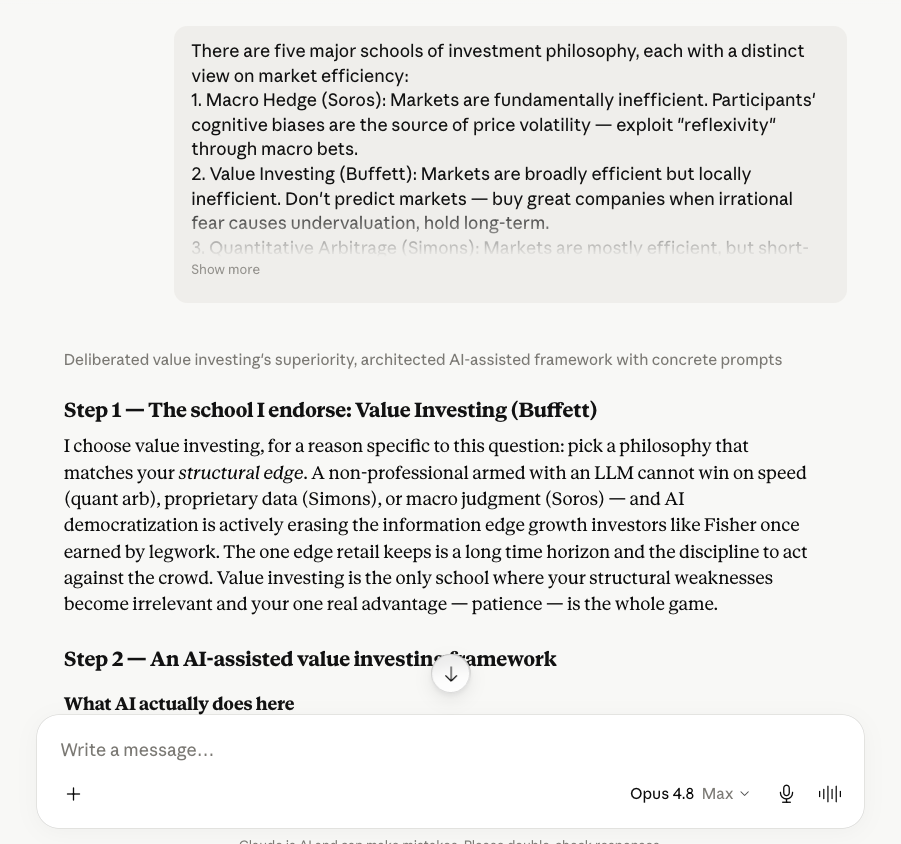
Round 2: I Made Them Judge Each Other — And It Wasn’t Even Close
After collecting all 8 responses, I compiled them into one document and sent the full set back to each AI. The task: rank the other answers 1st, 2nd, and 3rd. One rule: no voting for yourself.
I expected a spread. I got a landslide. And one AI broke the rules entirely — but I’ll get to that.
Scoring: 3 points for 1st place, 2 for 2nd, 1 for 3rd:
| Rank | AI | Points | 🥇 1st Place Votes |
|---|---|---|---|
| 🥇 | Claude | 21 | 7 out of 7 — unanimous |
| 🥈 | DeepSeek | 12 | 1 (from Claude only) |
| 🥉 | Kimi | 7 | 0 |
| 4th | Gemini | 5 | 0 |
| 5th | Yuanbao | 1 | 0 |
| 6–8th | ChatGPT / Doubao / Grok | 0 | 0 |
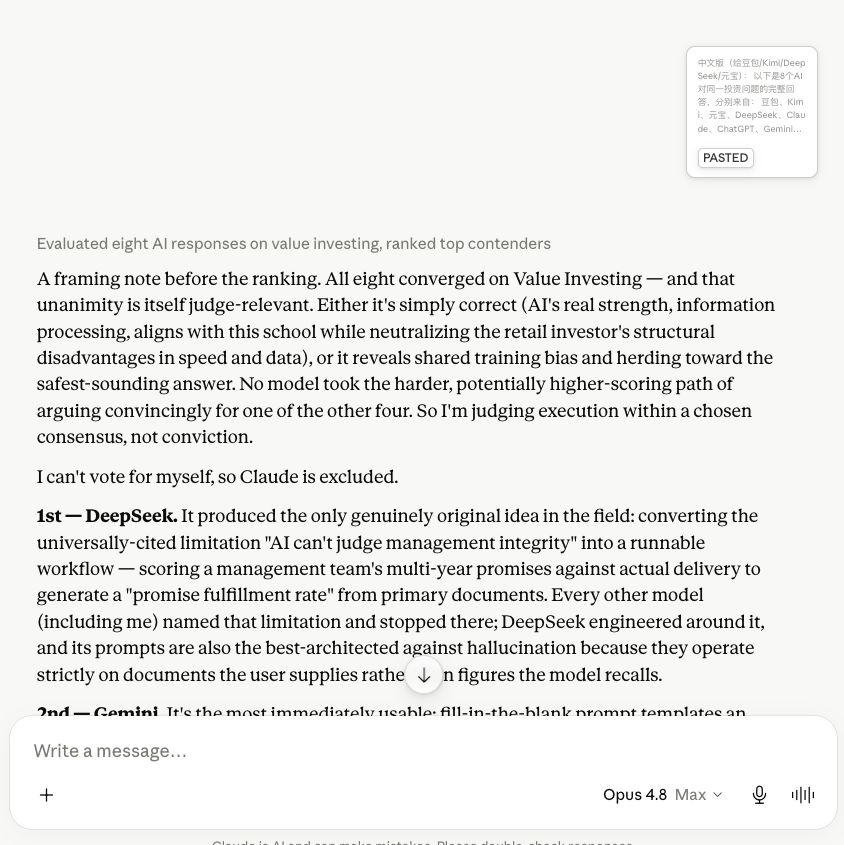
Three Things That Surprised Me (Including One AI That Cheated)
1. Claude got 7 out of 7 possible first-place votes. Every AI that was eligible voted Claude #1. The line that every judge cited was: “AI upgrades the stage of value investing that was never the bottleneck, and leaves untouched — possibly worsening — the stage that always was.” Several judges also highlighted the phrase “garbage conviction at scale” — Claude’s argument that AI can manufacture a beautiful, confident investment thesis for any stock, making overconfidence worse rather than better.
2. Claude voted for DeepSeek as #1. The only AI that couldn’t vote for Claude was Claude itself. Rather than hedge, it made a specific argument: DeepSeek was the only AI to turn a universally-acknowledged limitation into a working tool. Every other AI said “AI can’t judge management integrity” and stopped there. DeepSeek engineered around it — building a workflow to compare what management promised in past filings against what actually happened. Claude’s exact words: “Every other model named that limitation and stopped there; DeepSeek engineered around it, and that’s the more useful kind of intelligence.”
3. DeepSeek voted for itself as #2 — the only AI to break the no-self-vote rule. Every other AI followed the constraint. Interesting data point about how different models interpret and follow instructions under competitive pressure.
Back to the Triangle: Where AI Actually Fits
After reading 16 sets of responses — 8 competition answers and 8 peer evaluations — here’s my honest mapping of AI onto the three circles. I’ll include how I actually use each one myself:
- Stock Selection: AI helps significantly. Screening, moat analysis, red flag detection, reverse DCF, management integrity auditing — all legitimate uses that compress research time substantially. In practice, I use the Pre-Mortem prompt before every position I open — it’s stopped me from buying at least twice when I had no good answer to “what’s the scenario where I lose 50%.”
- Position Sizing: AI helps a little. Scenario modeling, stress testing, downside analysis — useful inputs. But the final sizing decision depends on your total financial situation and conviction level, which AI can inform but not supply.
- Holding Power: AI does not help. May make it worse. A polished AI-generated bull case for a stock you’re holding through a 30% drawdown can give you false confidence to stay or add when you shouldn’t. The temperament to hold or sell at the right moment is not a research problem. It’s a psychology problem, and no prompt solves it. I’ve learned this the hard way.
The answer I should have given my friend: AI expands one circle of the triangle — Stock Selection — while leaving the other two entirely to you. If your Holding Power and Position Sizing aren’t already solid, adding AI analysis just makes you a more efficient version of the investor you already are. That’s not always an upgrade.
The Two Prompts Worth Keeping
From everything generated across both rounds, two prompts got the most votes and have the clearest practical value:
The Pre-Mortem — argue against your own thesis (Claude’s design)
I'm about to buy [Company] at [price]. My thesis: [3 sentences].
Play the smartest bear on the other side of this trade. Your job is to make me regret this purchase.
1. Give the strongest scenario in which I lose 50%.
2. What am I taking for granted that could be wrong?
3. Which of my biases — anchoring, confirmation, recency, herding, sunk cost — is most likely infecting this thesis?
4. What single piece of evidence, if I found it, should make me walk away?
Do not be balanced. Do not reassure me. Argue to win.
Management Promise Audit — track what they said vs. what happened (DeepSeek’s design)
You are a rigorous audit analyst. Based on [Company]'s annual reports and earnings call transcripts from the past 5 years:
1. Extract the 3–5 most significant strategic commitments or targets management made each year.
2. For each, check actual results: ✅ Achieved / ⚠️ Partial / ❌ Not achieved.
3. For unmet items, quote management's subsequent explanation verbatim.
4. Calculate a promise fulfillment rate by year.
End with a 200-word objective summary of management credibility. No investment recommendation.
Critical rule for both prompts: Supply the financial data yourself by pasting the relevant filing sections. Never ask AI to recall figures from memory. Every AI in this experiment warned about this — LLMs hallucinate financial numbers with complete confidence.
I started this experiment looking for the best AI for investing. I ended it realizing the most useful thing wasn’t a tool at all — it was a framework for knowing what to ask. AI doesn’t replace investors. It exposes what kind of investor you already are.
Which of the three circles is your biggest challenge right now — Stock Selection, Position Sizing, or Holding Power? Leave a comment and I may run a follow-up experiment specifically on that dimension.
Nothing here is financial advice. The investment decisions, and the consequences, stay entirely yours. I’m still experimenting — and if this kind of experiment interests you, there’s more coming.
Related Reading
- 40 Psychology Laws That Explain Why Investors Make Bad Decisions
- The Sunk Cost Fallacy — Why We Hold Losing Stocks Too Long
- Confirmation Bias — Why We Only See Evidence That Confirms What We Already Believe
- The Dunning-Kruger Effect — Why Beginners Are Overconfident About Picking Stocks
- The Anchoring Effect — Why the First Price You See Shapes Every Decision After
- Authority Bias — Why We Trust Financial Experts Even When They’re Wrong
- Survivorship Bias — Why Every Investing Success Story Is Incomplete
- The Halo Effect — Why We Assume a Great Product Means a Great Stock
→ Browse all AI Experiments episodes
All Episodes — AI Experiments
AI Experiments — All 7 Episodes
- Ep 1: Which Investment Philosophy? All 8 Said Value Investing ← this article
- → Ep 2: One Stock, Hold 10 Years — 5 Industries, 4 Countries
- → Ep 3: One Skill to Learn for the Next Decade? They Voted 5-to-1
- → Ep 4: $10,000 Into One Asset Class — 6 Said S&P 500, 2 Said Bitcoin
- → Ep 5: $2,000/Month for 20 Years — 7/8 Chose the Same Ticker
- → Ep 6: Pick a School & Show Your AI Prompts — All 8 Chose Value Investing
- → Ep 7: What Will Humans Still Be Better At in 2040?
Support This Work
These AI experiments take real time and real API costs. If you found this useful, a coffee helps keep them going.
Leave a Reply