
An ordinary Chinese investor’s experiment — and a time capsule sealed in July 2026.
This article was published on July 20, 2026 and immediately archived by the Internet Archive Wayback Machine (snapshot: 2026-07-20 15:16 UTC). The archive is permanent and cannot be altered — it proves these AI predictions were recorded before any outcomes are known. Come back and check the archive link if you want to verify the original publish date in 2031.
The Story That Started This
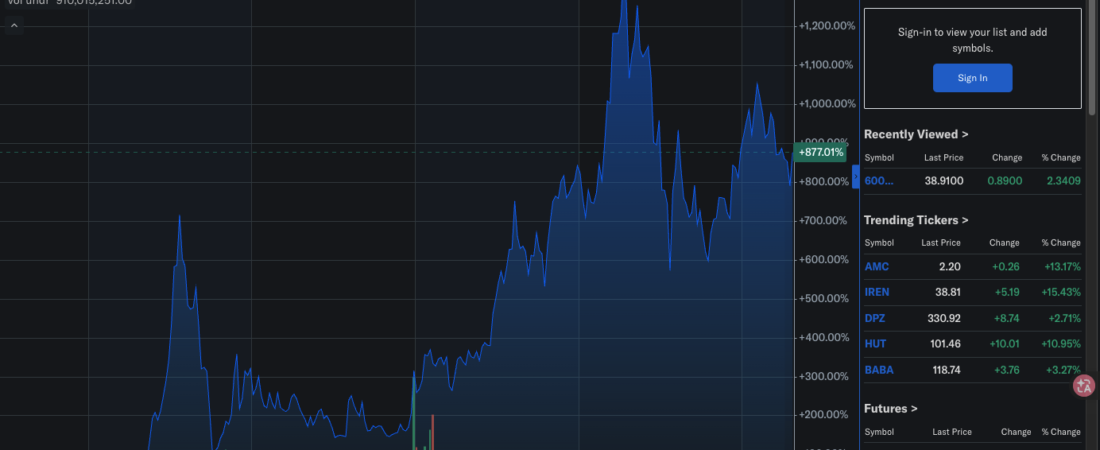
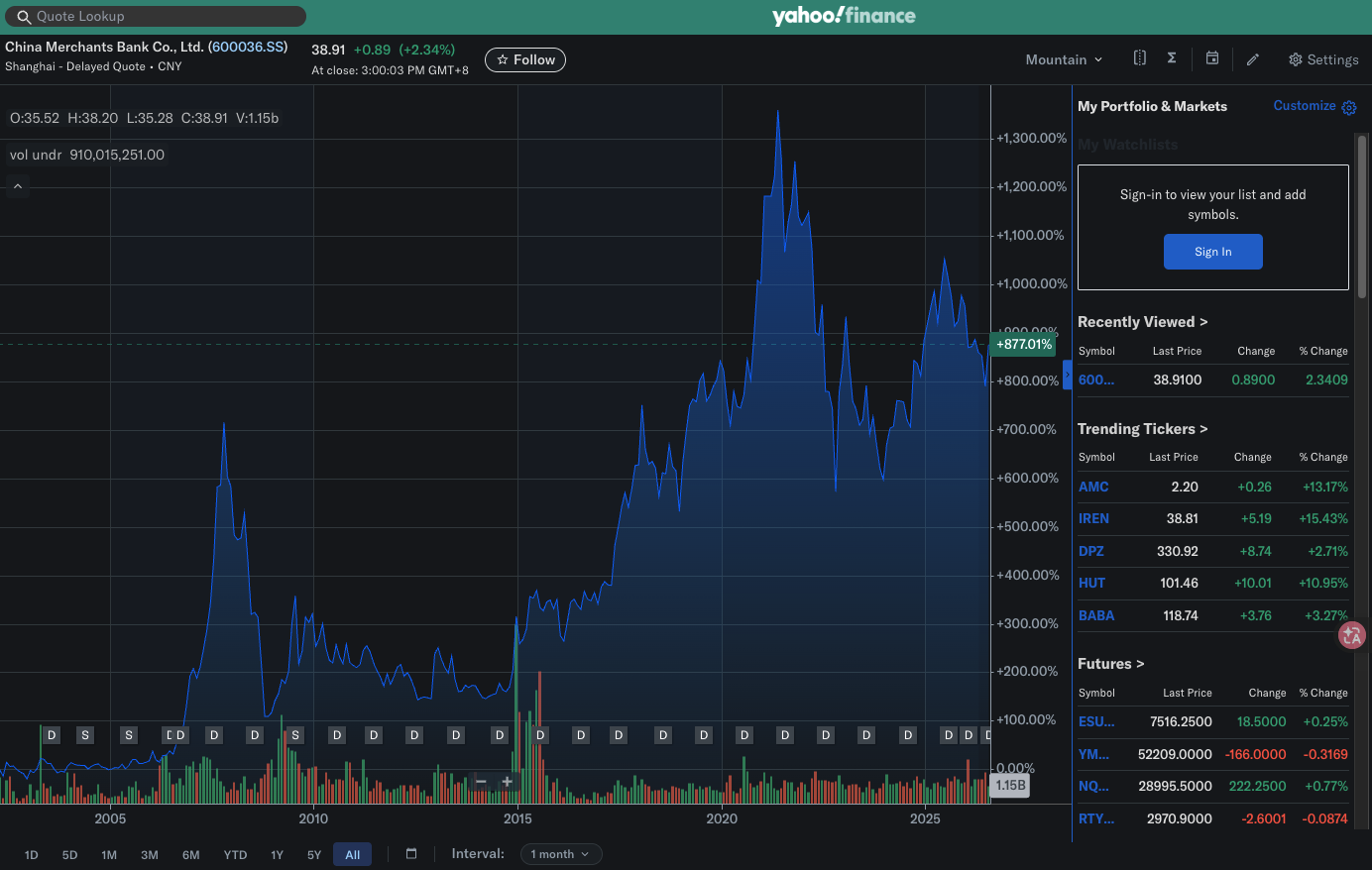
A video went viral in Chinese investing circles. A retail investor held shares of China Merchants Bank (CMB) for 18 years. He started with roughly ¥300,000 (~$42,000). He reinvested every dividend. His cost basis eventually dropped to ¥2.8 per share.
By 2026, his position was worth ¥4.8 million (~$660,000). His annual dividend payout: ¥244,800 — almost equal to his original investment. The initial ¥300,000 had compounded into a dividend machine that would repay him in full every 14 months, forever.
The numbers are striking. But the story behind the numbers is even more striking.
During those 18 years, he sat through:
- The 2008 global financial crisis — Chinese stocks fell 70% from peak
- A 6-year stretch where his stock went absolutely nowhere (2008–2014)
- The 2018 US-China trade war selloff
- The 2021 banking sector scare triggered by property debt fears
Most people would have sold somewhere in there. He didn’t. That’s the entire story.
There’s a detail that confirms this isn’t fabricated: his share count ends in 57 — an odd number only possible if he participated in a rights offering before 2013, when CMB issued fractional shares. You can’t fake a 57-share tail. He really was there from the beginning.
The Question I Wanted to Answer
Reading this story, I had an obvious follow-up question: which Chinese stock could do the same thing over the next 18 years?
I’m an ordinary Chinese person. No finance degree. Don’t work at a fund. I follow the market, read annual reports when I can, and try to think long-term.
So I did what any ordinary person would do in 2026: I asked the AIs.
I gave seven different AI systems the same backstory, the same challenge, and the same starting candidate. Then I asked each one: “Is this the stock? And if not, who is?”
Their answers were fascinating — and they didn’t agree.
First: The Formula Behind 18-Year Compounding
Before the AI answers, it’s worth understanding why the CMB story worked. Every AI I consulted independently identified the same four ingredients:
- High ROE, sustained for decades — CMB maintained 15–22% return on equity for twenty years. This is the compounding engine. Without it, no amount of time helps.
- Consistent, growing dividends — Dividends increased every single year for over a decade. This made the reinvestment strategy work.
- Extremely cheap entry price — The investor bought during the 2008 panic at 5–6× earnings. This unlocked the “Davis Double-Play”: profits grew AND the valuation re-rated upward simultaneously.
- A moat that didn’t erode — CMB’s retail banking franchise (low-cost deposits, wealth management, credit cards) was just as relevant in 2026 as it was in 2008.
The hardest part wasn’t picking the stock. It was not selling for six years while the stock went sideways and everyone else chased hot money in other sectors.
“If you care about price movements, you will never hold a stock long enough.”
The Starting Candidate: NARI Technology
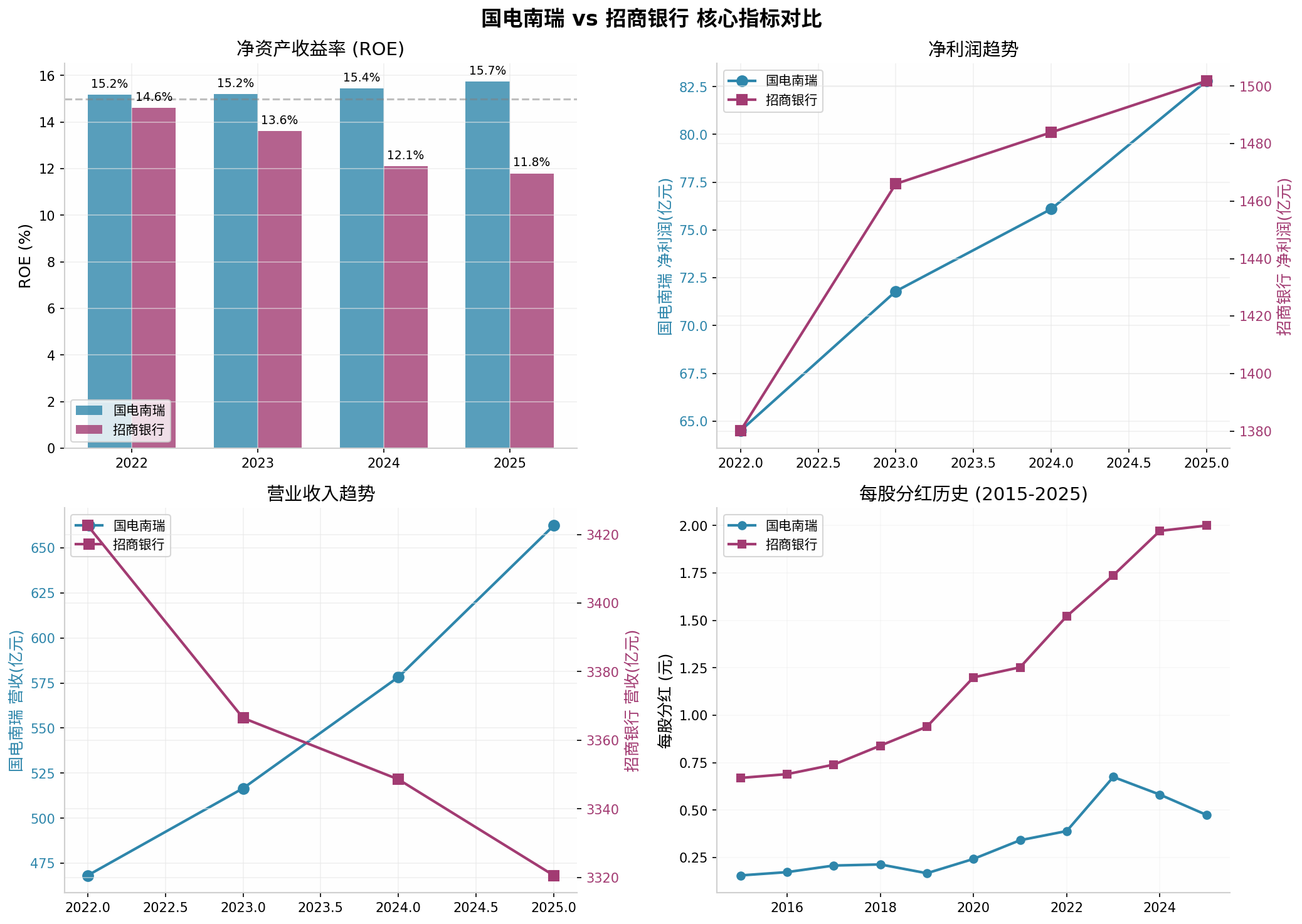
The stock I brought to every AI was NARI Technology (600406.SH) — China’s dominant provider of smart grid automation and power dispatch systems. Think of it as China’s Schneider Electric, but with a near-monopoly on the world’s largest power grid.
The basic profile:
- Controls 75%+ of China’s grid dispatching automation market
- Core subsidiary of State Grid Corporation (China’s largest state-owned enterprise)
- ¥66.2 billion in revenue in 2025, growing 14.5% year-over-year
- ~60% dividend payout ratio, ROE held at 15%+ for over a decade
- No meaningful debt — nearly zero interest-bearing liabilities
The global energy transition is reshaping power grids everywhere. China is spending the equivalent of $550 billion on grid infrastructure in the five years from 2026–2030. NARI sits at the center of every dollar of that spending.
Every AI agreed it’s a high-quality company. But their verdicts on “is it the next CMB?” split in interesting directions.
What the 7 AIs Said
🟡 Grok — “Close, but it’s a utility, not a bank”
Grok gave NARI a thoughtful endorsement but flagged the core difference from CMB: NARI has no pricing power over its biggest customer — State Grid Corporation, which is also its controlling shareholder. CMB could raise fees on retail customers. NARI cannot raise prices on the entity that owns it.
Grok’s alternative top pick: China Yangtze Power (600900.SH) — the world’s largest listed hydropower company, operating the Three Gorges Dam and five other mega-stations on the Yangtze River. Grok called it “the closest thing to a perpetual cash machine in Chinese equities.” Solar and wind power require subsidies; hydro pays for itself for a century.
🟢 Gemini — “NARI scores 87/100. But my real pick is Fuyao Glass.”
Gemini produced the most formal analysis, complete with a weighted scorecard across moat strength, growth quality, margin of safety, and industry trend. NARI scored 87/100. But Gemini’s true conviction pick was a surprise: Fuyao Glass (600660.SH), scoring 89/100.
Fuyao is the global #1 in automotive glass, supplying virtually every major car manufacturer on earth. Foreign readers may recognize it from the 2019 Netflix documentary “American Factory,” which followed the opening of Fuyao’s factory in Dayton, Ohio.
Gemini’s logic: Fuyao has CMB-like financial DNA — consistent 15–20% ROE, 50%+ dividend payout ratio, and a moat built on vertical integration (they mine their own silica sand and manufacture their own production equipment). The rise of panoramic EV sunroofs and HUD windshields means the value of glass per vehicle is actually increasing — EV-era glass is worth 2–3× traditional glass per car.
🔴 Claude — “Nobody can answer this question. Including me.”
The most contrarian response came from Claude. It spent the first part of its answer dismantling the question itself.
Core argument: The CMB story suffers from survivorship bias. In 2008, Chinese investors could have bought Minsheng Bank, Huaxia Bank, or PetroChina with the same discipline. Those who did have a very different 18-year story. We’re talking about the winner — not the full population of people who tried.
Claude also raised one technical yellow flag on NARI specifically: gross margins in the high-growth energy storage segment are declining — meaning the “second growth curve” is being built in a more competitive market than the core grid automation business. Revenue is growing faster than profits.
If forced to name a candidate, Claude pointed to Inovance Technology (300124.SZ) — China’s Rockwell Automation. Its customer base is diversified across thousands of manufacturers (no single dominant buyer), and it keeps expanding into adjacent categories: servo systems → EV powertrains → industrial robots. That pattern looks more like CMB’s internal compounding than a utility with a captive customer.
🟢 ChatGPT — “The answer isn’t tech. It’s boring consumer brands.”
ChatGPT built a five-factor framework and concluded that the most CMB-like candidates are companies with stable, commodity-like demand that never disappears.
Top picks:
- Midea Group (000333.SZ) — China’s Honeywell. Home appliances + industrial automation + robotics. Capital allocation discipline is exceptional; they’ve expanded into six business categories without destroying returns.
- Haitian Flavouring (603288.SH) — China’s Kikkoman. Soy sauce doesn’t go out of style. The brand moat is deep, cash conversion is extraordinary, and the business model hasn’t changed in decades.
ChatGPT’s observation that stuck with me: “The companies most likely to compound for 20 years aren’t the exciting ones. They’re the boring ones nobody talks about at dinner parties.”
🟡 Doubao — “Stop looking for the next growth story. It’s the banks.”
Doubao ran the most data-heavy analysis, pulling current PE ratios, ROE, and dividend yields for every candidate. Its conclusion was blunt:
The stocks most resembling CMB’s 2008 profile right now are Chinese bank stocks themselves.
| Bank | PE | ROE | Dividend Yield |
|---|---|---|---|
| Jiangsu Bank | 5.5× | 12–14% | ~6% |
| Hangzhou Bank | 5.8× | 13–15% | ~5% |
| China Merchants Bank | 7.1× | 12% | ~5.5% |
| China Shenhua Energy | 8–9× | 13–18% | 8–10% |
The catch Doubao acknowledged: these banks grow slower than 2008-era CMB did. The 18-year story might be “cost basis goes to zero from dividends” rather than “¥300,000 → ¥4.8 million.” Still a good outcome. Just a different one.
🥇 Kimi — “Long answer short: China Yangtze Power.”
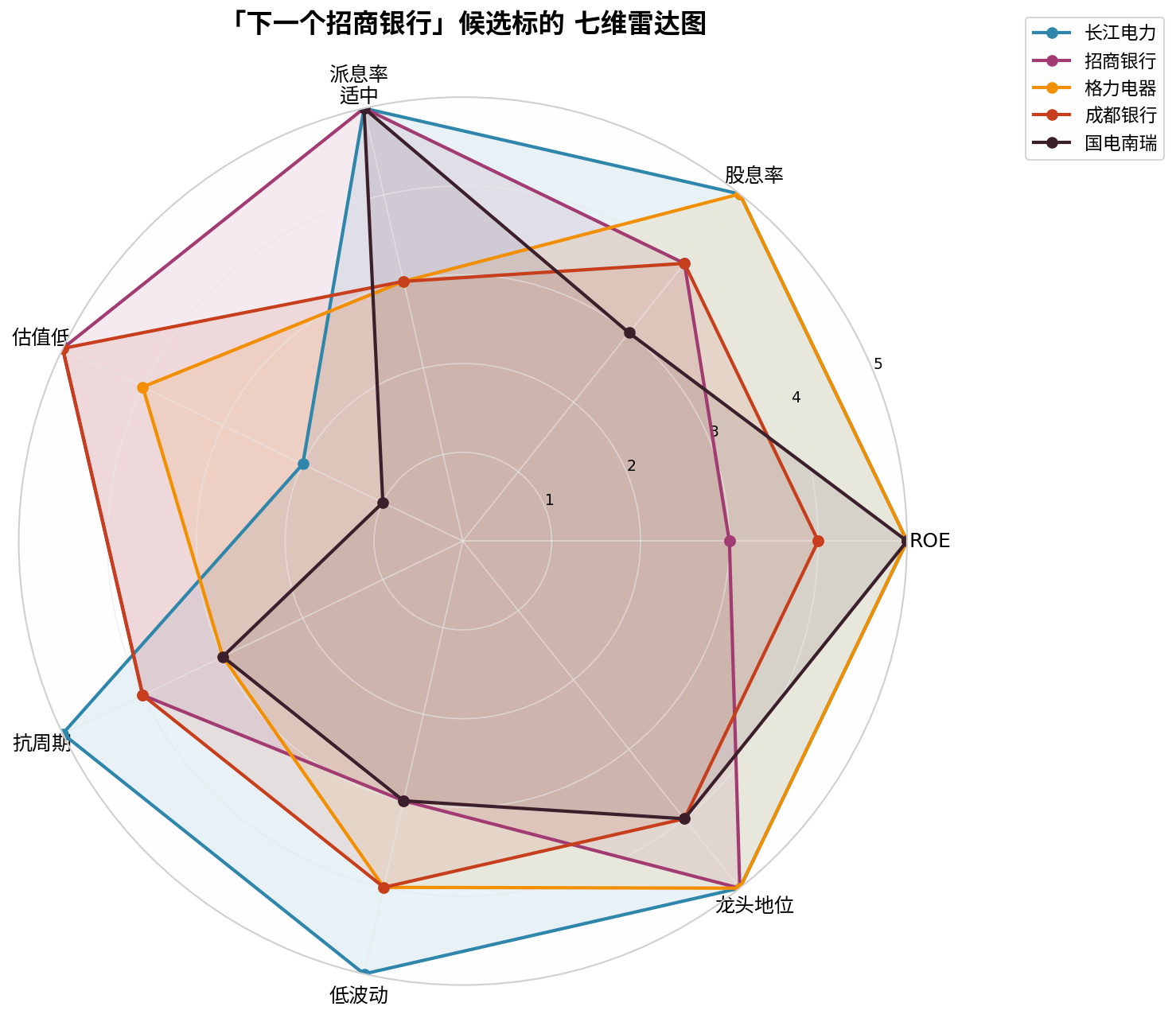
Kimi ran a formal 7-dimension scoring model (35 points maximum) across ROE, dividend consistency, payout ratio, valuation, cycle resistance, cash flow quality, and moat durability.
| Rank | Company | Score /35 | Strongest Attribute |
|---|---|---|---|
| 🥇 | China Yangtze Power | 32 | Charter-guaranteed 70% dividend payout through 2030 |
| 🥈 | China Merchants Bank | 29 | The original benchmark |
| 🥈 | Gree Electric | 29 | ROE 19%, dividend yield 7.5%, PE only 7.8× |
| 4 | Bank of Chengdu | 28 | PB below book value (0.86×), deeply undervalued |
| 5 | NARI Technology | 24 | High growth, but dividend yield only 2.6% |
Kimi’s case for China Yangtze Power: The company’s articles of association legally guarantee a minimum 70% dividend payout through 2030 — this isn’t a management promise, it’s written into the charter. Its portfolio of mega-dams — Three Gorges, Baihetan, Wudongde, Xiluodu — is physically irreplaceable; you can’t build another Three Gorges. The stock has a beta of 0.10, meaning when the market falls 10%, it typically falls 1%. That’s how you hold something for 18 years through three bear markets.
🟡 DeepSeek — “Find the framework. Wait for the crisis. The stock already exists.”
DeepSeek gave the most philosophical answer. It agreed with Claude that the entry price matters as much as the company quality — and that 2008’s opportunity came from genuine systemic panic, not from clever stock selection.
DeepSeek’s long-term watch list: Kweichow Moutai (600519.SH) (China’s most valuable spirits brand, with pricing power that defies recessions — the bottles literally appreciate in value sitting in a warehouse) and Tencent Holdings (700.HK) (the WeChat network effect is arguably deeper than any Chinese bank’s retail franchise).
But DeepSeek’s real message cut to the core: build the watchlist now, do the analysis now, set your entry prices now — and then wait for the market to panic. The stock that becomes China’s next 18-year compounder is probably already obvious. The question is whether you’ll have the cash and the nerve to buy it when the headlines are terrifying.
All 7 AIs at a Glance
Seven AI systems, seven different top picks. Here’s the full scorecard — what each AI recommended, why the industry matters globally, and a quick intro to each company for readers outside China.
| AI | Top Pick & View | Industry — Global Context | Company in Plain English |
|---|---|---|---|
| Grok | China Yangtze Power A “perpetual cash machine.” Once a dam is built, it generates clean electricity — and dividends — for a century with almost zero fuel cost. Hydro assets cannot be replicated. |
⚡ Hydropower / Renewable Energy Same industry as Brookfield Renewable (Canada), Enel Green Power (Italy), Statkraft (Norway). Rivers don’t stop flowing — and clean energy demand only grows. |
China Yangtze Power (600900) The world’s largest listed hydropower company. Operates six mega-dams on the Yangtze River, including the Three Gorges Dam — the world’s largest power station (22,500 MW). Dividend payout legally guaranteed at ≥70% of profit through 2030. Stock beta: 0.10. |
| Gemini | Fuyao Glass Highest score: 89/100. EV panoramic roofs and HUD windshields are worth 2–3× traditional glass per car. The company mines its own silica sand and builds its own equipment — competitors can’t match the cost. |
🚗 Automotive Glass / Auto Parts Same industry as AGC (Japan), NSG Pilkington (UK), Saint-Gobain Sekurit (France). Every car needs glass — and as EVs add panoramic roofs and digital windshields, the glass content per vehicle is rising fast. |
Fuyao Glass (600660) Global #1 in automotive glass with 30%+ worldwide market share. Supplies BMW, Toyota, Ford, VW. Has major plants in the US (Dayton, Ohio) and Germany. Featured in the Netflix documentary American Factory (2019 Academy Award winner). |
| Claude | Inovance Technology The most skeptical AI. Warned that the question itself is a logical trap (survivorship bias). But if forced to pick, chose Inovance — thousands of customers, no single dominant buyer, and a track record of expanding into adjacent categories without destroying returns. |
🏭 Industrial Automation Same industry as Rockwell Automation (USA), Siemens (Germany), ABB (Switzerland), Fanuc (Japan). Factories everywhere need automation. As labor costs rise globally, this industry only grows. |
Inovance Technology (300124) China’s leading industrial automation company. Started with variable-frequency drives, expanded into servo systems, PLCs, EV powertrains, and industrial robots. Think of it as China building its own Rockwell Automation from scratch — and winning market share from the foreign incumbents. |
| ChatGPT | Midea Group + Haitian Flavouring “The companies most likely to compound for 20 years aren’t the exciting ones — they’re the boring ones nobody talks about at dinner parties.” Picked two businesses with demand that never disappears and disciplined capital allocation. |
🏠 Smart Appliances + 🍶 Condiments Midea: same space as Honeywell, Bosch, Daikin. Haitian: same space as Kikkoman (Japan), Heinz (USA). People always need air conditioners. People always need soy sauce. Both industries survived every recession in history. |
Midea Group (000333) — Global home appliance and industrial tech company. Owns KUKA, the German robotics giant. Products sold in 200+ countries.
Haitian Flavouring (603288) — China’s largest condiment maker. Dominates soy sauce and oyster sauce with a brand built over 50 years. Cash conversion is extraordinary — needs almost no reinvestment to hold its position. |
| Doubao | Jiangsu Bank + Hangzhou Bank The most valuation-focused AI. Ran the numbers and concluded: Chinese regional bank stocks currently trade at 5–6× earnings — exactly what CMB looked like in 2008. High dividend yields (5–6%) mean the reinvestment snowball starts immediately. |
🏦 Regional Banking Same concept as US regional banks, UK building societies, or German Sparkassen. They serve local businesses in economically strong areas. When the region prospers, the bank prospers with it. |
Jiangsu Bank (600919) + Hangzhou Bank (600926) Two of China’s highest-quality city commercial banks, headquartered in the Yangtze River Delta — China’s most productive economic region (home to Shanghai, Suzhou, Hangzhou). Both maintain ROE above 13%, non-performing loans below 1%, and dividend yields around 5–6%. |
| Kimi | China Yangtze Power Top score in Kimi’s 7-dimension model: 32/35. Charter-guaranteed dividend, near-zero volatility (beta 0.10), and physically irreplaceable assets made it the clear winner. “This is how you hold something for 18 years through three bear markets.” |
⚡ Hydropower / Renewable Energy Same as Grok’s pick. Two AIs reached the same conclusion through completely different methods — Grok from qualitative moat analysis, Kimi from a quantitative scoring model. That independent convergence is the closest thing to a signal in this experiment. |
China Yangtze Power (600900) Same company as Grok’s pick. In the 2008 crash (Chinese market –70%), this stock barely moved. In 2018 trade war, same story. That’s not luck — dams don’t stop producing electricity because of geopolitical headlines. |
| DeepSeek | Kweichow Moutai + Tencent Focused on moat depth above all else. Real message: stop looking for the stock — start waiting for the crash. “The right moment to buy is when everyone is panicking.” |
🥃 Premium Spirits + 📱 Internet Platform Moutai: same luxury tier as Hennessy, Macallan, Dom Pérignon — but culturally untouchable in its home market. Tencent: same network effect as Meta/WhatsApp, operating as China’s digital infrastructure layer. |
Kweichow Moutai (600519) — World’s most valuable spirits company. Produces baijiu that functions like a collectible: bottles appreciate in storage, demand exceeds supply, production since 1704.
Tencent Holdings (700.HK) — Operates WeChat (1.3 billion users). Also the world’s largest video game company by revenue. Listed in Hong Kong, accessible to international investors. |
Two AIs independently converged on China Yangtze Power (Grok and Kimi) — one using qualitative moat analysis, the other a quantitative scoring model. Independent agreement across different methods is the closest thing to a signal in this experiment.
The sharpest disagreement: Doubao ignored business quality entirely and focused on valuation — arguing bank stocks at 5–6× earnings are the real opportunity. Every other AI disagreed.
The honest outlier: Claude was the only AI that refused to give a confident answer, warning that “finding the next CMB” contains a logical trap. Whether that makes Claude wiser or less useful — you can judge in 2031.
The One Thing Every AI Agreed On
Seven different AI systems. Six different styles of analysis. One shared conclusion:
The stock matters less than the moment you buy it.
Every AI noted that the CMB investor’s “secret” wasn’t picking the right company — it was buying a great company at 5–6× earnings during a global financial panic, when everyone else was selling. The compounding was powered by cheap entry as much as business quality.
This means the question “what should I buy today?” may matter less than “what should I buy when the market crashes next?” — and whether your cash, your watchlist, and your nerves are ready for that moment.
As DeepSeek put it: the panicked headlines you’ll need to ignore in order to buy have not yet been written. But they will be. They always are.
The Time Capsule: Sealed July 2026
This article is dated July 20, 2026.
The picks are locked in. The AIs have spoken. The clock is running.
Here’s the scoreboard as of today:
- Kimi → China Yangtze Power
- Grok → China Yangtze Power + NARI Technology
- Gemini → Fuyao Glass
- Claude → Inovance Technology (while refusing to guarantee anything)
- ChatGPT → Midea Group + Haitian Flavouring
- Doubao → Jiangsu Bank / Hangzhou Bank
- DeepSeek → Kweichow Moutai + Tencent
Come back in 2031 — halfway through the test — for the first checkup. I’ll update this post with actual performance data. Come back in 2038 if you want the full 12-year verdict.
If you’re reading this from the future: which AI was closest?
Which AI Do You Trust Most? (Vote)
Seven AIs, seven different answers. Which reasoning do you find most convincing? Vote below — we’ll compare reader picks vs AI picks when 2031 arrives.
Related Reading
If this style of thinking resonates with you, these posts go deeper:
- The Biggest Mental Traps in Value Investing (And How I Learned to Spot Them)
- The Ordinary Man’s Guide to Building a Personal Investment Philosophy
- How I Use AI to Analyze Stocks: My Actual Workflow as a Non-Professional
Free Tools for This Kind of Thinking
I built a few free tools designed for exactly this type of long-term analysis. No login required.
🔧 Free Investment Tools
- Value Investing Calculator — Is this stock cheap at today’s price? Enter a few numbers and get an instant valuation check.
- 10× Stock Screener — 12 questions that separate great long-term businesses from mediocre ones.
- Buffett’s 20-Punch Card Tracker — Buffett’s rule: you only get 20 investment decisions in a lifetime. Track yours.
- Investor Bias Checker — 8 questions to catch the mental errors that kill long-term returns.
This article does not constitute investment advice. The AI predictions collected here are presented for informational and entertainment purposes only. All investments carry risk. Do your own research before making any financial decisions. I am an ordinary Chinese person sharing my thought process — not a licensed financial advisor.
🛠 Related Tool
My AI Investment Operating System — Free 5-Step Builder
8 AIs debated investing philosophies across 7 experiments. This free tool turns their consensus into your personalized AI investment coaching system — with a copy-paste Prompt Library.
Build My AI Investment OS →
Leave a Reply