
This is Episode 5 of AI Experiments — a series where I ask 8 AIs the same question and compare the answers. See all episodes →
Episode 4 asked about a $10,000 lump sum. Six chose S&P 500, two chose Bitcoin. The debate came down to one valuation number: CAPE 41.
Episode 5 changes one thing: instead of a lump sum, it’s $2,000 every month for 20 years. That single structural difference produces the most unanimous result in the series.
The Question
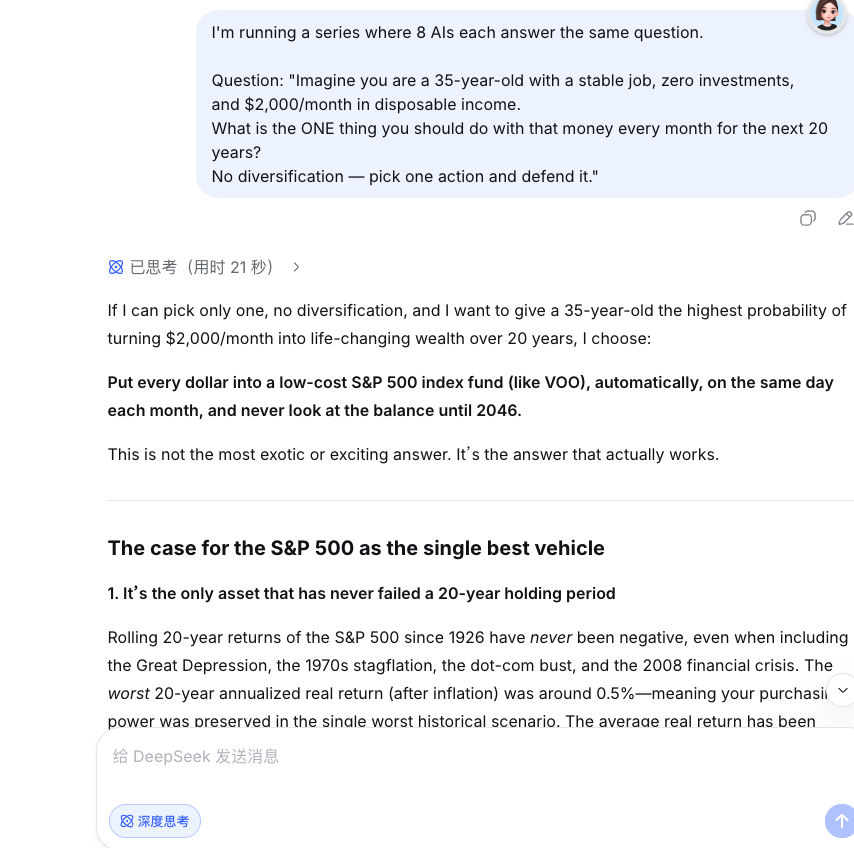
“Imagine you are a 35-year-old with a stable job, zero investments, and $2,000/month in disposable income. What is the ONE thing you should do with that money every month for the next 20 years? No diversification — pick one action and defend it.”
TL;DR
- Seven out of eight AIs chose the S&P 500 index fund — the most unanimous result since Episode 1
- The one dissenter (Kimi) didn’t disagree on “index fund” — it disagreed on “US-only vs. global”
- The real debate wasn’t about which asset. It was about behavior: why you will probably sabotage yourself, and how to prevent it
- Claude explained why this answer doesn’t contradict Episode 4’s Bitcoin pick — DCA and lump-sum investing are fundamentally different problems
- The most useful sentence in any of the 8 answers: “Delete the app.”
The Results
| AI | Choice | The Distinctive Angle | 20-Year Estimate |
|---|---|---|---|
| Grok | S&P 500 (VOO) | Automate and forget. “Boring, disciplined, and brutally effective.” Biggest edge is time, not skill. | $950k–$1.35M |
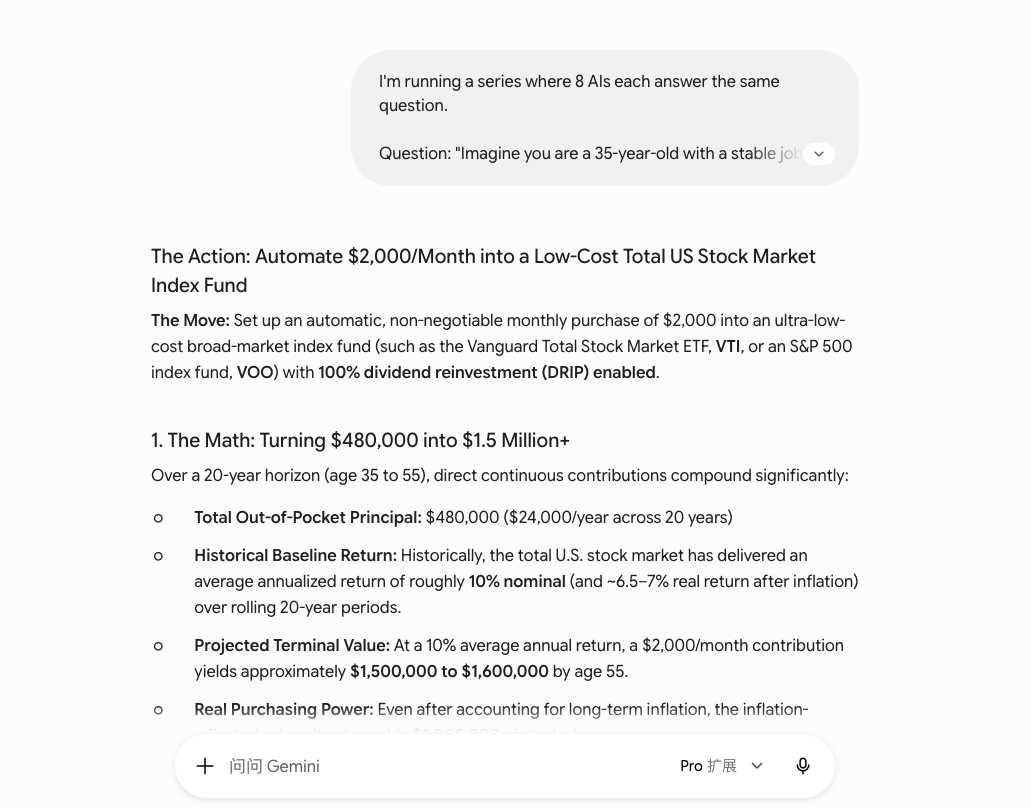
| Gemini | S&P 500 (VTI/VOO) | 100% dividend reinvestment (DRIP) emphasized. Behavioral automation converts market volatility into a long-term compounder. | $1.5M–$1.6M |
| Claude | S&P 500 | “Delete the app.” The asset choice is easy. Continuing for 240 months while your brain screams at you to stop is the actual challenge. | $820k–$1.53M |
| ChatGPT | S&P 500 | “One correct decision: keep buying productive businesses.” You’re buying the mechanism that replaces today’s winners with tomorrow’s. | 1.8×–3× total return |
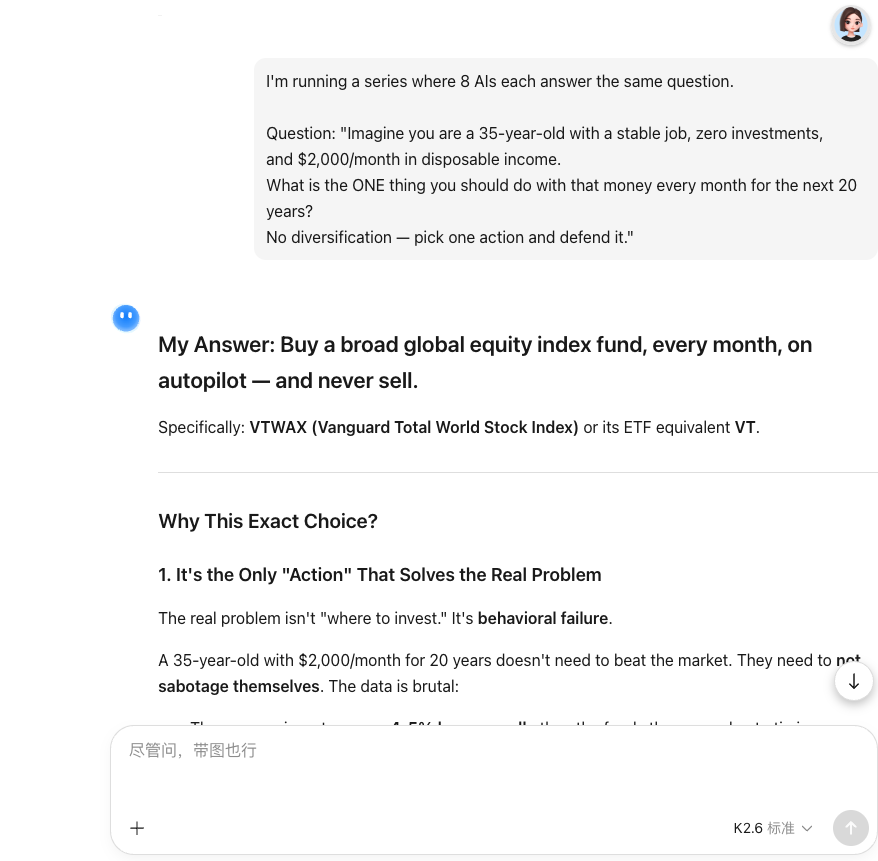
| Kimi | Global Index (VT/VTWAX) | The only AI to reject US-only exposure. “No one knows if the US will dominate for 20 more years.” Own the winners wherever they emerge. | $925k–$1.52M |
| Qianwen | S&P 500 | Buffett’s “productive asset” framework: businesses create value; gold, cash, and bonds just sit there. Compounding is “the eighth wonder of the world.” | ~$1.52M |
| DeepSeek | S&P 500 (VOO) | “The only asset that has never failed a 20-year holding period.” Not one rolling 20-year period in US history produced a negative total return. | $1.04M (real) / $1.5M (nominal) |
| Doubao | S&P 500 ETF | Already maximally diversified in a single ticker: 500 companies, every major industry, automatic survival-of-fittest rebalancing. | ~$1.5M |
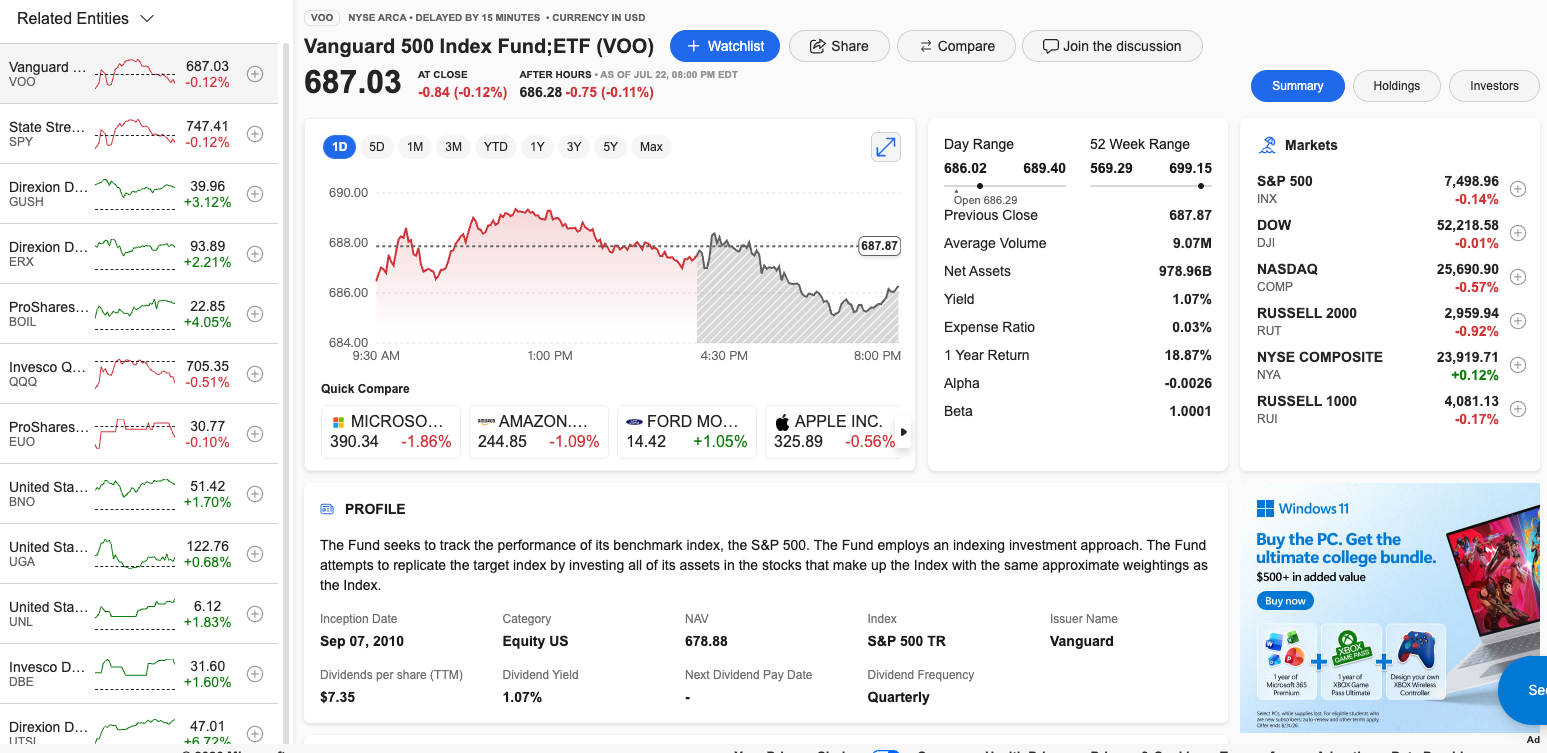
Final count: 7 S&P 500, 1 global index. Zero votes for Bitcoin, gold, real estate, bonds, or cash.
Why the Asset Choice Is the Easy Part
All 8 AIs agreed on the category: broad equity index, low cost, automatic contributions, don’t touch it. The split between S&P 500 and global index is a real debate — more on that below — but it’s a debate about implementation detail, not philosophy.
What’s more interesting is how each AI framed the reason the answer works. The math ($2,000/month × 20 years × 10% nominal = ~$1.5 million) is the same across all 8. The explanation for why most people won’t actually achieve it differed significantly.
DeepSeek’s framing was the most specific: the S&P 500 has never produced a negative total return over any rolling 20-year period in history — not the Great Depression, not the 1970s stagflation, not the dot-com crash and 2008 financial crisis combined. That’s not a probabilistic argument. It’s a record. For someone starting from zero who needs a plan that actually works, “has never failed this exact holding period in 100 years of data” is a different kind of claim than “historically has good returns.”
Grok and Doubao emphasized the automated compounding engine: by automating the transfer on payday, you remove the question of whether to invest this month. The decision becomes invisible, which means it survives recessions, job changes, and the 47 times over 20 years when a financial pundit on TV will explain why now is the wrong moment to be buying stocks.
Gemini added one specific detail others glossed over: enable dividend reinvestment (DRIP). Every dividend goes back into more shares, which generate more dividends, which generate more shares. Over 20 years, dividend reinvestment typically adds 1–2% annually to total return — the difference between $1.2M and $1.5M at the end.
The Real Advice Is “Delete the App”
Claude’s answer spent less time on the asset and more time on the failure mode. The argument: the average equity fund investor earns roughly 4–5% less per year than the fund they’re invested in. Not because they chose the wrong fund. Because they stopped buying when prices were low and resumed buying when prices were high.
Over 20 years, this person will experience approximately 4–5 significant market corrections and 2–3 genuine bear markets. During each one, every financial headline will explain why “this time is different.” Their portfolio will show a large red number. Friends will report having moved to cash. The urge to “just pause the contributions temporarily” is overwhelming — and nearly always wrong.
Claude’s solution isn’t willpower. It’s removal from the decision loop: “Set up the automatic transfer. Delete the brokerage app from your phone. Check your balance once a year, on your birthday, at most. The less you interact with your investment, the better it will perform — not because the market knows you’re watching, but because you are the biggest risk to your own returns.”
This is the behavioral insight that none of the pure-math answers contain. The S&P 500 will return what it returns regardless of whether you watch it. The only variable you control is whether you keep buying during the months when stopping feels like the rational thing to do. The action isn’t “invest in the S&P 500.” The action is “invest in the S&P 500 every month for 20 years including the bad months” — and those are completely different things.
Kimi’s Home Bias Argument: The One Real Dissent
Kimi chose VTWAX / VT — Vanguard’s total world stock market fund — instead of the S&P 500. This isn’t a rejection of equity indexing; it’s a rejection of US-only equity indexing. The argument deserves to be taken seriously.
The core claim: over a 20-year horizon, you cannot confidently assume the US will continue to dominate global equity returns. The 20th century saw a transition from UK-dominated to US-dominated capital markets. A similar shift — toward China, India, or regions not yet prominent — is possible over the next two decades. If you’re 100% in the S&P 500 and that shift happens, your wealth is concentrated in yesterday’s engine.
A global index solves this automatically: if the US underperforms, the index will already own the outperformers. If the US continues to dominate, the index will be roughly 60% US anyway. You don’t have to predict the outcome. You own the result regardless.
Kimi’s critique of the S&P 500 majority: “Over 20 years, no one knows if the US will continue to dominate. Owning a global index means you don’t have to guess. You own the winners wherever they emerge.”
The counterargument — which the S&P 500 majority implies without making explicit — is that the US has structural advantages (reserve currency, innovation ecosystem, rule of law, depth of capital markets) that are genuinely durable, not just historical luck. Those advantages don’t disappear in 20 years. But they also aren’t guaranteed. Kimi’s choice is the more epistemically humble option: it says “I don’t know which region wins, so I’ll own all of them.” The S&P 500 majority is making an implicit country bet. Both are defensible.
Why This Doesn’t Contradict Episode 4
In Episode 4, two AIs chose Bitcoin for a $10,000 lump sum. One of them was Claude. In Episode 5, Claude chose the S&P 500 for $2,000/month. That looks like a flip. It isn’t.
Claude addressed this directly: “Last round I was asked to invest $10,000 as a lump sum at a moment when the S&P 500 CAPE ratio is 41 — the second-highest in 155 years. I argued against the S&P 500 because you were buying the entire position at peak valuation. This question is structurally different in three ways.”
The three differences that change the answer:
240 purchases, not one. Dollar-cost averaging over 20 years means buying at 240 different prices. Some months CAPE will be 41. After the next recession, it might be 15. The valuation risk that made the lump-sum argument so compelling — buying the entire position at peak valuation — essentially disappears when you’re spreading $480,000 over 240 months. You’re not betting on today’s valuation; you’re averaging across whatever valuations the next 20 years produce.
Labor income, not capital. $2,000/month is salary. It arrives whether markets are up or down. The risk of “buying at the top” applies to the first few months, not to the entire $480,000. By year 5, the early purchases at CAPE 41 will be a small fraction of the total position.
20 years eliminates what 10 years can’t. There has never been a 20-year period of dollar-cost averaging into the S&P 500 that produced a loss. Not one. The 10-year horizon has meaningful failure scenarios. The 20-year horizon, historically, has none. Meanwhile, Bitcoin has exactly 17 years of total existence — meaning there is literally not one complete 20-year data set for it. “It’s probably going to be great based on 17 years of data” is a different claim than “has never failed this holding period in 100 years of data.”
The underlying principle: the right answer to an investment question depends on the structure of the question. Lump sum vs. DCA, 10 years vs. 20 years, affordable loss vs. retirement savings — changing these parameters changes the optimal answer. An AI that gives the same answer to all investment questions regardless of structure isn’t thinking; it’s reciting.
What This Episode Revealed
Question structure drives divergence more than AI personality. Episode 2 asked for a single stock pick with an open field — and got 6 different stocks. Episode 5 asked for a single action with a fixed 20-year monthly contribution — and got 7 identical tickers. The AIs aren’t being arbitrary. They’re responding to the actual constraints of the problem. A longer horizon, a DCA structure, and a “no exotic choices” framing produces convergence.
Consensus on the asset masks disagreement on the mechanism. All 8 said “index fund.” But Kimi said “global, not US-only.” Claude said “the asset is secondary; behavior is primary.” Gemini said “DRIP is the detail that matters.” DeepSeek said “20-year track record is the decisive fact, not expected return.” ChatGPT said “you’re not picking winners, you’re buying the machine that picks them.” Same destination, different maps — and the maps reveal what each AI actually thinks is important.
The series is building a coherent picture. Episode 1: all 8 chose value investing. Episode 4: 6 chose S&P 500 for a lump sum (2 chose Bitcoin). Episode 5: 7 chose S&P 500 for monthly DCA (1 chose global index). The consistent thread is “own productive businesses via broad index” — but the specific recommendation changes with the specific constraint. This is what it looks like when AI reasoning is actually tracking the problem rather than just retrieving a cached answer.
All Episodes in This Series
Each episode reveals how 8 AIs reason about a different investment constraint — and where their answers agree, diverge, or surprise.
All Episodes — AI Experiments
AI Experiments — All 7 Episodes
- → Ep 1: Which Investment Philosophy? All 8 Said Value Investing
- → Ep 2: One Stock, Hold 10 Years — 5 Industries, 4 Countries
- → Ep 3: One Skill to Learn for the Next Decade? They Voted 5-to-1
- → Ep 4: $10,000 Into One Asset Class — 6 Said S&P 500, 2 Said Bitcoin
- Ep 5: $2,000/Month for 20 Years — 7/8 Chose the Same Ticker ← this article
- → Ep 6: Pick a School & Show Your AI Prompts — All 8 Chose Value Investing
- → Ep 7: What Will Humans Still Be Better At in 2040?
Support This Work
These AI experiments take real time and real API costs. If you found this useful, a coffee helps keep them going.
Leave a Reply