In May 2025, Builder.ai — an AI startup that had raised $450 million from investors including Microsoft and the Qatar sovereign wealth fund — filed for bankruptcy.
The same month, Cursor — a coding AI built by 20 engineers with no marketing budget — was reportedly generating over $300 million in annual recurring revenue.
Same market. Same year. Completely opposite outcomes.
I spent weeks digging into the AI startup collapses and breakouts of 2024–2026: Builder.ai, DeepSeek, Jasper, Woebot Health, Perplexity, Character.ai, Cursor. I wanted to understand what actually separated the companies that survived from the ones that didn’t. Then I turned everything I learned into a free interactive decision game.
This is what I found — and why the answer isn’t what most people think.
The AI Startup Graveyard (2024–2026)
A lot of AI companies died quietly between 2024 and 2026. Some died loudly. The pattern was almost always the same.
Builder.ai is the most dramatic case. The company promised AI that could build software automatically. It raised $450M. It had a charismatic founder, enterprise clients, and press coverage calling it a potential OpenAI competitor. What it actually had, according to post-bankruptcy investigations, was hundreds of offshore workers doing the work manually while the company claimed it was AI. When the truth emerged and funding dried up, there was nothing underneath.
Jasper AI raised $125 million at a $1.5 billion valuation as an AI writing tool. Then ChatGPT launched with native writing capability. Jasper lost an estimated 40% of its customers within six months. Multiple rounds of layoffs followed. The valuation collapsed. The company is still alive, but the story it told investors in 2022 — “we’re the AI writing category leader” — became impossible to defend the moment OpenAI decided writing was a core ChatGPT use case.
Woebot Health raised $114 million to build an AI mental health companion. In 2025, it shut down entirely.
These weren’t bad companies run by stupid people. They were good companies with a structural problem that only became visible after OpenAI’s pricing changed: they didn’t have a moat.
What “Moat” Actually Means in the AI Era
In traditional software, moat usually means brand, distribution, or switching costs. In AI, there’s a fourth type that dominates everything else: what happens when OpenAI ships your product for free.
If the answer is “our customers leave immediately,” you don’t have a business. You have a distribution layer on top of someone else’s infrastructure. The moment that infrastructure provider decides to compete with you — which they will, because your success is proof the market exists — you’re finished.
This is the trap that caught most 2023–2024 AI startups. They built on top of GPT-4, charged a margin, and called it a product. When OpenAI shipped GPT-4 features natively into ChatGPT at lower prices, the arbitrage collapsed.
The companies that survived had one of three real moats:
- Regulatory moat: Harvey AI targeted law firms that couldn’t use ChatGPT due to client confidentiality requirements. Compliance rules became a wall that OpenAI couldn’t scale over.
- Data moat: If your model is trained on data that doesn’t exist in any public dataset — proprietary hospital records, legal case histories, financial transactions — the output is unique in a way that can’t be replicated by buying more GPUs.
- Switching cost moat: Glean built enterprise AI search so deeply integrated into internal workflows that migration became an 18-month project. You weren’t a vendor anymore; you were infrastructure.
What’s interesting is that none of these moats require breakthrough AI research. They require understanding what makes your customers unable to leave.
Why DeepSeek Won With Less
In January 2025, DeepSeek released an open-source AI model that matched — and in some benchmarks exceeded — GPT-4 performance. The immediate reaction on X was disbelief. The second reaction was panic. NVIDIA’s stock dropped 17% in a single day.
DeepSeek’s model was reportedly trained on approximately 2,000 NVIDIA H800 GPUs. OpenAI’s models are trained on clusters ten to fifty times that size.
The constraint forced invention. When you can’t win on raw compute, you have to find efficiency insights that a better-funded competitor has no incentive to discover. DeepSeek found several: architectural improvements, training optimizations, inference tricks that made the output competitive at a fraction of the cost.
This isn’t a story about cutting corners. It’s a story about what constraints do to problem-solving. The most generative constraint in AI right now might be: what would you build if you couldn’t just throw more GPUs at the problem?
Cursor asked the same question about team size. Twenty engineers. No office. No head of marketing. Every person on the team used the product daily and shipped updates based on what they personally experienced. The feedback loop was so tight that they were iterating faster than companies with 10x the headcount.
I Turned All of This Into a Decision Game
After going through all these cases, I noticed something: the decisions that separated winners from losers weren’t obvious in the moment. They looked reasonable at the time. Sometimes they looked like the only option.
Hiring 50 engineers and leasing office space in San Francisco felt like the “move fast” strategy that Silicon Valley celebrates. Building an API wrapper on top of GPT-4 felt like the fastest path to revenue. Competing on price after OpenAI’s Dev Day announcement felt like the only way to survive.
These choices made sense given the information and incentives available. They were also, in most cases, the wrong calls.
I wanted to build something that let people experience these decisions from inside the story — not as a retrospective analysis, but as live pressure, with real consequences. So I built the AI Startup Simulator.
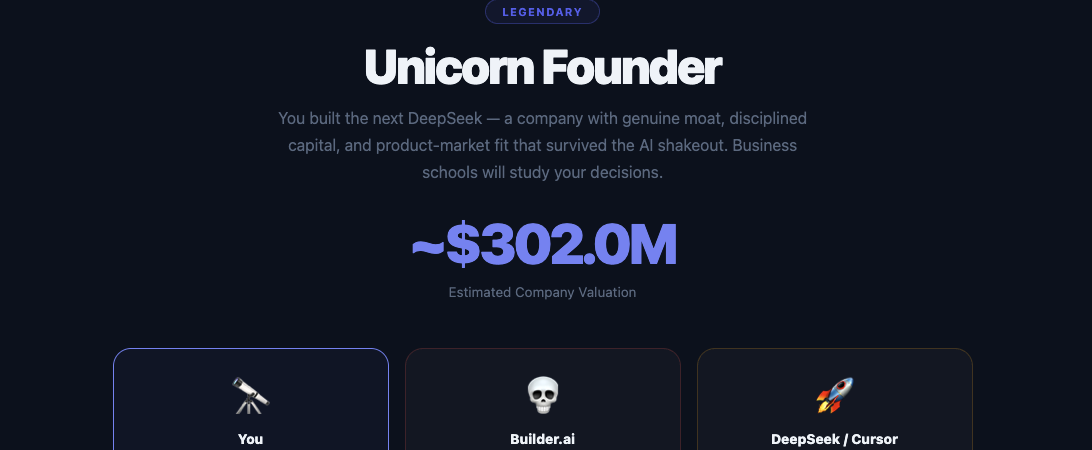
You start with $10 million from Andreessen Horowitz. You choose a founder archetype (Visionary, Operator, or Hustler — each with different trade-offs on burn rate, moat instinct, and market speed). You face five decisions drawn directly from the real cases: the Big Bet, the Team question, the OpenAI Bomb, the Cash Crunch, and the Exit.
Every choice has real consequences. The dashboard tracks your cash, ARR, moat score, and runway in real time. The expert boxes after each decision show you what actually happened in the real world. There are five possible endings — from Unicorn to the next Builder.ai — and a random event mid-game that mirrors the black-swan moments every real startup faces.
The goal isn’t to make it easy to win. It’s to make the losing paths understandable — so the next time you’re facing a similar call in real life, the pattern recognition is already there.
The Pattern That Keeps Repeating
After going through dozens of AI startup cases from 2023–2026, the same patterns show up over and over:
Fast-growing consumer AI plays die first. The ones with viral launches, quick user numbers, and no proprietary technology are almost always the first to collapse when incumbents ship competitive features. They optimize for top-line metrics before building anything defensible underneath.
Enterprise AI takes longer to build but compounds harder. The sales cycle is brutal. Procurement takes months. But once you’re inside an enterprise workflow, the switching cost is enormous. The same friction that slows you down at the start protects you from competition later.
Team size is inversely correlated with execution speed in early-stage AI. This seems counterintuitive, but it’s consistent across the cases. Cursor (20 people), DeepSeek (under 200 employees at breakthrough), Perplexity (small team aggressive on product velocity) all outperformed larger organizations on shipping speed. Coordination overhead is a real tax, and in a market where the underlying technology changes every quarter, that tax compounds.
The companies that survive OpenAI bombs are the ones that built something OpenAI has no incentive to replicate. Compliance-heavy industries, proprietary data, deep enterprise integrations — these aren’t “AI” moats. They’re business moats that AI happens to enable.
Related Reading
- $20M Investment Simulator — Similar decision game: you inherit $20M as a retired athlete. Based on real celebrity finance disasters. Same dark-themed format.
- AI Startup Simulator — The tool this post is about. Free, browser-based, ~5 minutes.
The uncomfortable truth about AI startups in 2024–2026 is that the market didn’t punish bad technology. It punished the absence of structural reasons for customers to stay. You can build something technically impressive and still fail. You can build something technically unimpressive and still win — if you understand what your customers can’t live without, and make yourself impossible to dislodge from it.
Builder.ai didn’t lose because its engineers weren’t smart. It lost because it tried to fake the moat instead of building one.
DeepSeek and Cursor didn’t win because they had more resources. They won because they had more constraints — and those constraints forced them to find insights that better-funded competitors never had to look for.
See how your instincts hold up in the simulator. Five minutes. Real cases. Five possible endings.
Leave a Reply