It was a Tuesday afternoon. My servers were humming quietly — a Mac mini M1 and an HP desktop I use for running stock analysis — and I was deep into reviewing financial reports for my A-share portfolio. Then the notification came in: my annual physical exam results were ready.
I scrolled through expecting the usual numbers. Cholesterol, blood pressure, glucose. Normal stuff for a man in his forties.
Then I stopped.
“Prostate calcification and enlargement.”
If you work in tech, finance, or any job that keeps you in a chair for ten hours a day, you’ve probably read the warnings about prolonged sitting and pelvic health. I had too. But there’s a strange distance between knowing something as a fact and seeing it in a report with your own name on it.
My doctor’s advice was simple: stand up and move every 40 to 50 minutes.
That’s it. The entire prescription. Simple to say. Completely impossible to actually do.
Why Pomodoro Timers Failed Me — Every Single One
I tried them all. Phone alarms. Desktop widgets. Browser extensions. The classic Pomodoro technique. Apps that pop up with cheerful little tomatoes telling me to take a break.
They all failed. Not because the software was bad. Because they fundamentally misunderstand what happens to the human brain during a flow state.
Imagine you’re tracking a stock that has been consolidating for three weeks and suddenly it breaks out. Or you’re 200 lines deep into a piece of code and you can finally see the shape of the solution. Your phone buzzes. Time for a break!
What do you do? You dismiss it. Without thinking. The dopamine hit of the work in front of you is immediate and visceral. The danger of sitting for too long is abstract and distant. There’s no contest.
That’s the structural problem with every Pomodoro timer I’ve ever used: they remind you, but they make it completely painless to ignore the reminder. And I am very good at ignoring painless reminders.
Health Is a Balance Sheet. I Was Running Mine at a Deficit.
I spend a lot of time thinking about risk — in stocks, in business decisions, in how I allocate my attention. After that medical report, I started applying the same lens to my own body.
If I were analyzing a company that was quietly burning through its assets while management dismissed every early warning signal, I would call that a structural problem — not a temporary dip. So why was I treating my own health differently?
I didn’t need another reminder. I needed something that made the cost of sitting too long feel as real and immediate as losing money on a bad trade.
That’s when I started building.
What I Built: SeatRisk™
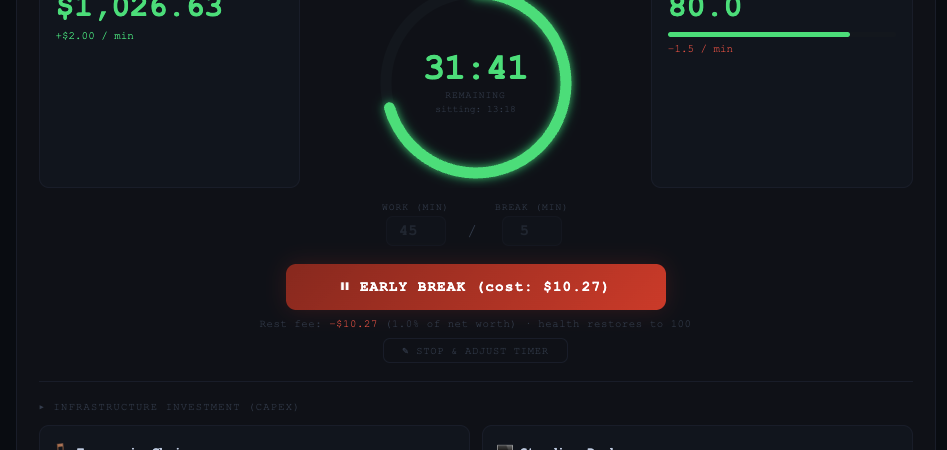
Over a few weeks, working with Claude (Anthropic’s AI assistant), I built a browser-based tool I call SeatRisk™. It’s free, requires no signup, and runs entirely in your browser. The mechanics are simple but the psychology behind them is deliberate:
- Every minute you focus, your in-game net worth grows by $2.00
- At the same time, your health score drains at −1.5 points per minute
- When the ring timer empties (you set the interval — I use 45 minutes), an alarm fires. You stand up, walk around. Your health restores to 100.
- Taking a break costs 1% of your current net worth as a “rest maintenance fee”
- If you sit for 60 consecutive minutes without breaking, health hits zero — instant game over, net worth seized to “cover ICU bills”
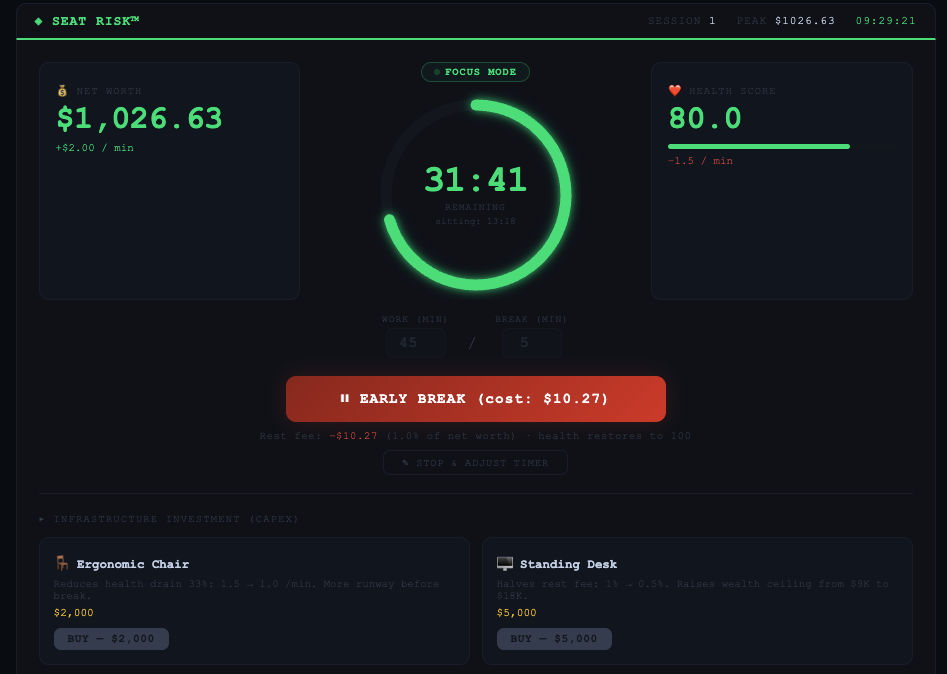
The first time I watched my health bar flash red while my net worth kept climbing, something clicked that no Pomodoro timer ever triggered: I was watching myself make a bad trade in real time.
There’s even a mathematical wealth ceiling built into the game. At $9,000, your 1% rest fee exactly equals what you earn in a 45-minute session — you can’t grow further. The only way to break through is to invest in upgrades: an Ergonomic Chair (reduces health drain 33%) or a Standing Desk (halves the rest fee, raises the ceiling to $18,000). It’s a small economic lesson about capital investment, embedded inside a standing reminder.
The Part I Didn’t Expect: Other Desk Workers Started Playing
A few weeks after launching, I added a global leaderboard. Players submit their peak net worth along with a display name and occupation when a session ends.
What surprised me was seeing who shows up: software developers, data analysts, traders, content writers, product managers. The full cross-section of people who sit too much and know it.
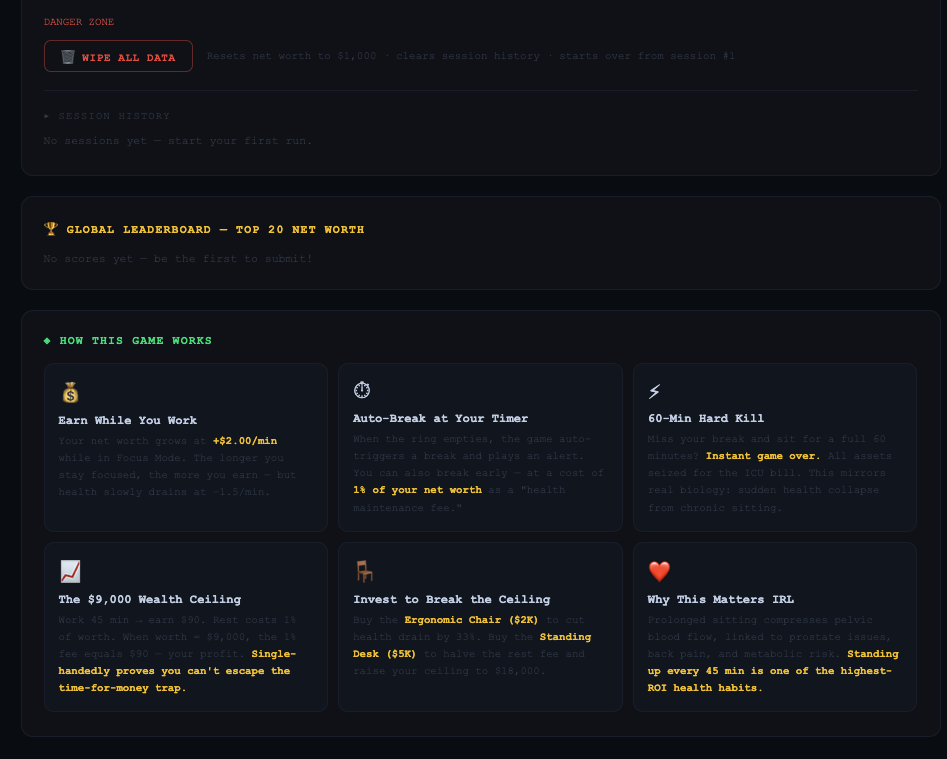
The competitive element does something I couldn’t have predicted. Seeing another software developer holding the top score genuinely makes me want to beat it. That impulse — which is completely irrational — does more for my standing habit than any alarm I’ve ever set.
The game also triggers a personal-best alert. If your peak net worth beats your all-time browser record, the submit form lights up and prompts you to post your score. It turns a solo habit into something that feels shared.
What Actually Changed
I want to be careful about what I claim here. I don’t know if three weeks of standing every 45 minutes changed anything measurable in my body. My follow-up appointment is in a few months and I’ll report back honestly.
What I can say is this: the habit formed. Not through discipline. Through the discomfort of watching a number fall.
When my health score drops below 50 and keeps falling while I’m mid-session, I feel a small but real unease — the same thing I feel when a position moves against me and I haven’t acted yet. That feeling, apparently, is what I needed. Not a chime. An actual consequence I can watch unfold in real time.
That’s the difference between a reminder and a system.
Other Tools Worth Knowing
SeatRisk works for me because of the financial framing. It speaks my language. But that framing won’t work for everyone, and I want to be honest about that. These are the alternatives I’d actually recommend:
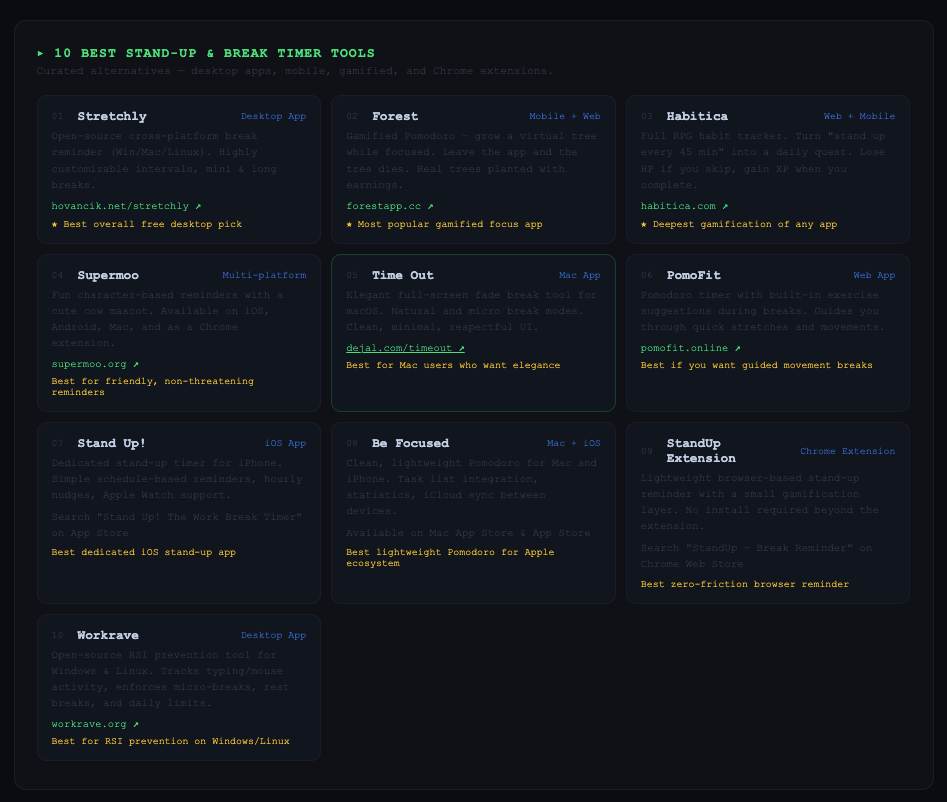
- Stretchly — Open-source, cross-platform, free. Has a “strict mode” that locks your screen. The most reliable pure break enforcer I’ve found.
- Forest — If you respond better to growing something than losing something, Forest is the one. You plant a virtual tree while you work. Leave the app and it dies.
- Habitica — Full RPG habit system. Set “stand every 45 minutes” as a daily quest. Miss it and your character loses HP. The deepest gamification of any app in this category.
- Time Out — Mac only, but the most elegant solution I’ve seen. Fades your screen gently to enforce breaks without feeling aggressive.
The full comparison of all 10 tools — with links — is built into SeatRisk itself, below the game.
Don’t Wait for the Report to Tell You
We track portfolio returns, optimize tax efficiency, and think carefully about how we allocate capital over decades. A lot of us are simultaneously letting our most important asset — the body that has to execute all of those plans — depreciate quietly in the background.
The dangers of prolonged sitting are quiet. You don’t feel it happening. It accumulates across years of unbroken desk sessions, and by the time a number appears in a medical report, the habit has already been built in the wrong direction.
I needed that report to take it seriously. You might not.
If you’re a man over 40 working a desk job — or honestly anyone who sits for most of the day — the simplest version of this is just setting a timer and standing up when it rings. You don’t need a gamified terminal with Bloomberg aesthetics and a fake net worth counter.
But if you’re the kind of person who checks stock prices before getting out of bed, you might find that a game speaks louder than an alarm.
Free. No signup. Runs in your browser.
How long did you last before getting liquidated? Drop your score in the comments.
This article reflects personal experience only and is not medical advice. Please consult a qualified doctor for any health concerns.
Related Reading
- I’m 45, I Work in IT, and I Asked AI to Plan My Next 5 Years — Applying the same analytical mindset to life decisions, not just stocks
- I Spent ¥340 on a Mini PC to Run a Local AI Agent — More on building your own tools with AI when off-the-shelf options don’t fit
- I Used AI to Research My Dad’s Parkinson’s Disease — Using AI as a research partner for health-adjacent questions (not medical advice)
Share your experience or thoughts below.
Leave a Reply