Six years.
That’s how long I’ve been trying to build something online. Different projects. Different ideas. Same result: roughly zero dollars.
So last year, I started an English blog. My mom asked me what I was doing. I said I was building a website. She reminded me I’ve said that before — and asked what I’d made from it.
She wasn’t wrong. I just sat there, a little embarrassed, thinking: this time is different. But that’s exactly what I thought the last two times.
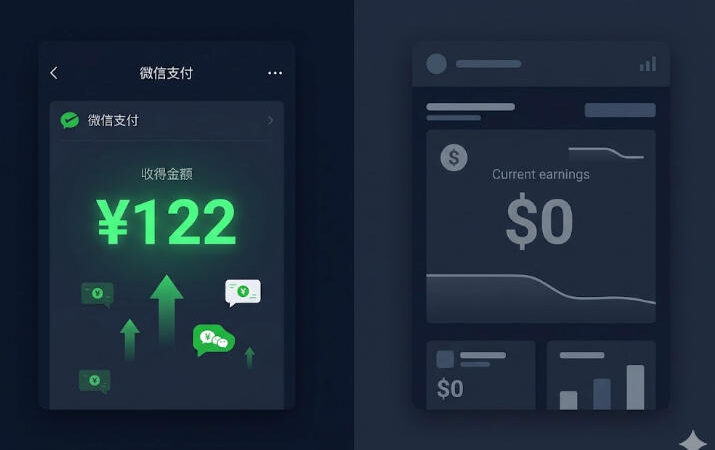
At the same time, a friend started a WeChat public account. Six months in: he’s making ¥122 a month. I’m making $0.
Here’s the full comparison — and why neither of us is stopping.
What My Friend Built
A few months ago, a friend of mine started a WeChat public account.
His concept: AI-generated cartoon strips about finance and everyday life. The kind of content where a stick-figure family watches the stock market go sideways and reacts in a way that’s funny precisely because it’s accurate. Light, timely, shareable. He churns these out with AI image tools in a fraction of the time hand-drawing would take.
He hit 100 followers. The platform automatically switched on ad monetization — WeChat inserts ads into your articles once you reach the threshold, roughly one ad per 900 words. He didn’t have to negotiate with anyone or apply anywhere. The system just turned on.
This month’s revenue: ¥122.71. Yesterday alone: ¥9.41, up 307% from the day before.
One article hit 10,689 readers. 30 shares. The algorithm pushed it because it performed well.
He started a few months ago. He’s already profitable.
How WeChat Monetization Actually Works
The mechanism is genuinely elegant if you’re writing in Chinese for a Chinese audience.
WeChat embeds ads automatically once you pass 100 followers — you write, they insert, you get paid. Every 1,000 reads earns roughly ¥6–10, depending on your content category. Finance pays more than entertainment. The platform settles twice a month directly to your account.
The algorithm rewards completion rate more than raw click count. If readers actually finish your articles, the platform pushes your future articles to more people. This creates a compounding loop: good content → higher completion → wider distribution → more followers → better performance on the next article.
There’s no cold outreach, no SEO, no waiting for Google to notice you exist. The platform handles discovery. You handle content.
My Numbers, Month 6
Here’s what I can share right now:
| Metric | This Month |
|---|---|
| Articles published | 35 |
| Blog revenue | $0 |
| Adsense | Pending approval |
| Google impressions & clicks | → updated monthly in my Live Diary |
| Tools built | 12 (life simulators, voting tools, AI experiments) |
The traffic and search data I update every month in my building-in-public diary. Right now the Google numbers are small enough to be embarrassing. I’m sharing them anyway — that’s the point of doing this publicly.
So on paper — especially the paper my mom is looking at — my friend is winning.
But We’re Playing Different Games
Here’s what I keep coming back to.
WeChat has over a billion active users in China. My friend is writing in Chinese, for Chinese people, on the dominant Chinese social platform. The distribution is pre-built. The ceiling for a typical account is real too: ¥2,000–5,000 a month represents strong performance for most creators. The platform owns the relationship — if the algorithm changes or the account gets flagged, the audience doesn’t transfer anywhere.
I’m writing in English. 1.5 billion English speakers. Google as a distribution mechanism that compounds differently from a social platform — an article that ranks today keeps ranking. It doesn’t fade from a feed. Five years from now, something I published last month could still be sending me readers.
The revenue structures are also different. WeChat ad revenue scales with Chinese advertising rates. An English blog can earn affiliate commissions, sponsorships, and product revenue priced in dollars, from a global market, in a currency that doesn’t require conversion.
None of this means I’m smarter than my friend. He’s making money and I’m not. That’s real. What I’m saying is: we made different bets with different payout windows and different ceilings.
Why I’m Actually Doing This
I have two reasons. Neither of them is “I want to be a content creator.”
First: a backup plan if things go wrong at work.
AI is reshaping a lot of jobs faster than most people want to admit. I’m not panicking — but I’m also not pretending the next five years will look exactly like the last five. If I lose my job tomorrow, I want to have already spent years building something that isn’t tied to an employer. Not as a get-rich-quick plan. Just as something that exists, with real traffic and a real audience, that I could lean on or expand if I needed to.
My friend’s WeChat account is the same bet, made differently. We’re both hedging against a future that neither of us can predict.
Second: I want my kid to see this happen in real time.
I have a child who will one day think about how to make a living. I want them to grow up watching their parent actually try something — not just talk about it — and document every step of what worked and what didn’t. If this blog eventually earns something, that’s useful evidence. If it never earns a cent, that’s useful evidence too.
This isn’t a manual I’m writing for them. It’s more like a trail of footprints. Here’s what Dad tried. Here’s what the numbers actually looked like. Here’s what it felt like to do something for years before knowing if it mattered.
I’m not switching to WeChat because neither of those reasons changes based on which platform earns faster in Month 6.
Why This Time Is Different
My history with websites is not encouraging. I tried twice before — different projects, different ideas — and both went nowhere. Six years, roughly nothing to show for it.
AI changed what I can produce. My English is decent but not native. Two years ago, producing 35 articles at the quality level I’m publishing now would have taken me twice as long and the results would have been worse. The AI tools I use now compress the gap between what I want to say and what I can say in English. That gap was what killed my previous projects.
I’m building in public, which means I’m accountable. Every article I publish is a record. Every experiment has a result I’ll have to report. I can’t quietly give up and pretend this project never happened. That accountability changes the psychology of the work.
The content is actually about something. My previous projects were generic. This one is a real-time record of one ordinary person figuring out how AI changes the economics of side hustles, investing, and content creation. That’s something I can write honestly about because I’m living it.
My mom’s question still stings a little. Six years is a long time to invest in something without a visible return. But the compounding she’s not seeing yet is real. It’s just early.
Month 6 Scoreboard
| WeChat Account | English Blog | |
|---|---|---|
| Platform | WeChat (China) | WordPress + Google |
| Content | AI comic strips about finance/life | AI experiments + side hustle journal |
| Audience | Chinese | Global English speakers |
| Revenue this month | ¥122.71 (~$17) | $0 |
| Best single day | ¥9.41 | — |
| Top content | 10,689 reads (one article) | 35 articles, traffic → Live Diary |
| Monetization | Ad revenue (流量主) | Adsense pending |
| Platform risk | High (one algorithm change) | Medium (Google-dependent) |
| Ceiling | Bounded by platform + market | Theoretically global |
My friend’s account: ¥500–3,000/month if he stays consistent and hits more virality. Real money, relatively quickly.
My blog: unclear. The compounding hasn’t started yet. I’ll know more in a year, and again in five.
Neither of us knows how this ends. We’re both running experiments with uncertain outcomes. I’ll keep reporting the numbers — good or bad — in the Live Diary.
Related Reading:
- I’ve Been Blocked Everywhere Trying to Promote My AI Experiment — what happens when you build something useful and can’t reach anyone
- I Asked AI Which College Major to Pick. It Refused — So I Built a Voting Tool. — another long-bet experiment with 4-year results
- Free Tools → — life simulators, major voting experiment, and more
- Building in Public Diary — All Entries
Leave a Reply