The format is simple, and deliberately uncomfortable.
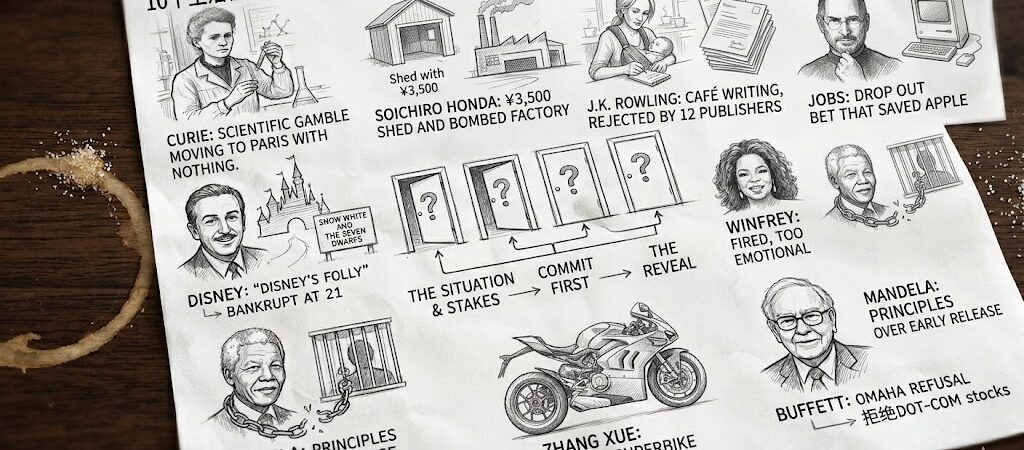
You’re shown a real moment in a real person’s life. A door on each side. You pick one — A, B, C, or D — before seeing any explanation of what they actually did. Then the reveal: their choice, their reasoning, and what happened next.
That’s it. No hints. No warm-up. You commit blind, and then you find out how close you were.
I’ve built ten of these, one for each of a set of people who changed things in ways that didn’t look inevitable at the time. The simulators are free, no sign-up, just a link and a decision to make.
Why the “commit first” format matters
There’s a version of this kind of game that doesn’t work: the one where you read the background, understand the context, see all four options laid out in full — and then pick the one that sounds most like a legend.
That version is too easy. It teaches you to recognize wisdom in hindsight, which is a completely different skill from exercising judgment under uncertainty.
The real thing — the thing that made Mandela, Curie, Jobs, and the others who they were — was not recognizing the right choice after the fact. It was making a choice with partial information, real risk, and no guarantee of outcome.
So I made the simulators work that way. You get the situation and the stakes. You don’t get the ending. You pick. Then you see.
Most people don’t match the legend on every decision. Some decisions are genuinely hard to call. Others feel obvious until you realize almost everyone at the time disagreed.
The ten people
Marie Curie — Seven decisions across the most improbable scientific career in history. The one who studied in secret, moved to Paris with almost nothing, and became the only person ever to win Nobel Prizes in two different sciences.
Steve Jobs — From his original dropout decision to the bet that saved Apple. Includes the moment he was fired from his own company and what he chose to do next.
Walt Disney — Bankrupt at 21. Lost his first character to a contract dispute. Then bet the entire studio on Snow White, which the industry called “Disney’s Folly.”
Soichiro Honda — His factory was bombed. He started over. Twice. The decisions that took him from a shed with ¥3,500 to Le Mans.
J.K. Rowling — A single mother on welfare, writing in cafés during her baby’s naps. Rejected by 12 publishers. Seven decisions before a single reader knew her name.
Oprah Winfrey — Fired from her first TV job for being “too emotional.” That quality became her entire business model. Seven decisions from a Mississippi farm to the most powerful person in American media.
Elon Musk — Quit his Stanford PhD after two days. Put his last money into a rocket that kept exploding. The decisions that built SpaceX and Tesla simultaneously, when both were on the verge of collapse.
Nelson Mandela — Imprisoned 27 years. Offered early release if he renounced his principles — the decision he made there is the one that changed everything. Seven decisions, including the one on the day of his release.
Warren Buffett — Rejected by Harvard. Moved to Omaha to think clearly. Refused to touch dot-com stocks when everyone said he’d lost his touch. Seven decisions across a 60-year career built on refusing to think like the crowd.
Zhang Xue — A Chinese motorcycle repairman who became World Superbike Champion, beating Ducati on a Chinese-made bike no one believed in. The one on this list you’ve probably never heard of — and the decisions are no easier for it.
What I found building them
I spent a lot of time in the research for each of these. Reading accounts of the actual moments, not just the Wikipedia summary version.
What surprised me: in most cases, the legendary choice was not the obviously bold one. Sometimes it was the patient one. Sometimes it was the principled refusal. Sometimes it was the one that looked like giving up.
The hardest ones to build were the Mandela decisions, because the weight of what was actually at stake — a nation, not just a career — makes the options feel different to read than they are to sit with. The Buffett decisions are deceptively boring-looking, which is exactly the point.
Try one. Start with whoever you feel you know best. Then try the one you know least. The gap between those two experiences is interesting.
All ten are at ordinarymantrying.com/tools.
Related Reading
I Fed 20 Annual Reports to AI. Here’s What It Found That I Missed. — The same curiosity behind the simulators: what happens when you pressure-test judgment with a tool that doesn’t flinch?
What Makes a Stock a 10x Candidate? I Asked AI to Build a Filter — Pattern recognition from the other direction: great companies and great decisions share some of the same structure.
I’m an Ordinary Chinese Guy Trying to Make Money Online with AI — Where this blog started, and why I keep building things like this.
Share your experience or thoughts below.
Leave a Reply