✍️ AI-written post. The tools, the ideas, the building — all mine. The writing was drafted by AI based on my notes. Curious what AI-written looks like? You’re reading it. Read my own voice here →
I ran the numbers on my own life last week. I wish I hadn’t.
Not because the result was catastrophic. Because it was specific. And specific is harder to ignore than vague.
The Question
Most life-visualization tools show you calendar time — how many weeks you’ve lived, how many remain. That’s useful, but it misses something.
Calendar time doesn’t explain why the first 18 years of your life felt like forever, and the last 10 years disappeared.
Same number of months. Completely different felt length. Why?
The answer has to do with novelty. When every month brings genuinely new experiences — new teachers, new places, new skills, new emotions — your brain creates distinct memories for each one. Time feels dense. When months blur together — same commute, same lunch, same evening routine — your brain files them as one memory. Time collapses.
A Black Hole month is one so routine it left no distinct memory at all.
My Numbers
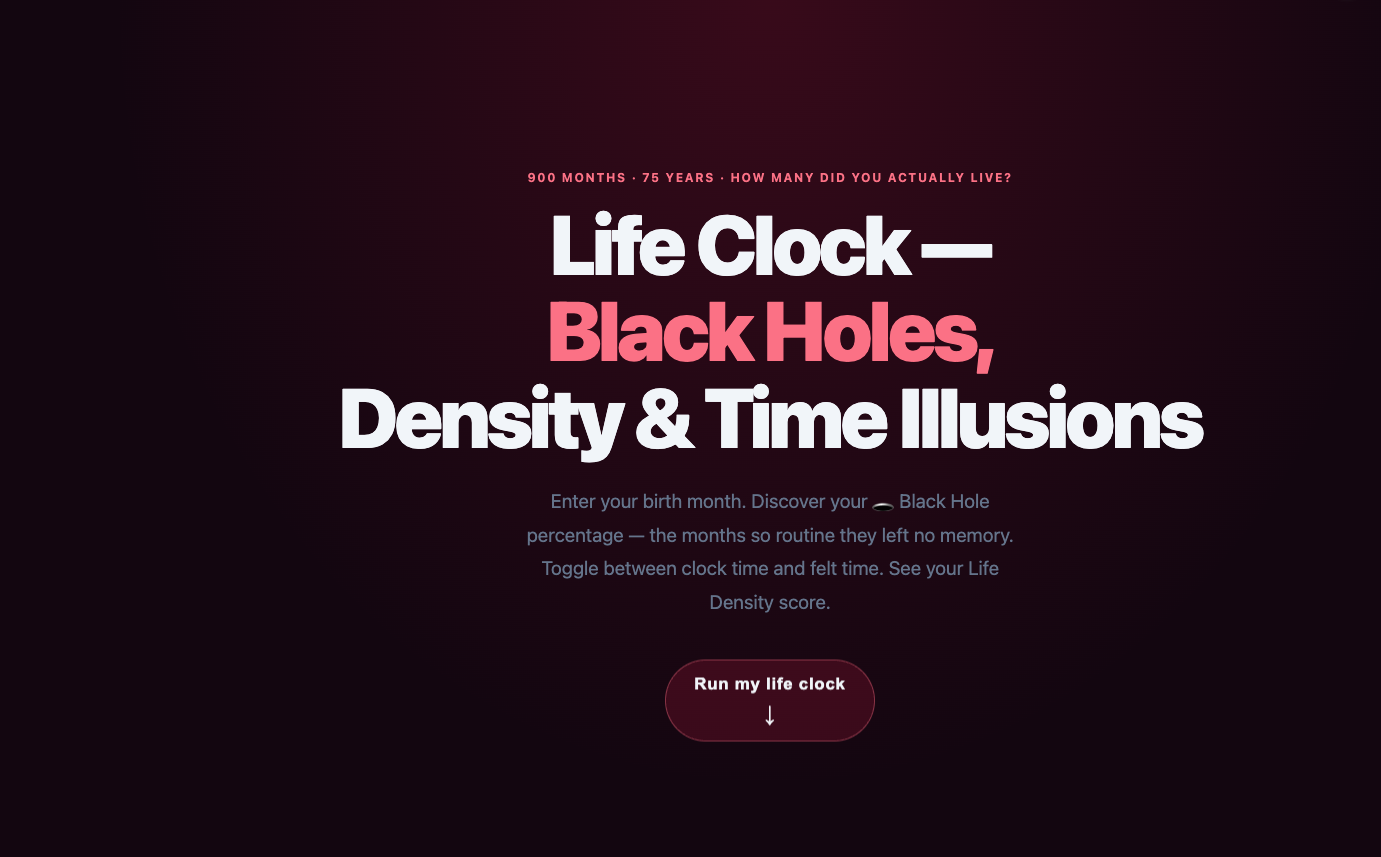
I built a tool to measure this: Life Clock. You enter your birth month, answer questions about your routine vs. novel-experience ratio, and it calculates two things:
- Black Hole % — the percentage of your months that were forgotten almost immediately
- Life Density Index — a 0–100 score for how “lived” your life has been so far
I won’t share my exact numbers here — some things are better kept private — but I will say the Black Hole percentage was higher than I expected. Not alarmingly high. Just higher than I’d have guessed if you’d asked me to estimate.
That gap between “how lived I feel my life has been” and “what the metric says” is the useful part.
The Golden Months
There’s a second feature that I didn’t expect to affect me as much as it did.
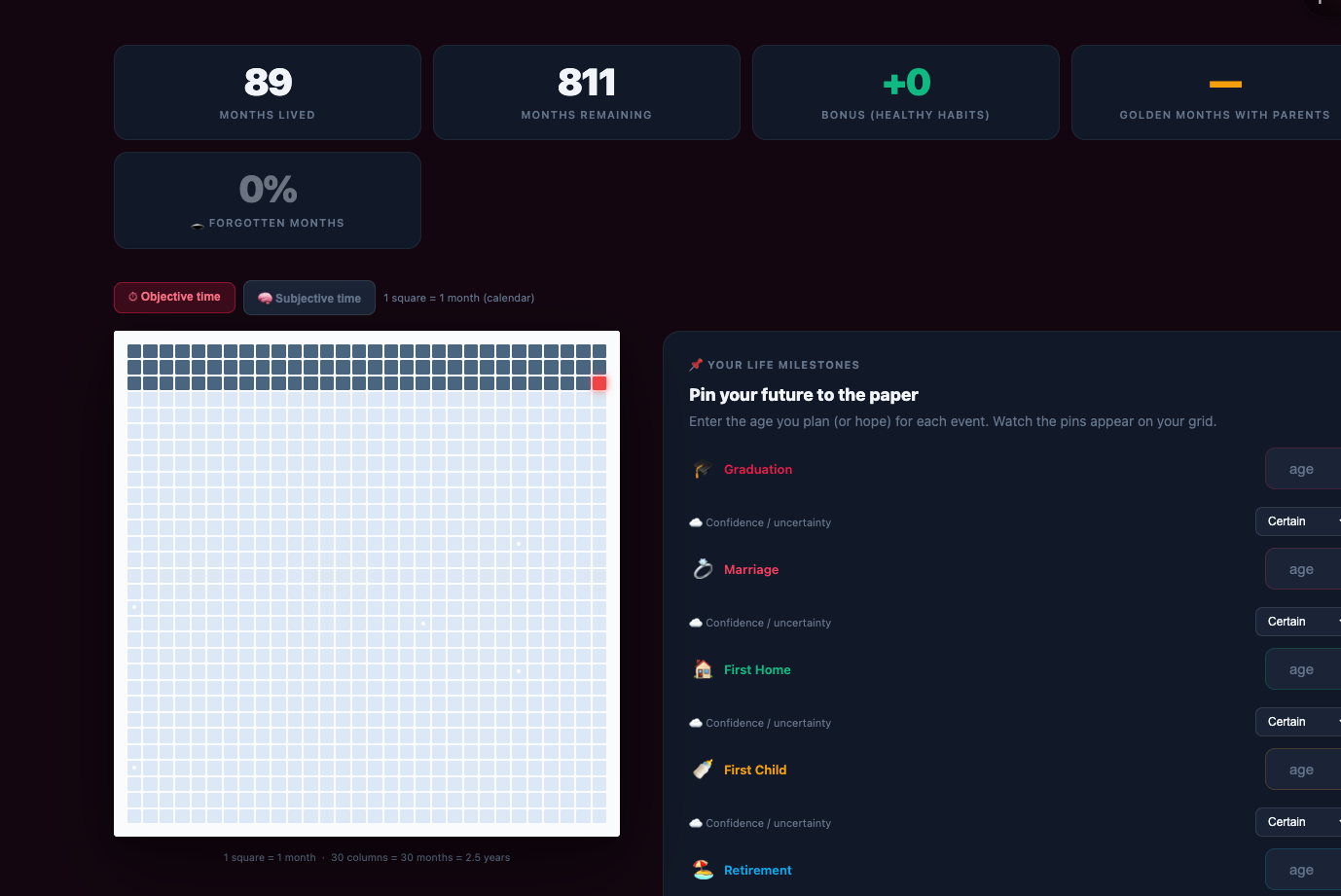
You enter your parents’ current ages. The tool calculates how many months of meaningful overlap you likely have left — before distance, health, or time makes regular contact impossible.
I’ve thought about this abstractly before. Seeing it as a specific number on a grid does something different to your brain.
The number isn’t doom. It’s a prompt. What are you doing with those months?
What I Did With the Information
Nothing dramatic. I didn’t quit my job or book a flight.
But I did call my parents that evening instead of putting it off. And I’ve been more deliberate about introducing novelty into otherwise routine weeks — not because I’m afraid of black holes, but because I’d rather my future self has something to remember.
That’s probably the most you can ask of a tool like this: not transformation, just a small shift in attention.
Run your own Life Clock here → No sign-up. No personal data saved.
Part of the Life Trilogy — three tools, one grid, different angles:
• Life Clock — black holes and felt time
• Life A4 — your own 900-square paper
• Life Paper — famous lives on the grid
Leave a Reply