I built a tool I was genuinely proud of.
900 squares. Each one a month of a human life. You enter your birth month, watch the squares fill in — gray for the past, a single orange dot for now, blank for what’s left. A few questions later, it tells you how many months you probably have with your parents before one of you can’t travel anymore.
I called it Life A4. I built it in a weekend with Claude. Zero coding background. I just described what I wanted, iterated 30 times, and it existed.
Then I had what felt like a brilliant idea.
“What If I Made It a WeChat Mini Program?”
I’m Chinese. My parents are on WeChat. My high school friends are on WeChat. Every person I grew up with has WeChat open 24 hours a day.
The logic seemed obvious: take this tool, translate it to Chinese, put it on the platform where 1.3 billion people already live. Instant distribution. Instant audience.
I brought the idea to an AI. I explained my plan. I expected enthusiasm.
Instead, I got a spreadsheet.
The Numbers I Didn’t Want to See
Here’s what the AI laid out, coldly and without mercy:
WeChat Mini Program monetization:
- Revenue model: display ads only — no paid features, no subscriptions
- Tencent takes 50% of all ad revenue
- Average RPM for this type of tool: 10–20 yuan per 1,000 views
- Traffic lifecycle: viral burst for 2–3 months via social sharing, then cliff-drop when novelty fades
- Users won’t pay. Ever. You can build the most beautiful “export to PDF” button in history. They’ll screenshot it.
English website (ordinarymantrying.com):
- Revenue model: Google AdSense + $2 one-time paid print download
- No platform taking half my earnings
- RPM for Tier 1 traffic: roughly 5–7x higher than WeChat ads
- Traffic lifecycle: Google SEO rankings hold for 3–5 years. The page keeps earning while I sleep.
- “Memento Mori,” “intentional living,” “life planning” — these are established Western niches. People pay for printable tools. The Etsy economy is real.
The AI’s conclusion was blunt: same traffic, same effort, the English website makes 6–10x more money. Building a Mini Program is choosing the smaller prize.
I pushed back. What about the sheer volume of Chinese users?
The answer: volume doesn’t help when the monetization ceiling is this low, the platform takes half, and the content (“here’s how much of your life is already gone”) is exactly what Chinese content moderation flags as “selling anxiety.”
The Part That Actually Stung
There’s a cultural asymmetry I hadn’t thought about clearly.
In the US, there’s a whole economy around mortality awareness. Tim Urban wrote a famous essay about life in weeks. People buy “memento mori” coins and put them on their desks. The Stoic community actively pays for tools that make death feel real and time feel precious.
In China, this same content gets called 贩卖焦虑 — selling anxiety. It’s not that Chinese people don’t think about mortality. It’s that the platform environment treats it as a liability, not a product.
The tool I built works better in the market where it’s allowed to work.
I Still Almost Did It Anyway
Not because the numbers were wrong. But because seeing 78 monthly active users on your English website and imagining WeChat’s billions is psychologically hard to resist.
The AI had to say it one more time: building a Mini Program doesn’t move the needle on your actual goal. It splits your attention and delays the one thing that compounds — your English site’s domain authority.
I closed the conversation. Sat with it for a day.
Then I opened Claude again and said: let’s build two more versions.
What Happened Instead
Over the next few weeks, with AI as my development partner, I built two more tools in the same life-visualization family.
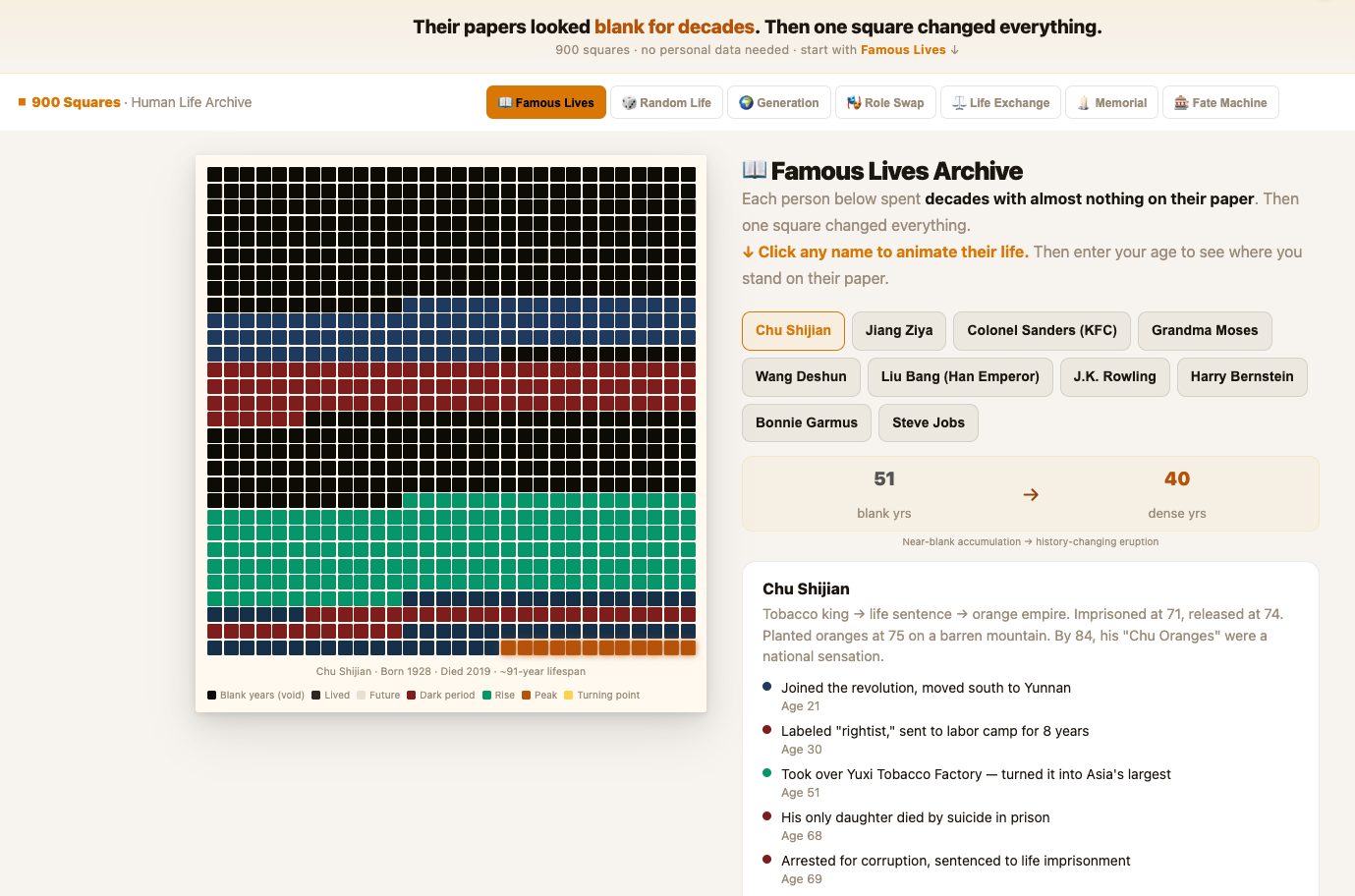
Life Paper — 900 squares, but instead of your own life, you watch famous lives animate. Grandma Moses started painting at 78. Chu Shijian started a new business at 74. Colonel Sanders built KFC at 62. You enter your age and see where you stand on their paper.
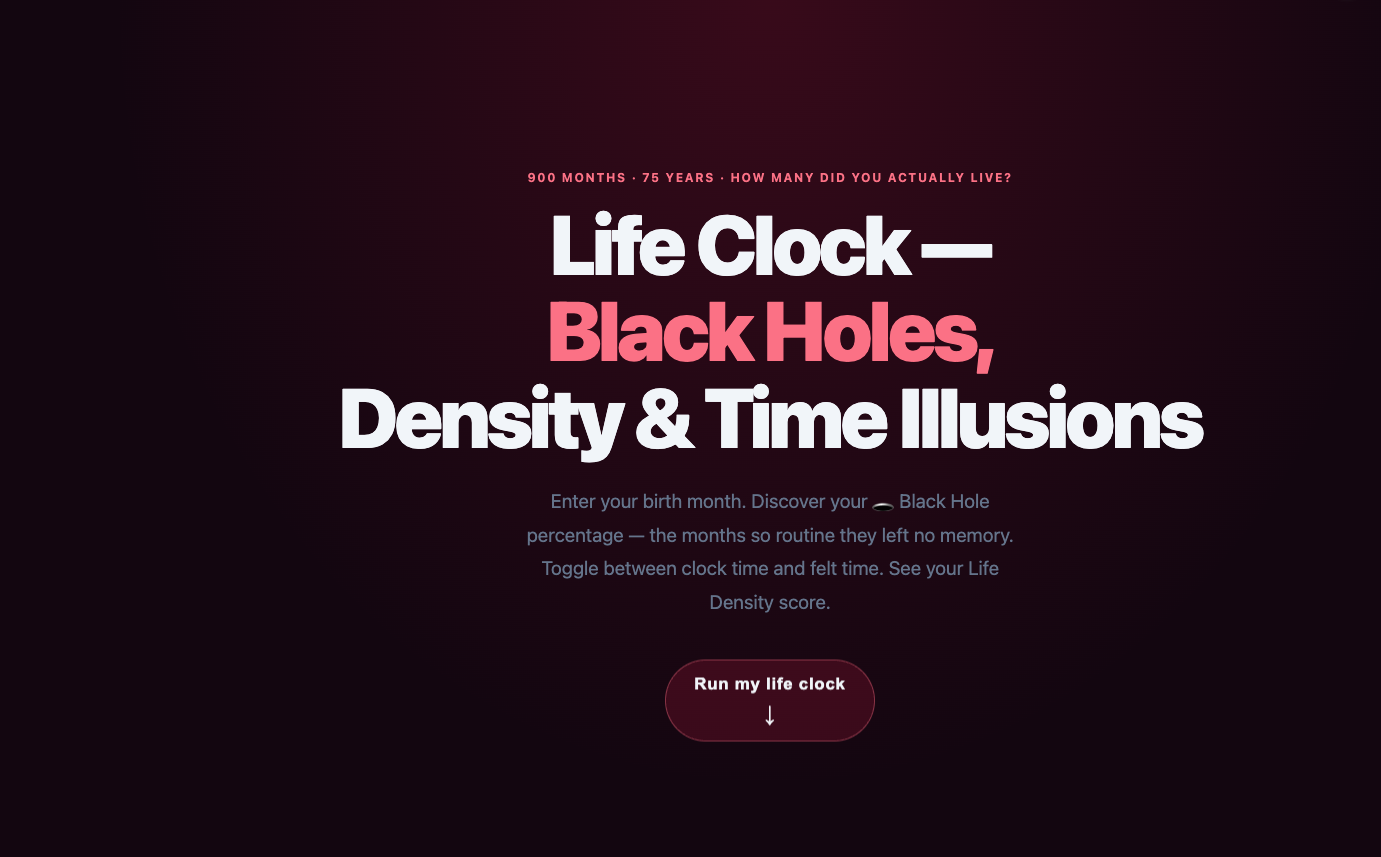
Life Clock — a different question entirely: what percentage of your months were “black holes” — so routine, so repetitive, that they left no distinct memory? It measures felt time versus clock time and gives you a Life Density score.
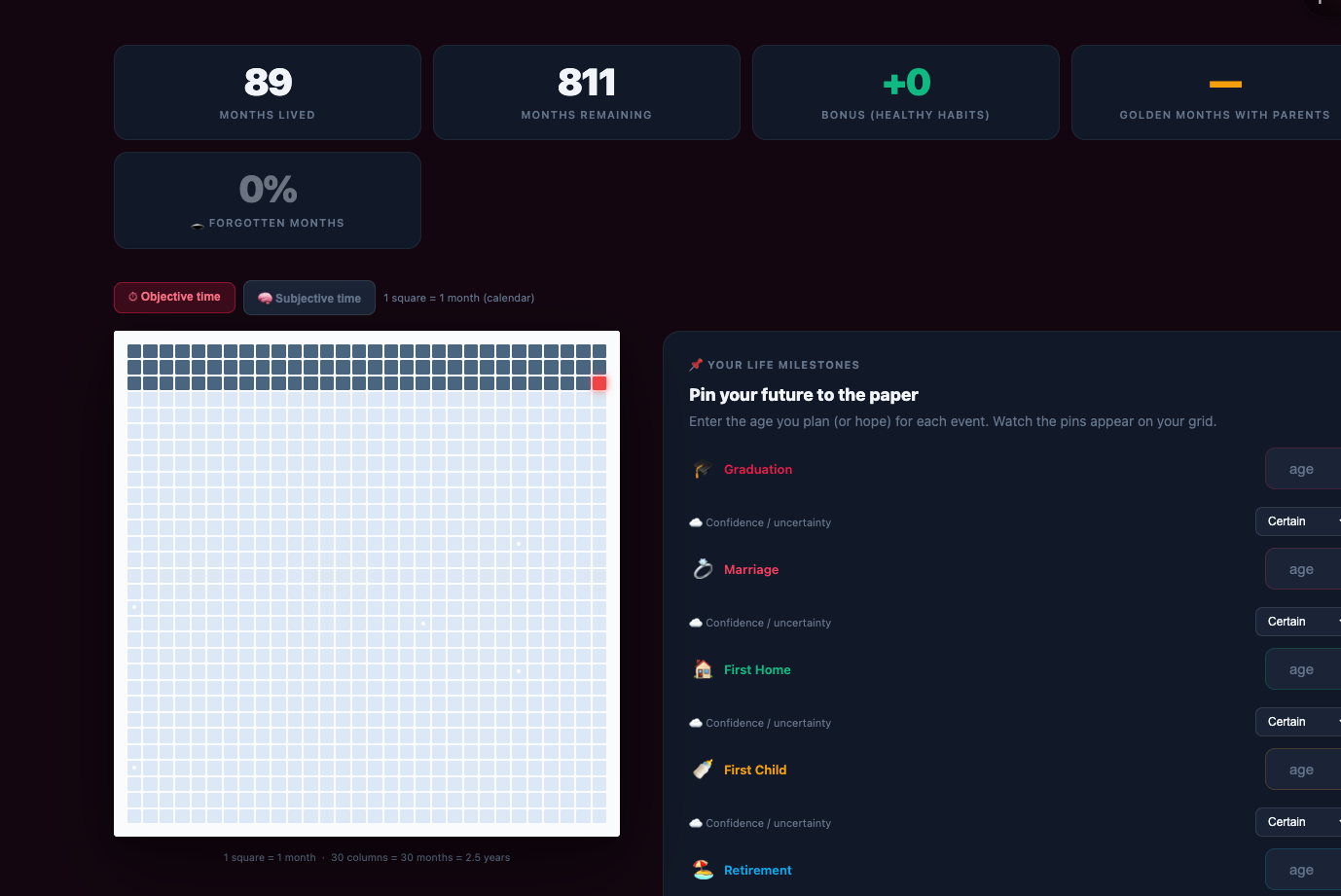
Three tools. One grid. Different angles on the same uncomfortable truth.
None of them required an app store approval. None of them pay a 50% platform tax. All of them run in any browser, anywhere in the world, with no installation required.
What I Learned
Building with AI removes most of the technical barrier. The tool that used to require a team and six months now takes a weekend. That’s genuinely new.
But it creates a different trap: when building is easy, you can build the wrong thing easily. The hard part isn’t coding. It’s deciding what to build, where to distribute it, and how it makes money.
I almost burned weeks on a WeChat Mini Program that would have generated enough ad revenue to cover maybe one dinner per month. Not because I’m stupid — because the idea felt right. Familiar platform, familiar language, familiar audience.
The AI’s job was to show me what the idea looked like in numbers, not feelings.
I’m glad I listened.
The three life tools are all free, no sign-up required:
• Life A4 — your own 900-square paper
• Life Paper — famous lives on the grid
• Life Clock — black holes and felt time
If any of this resonated, buy me a coffee — it keeps me building.
Leave a Reply