I’ve been writing about psychology and decision-making for a while. I thought I understood most of the big cognitive biases. Then I built a quiz around them, played it myself, and discovered I was confidently wrong about three of them.
Which, to be fair, is itself a demonstration of the Dunning-Kruger Effect.
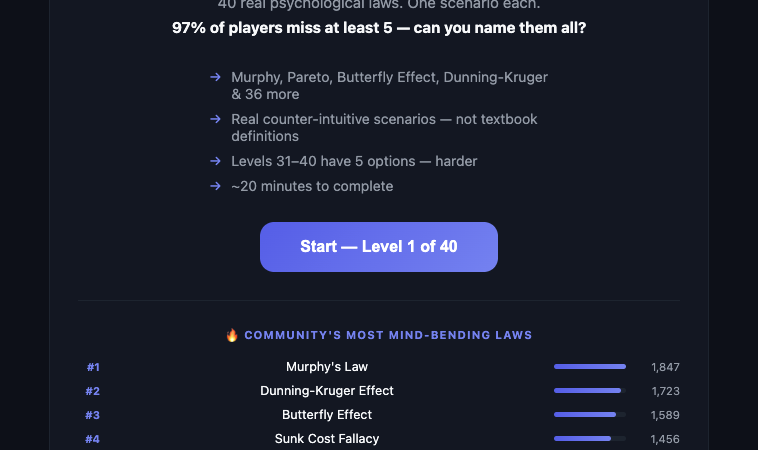
The tool is called Mind Traps — a free 40-level interactive quiz. Each level gives you a real-world scenario. Your job is to identify which psychological law or cognitive bias it demonstrates.
No definitions. No hints. Just the situation, and four (or five, in the harder levels) options.
How It Works
The quiz covers 40 psychological laws and effects — from the famous ones like Murphy’s Law and the Butterfly Effect to lesser-known traps like the Birdcage Effect, the Gadfly Effect, and Segal’s Law.
Every question is a scenario. Not a textbook definition — an actual situation you might recognise:
- A programmer’s system crashes at the exact moment of a live demo after hundreds of perfect test runs.
- A patient in a hospital has a colonoscopy extended by 3 extra minutes of mild pain — and later rates the whole experience as less unpleasant than shorter-procedure patients.
- A charity fundraiser asks for a full year of volunteering first, then asks for $10. She raises more than colleagues who ask for $10 directly.
Each scenario has one correct answer. After you choose, you see a full explanation: where the law came from, why it works, and how it shows up beyond the example.
Levels 1–30 have 4 options. Levels 31–40 have 5 — which sounds like a small change, but meaningfully increases the difficulty when several options feel plausible.
The Ones That Actually Trip People Up
Based on community votes (8,000+ casts so far), these are the laws people find most mind-bending:
- Murphy’s Law — not just “things go wrong,” but specifically at the worst possible moment. The mechanism matters.
- Dunning-Kruger Effect — most people think they know this one. The scenario reveals they know the name but not the precise mechanism.
- Butterfly Effect vs. Domino Effect — these are frequently confused. One is about unpredictability and compounding; the other is about predictable cascades.
- Gadfly Effect vs. Catfish Effect — both involve pressure activating a group, but the source is different. Most players mix these up.
- Peak-End Rule — the colonoscopy question is the hardest in the entire quiz. A longer, more painful experience rated better because of how it ended.
The one I got wrong on my own quiz: the Birdcage Effect. I knew the story about the man and the unwanted birdcage. I still selected the Sunk Cost Fallacy instead.
Why I Built It
I read a lot about psychology. Books, papers, case studies. After a while, I noticed I could recite the definitions but struggled to recognise the effects in actual situations — which is the only place they matter.
Knowing the Sunk Cost Fallacy in theory doesn’t stop you from sitting through a bad movie because you already bought the ticket. Recognition in context is a completely different skill from recall of a definition.
The quiz format forces that context. You don’t get asked “what is the Hawthorne Effect?” You’re put in a factory where every change the researchers make — more light, less light, longer breaks, shorter breaks — produces the same improvement. Why?
If you can answer that without looking, you actually understand it.
What’s Under the Hood
The tool is a single HTML file — no server required, no login, works offline after first load. Answer order is randomised on every play using a Fisher-Yates shuffle, so you can’t memorise positions.
Each of the 40 laws has a standalone deep-dive page on this site — full history, real examples, and context beyond what fits in the quiz explanation. Links appear in-game after each answer.
Community voting is live on the full version: after each playthrough (or mid-game if you get two wrong in a row), you can vote for the law you found most surprising. The Top 8 most-voted laws are shown on the start screen.
Try It
The quiz takes around 20 minutes if you read the explanations. Faster if you don’t. Either way, I’d recommend the explanations — that’s where the interesting parts are.
Play Mind Traps — Free, No Login →
If you finish all 40 levels and beat my score, I want to hear about it.
Leave a Reply