
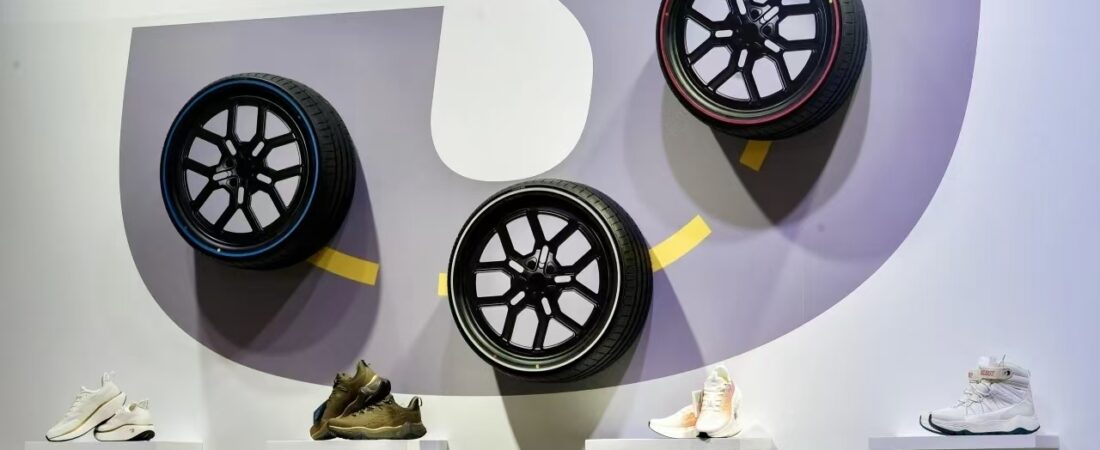
I want to tell you about a research rabbit hole that started with a tire company and ended somewhere I never expected to look.
A few months ago I became interested in Sailun Group (赛轮集团, 601058.SH) — a Chinese tire manufacturer that most people outside China have never heard of, but whose products end up on equipment made by Caterpillar, John Deere, Komatsu, and Volvo. The company has production bases in Vietnam, Cambodia, Mexico, and Indonesia, and sells into more than 180 countries. It’s the kind of unglamorous industrial company that value investors tend to like: global scale, real products, serious engineering, and a stock price beaten down by tariff fears.
I wanted to understand it properly. So I did something I hadn’t done before.
The Research Stack
Instead of asking AI to summarize the company, I assembled a full supply chain research package and fed it in piece by piece.
Sailun’s annual reports for 2023, 2024, and 2025. Their first-quarter 2026 results. Two investor relations meeting transcripts. Analyst reports from several Chinese brokerages. Then — and this is where things got interesting — the financial reports of four direct competitors: Triangle Tire, Fengsheng Tire, Linglong Tire, and Zhongce Rubber.
Then I went one level up the supply chain.
Carbon black is the key performance material in tire manufacturing — it strengthens rubber and gives tires their characteristic black color. Without it, a tire is soft and degrades quickly. I pulled annual reports and quarterly results for six Chinese carbon black producers. Then, one level further up: the coal tar and chemical companies that supply the feedstock for carbon black. Three of those as well.
Twenty-something documents total. A complete vertical map of one supply chain, from raw material to finished tire.
The Answer I Didn’t Expect
I expected a verdict on Sailun. Is the moat real? Is the global expansion strategy sound? Are the tariff risks already priced in?
AI gave me all of that. But then it said something I hadn’t asked for.
“The more interesting situation in this supply chain isn’t the tire company you asked about. It’s what’s happening one level up.”
The carbon black industry, AI explained, was in the opening stages of a brutal consolidation cycle. Input costs — coal tar — had risen sharply. Downstream tire makers were refusing to absorb price increases. Margins across the entire industry had turned negative. One major producer had just reported a quarterly loss approaching 100 million yuan. Others were in similar shape.
I had gone looking for information about a tire company. AI had read the same documents and noticed a different story hiding in the supply chain.
The Three-Phase Framework AI Gave Me
Here is what I learned about how industrial consolidation actually works — not the textbook version, but the multi-year physical reality.
Phase one — Profit destruction. Input costs rise, output prices fall, the whole industry bleeds. This is where carbon black was in early 2026. Every company looks terrible on paper. This is also where most investors stop looking.
Phase two — Cash flow exhaustion. Sustained losses drain reserves. Smaller producers begin delaying supplier payments, cutting shifts, and reducing headcount. The weakest hands start to show.
Phase three — Balance sheet collapse. Local government support dries up. Banks pull credit lines. Assets get seized and auctioned at distressed prices. Equipment sits idle and eventually rusts into permanence.
AI made a distinction that I found genuinely clarifying: the difference between idle capacity and eliminated capacity is everything. Idle capacity can restart when prices recover — which prevents prices from recovering. Eliminated capacity cannot. The consolidation cycle only truly ends when enough production has been physically destroyed that the survivors gain real pricing power for the first time.
AI’s estimate: at the rate things were moving in mid-2026, the meaningful clearing in carbon black likely wouldn’t show up in financial statements until 2027 or 2028 at the earliest.
The Company at the End of the Chain
The dominant carbon black producer in China is Heijin Carbon Black (黑猫股份, 002068.SZ). It has the lowest cost structure and deepest balance sheet in the industry. If the consolidation plays out as the framework describes, it will likely be among the last companies standing — and when pricing power returns to a market it dominates, the financial reversal could be dramatic.
You can look up the current situation on Yahoo Finance: 002068.SZ
AI did not tell me to buy it. It told me something more useful:
“A good company and a good investment are two different questions. The question here isn’t whether Heijin is a good company — it’s whether the industry clearing will complete before the company’s balance sheet can no longer absorb the losses. That’s the risk you’re actually taking.”
That framing changed how I thought about the position.
The Record, Set in June 2026
I’m writing this down publicly, with the numbers on record.
As of mid-June 2026, Heijin Carbon Black (002068.SZ) trades at approximately 9.62 to 10.08 yuan per share — fluctuating in that range as the industry downturn continues and investors stay cautious.
The thesis, stated plainly:
– The carbon black industry in China is in the middle of a painful consolidation
– Heijin has the cost structure and resources to outlast smaller competitors
– If the industry clears by 2027–2028 as the framework suggests, the earnings recovery could be substantial
– The risk is duration: if consolidation takes longer, even a strong balance sheet has limits
I’ll revisit this article in 2031. By then, five years of financial statements will have accumulated. Either the consolidation completed and the thesis played out, or something interrupted it — a new wave of capacity, a policy intervention, a demand collapse. Either way, the analysis will have been tested by time, which is the only test that matters in investing.
Right now, I genuinely don’t know which outcome awaits. That uncertainty is the point.
What I Actually Learned From This
The most useful thing AI did in this research wasn’t the analysis of Sailun — it was the decision to look somewhere I hadn’t thought to look. I gave it twenty documents about one company and its competitors, and it found the more interesting story in the documents I’d gathered almost as an afterthought.
That’s a specific kind of value I’ve come to rely on: not asking AI what to think, but letting it read everything and tell me what I missed. Sometimes the answer to the question you asked isn’t the most important answer in the room.
In this case, I went looking for information about tires. I came back thinking about carbon black.
I’m not a financial advisor. This is a record of my own research process, not a recommendation to buy or sell any security. Do your own research — and if you use AI to do it, feed it the whole supply chain.
Share your experience or thoughts below.
Want to run this kind of deep research on your own stocks? Use the free 10× Stock Screener →
Related Reading
- 10 Months Using AI as a Value Investing Tutor — What I Actually Learned
- How I Analyze Chinese Stocks with Claude Every Morning
- I Asked AI to Read 10 Months of My Investment Conversations and Write a Second Opinion. It Found the Flaw I Was Hiding From Myself.
Leave a Reply