
✍️ AI-written post. The tools, the ideas, the building — all mine. The writing was drafted by AI based on my notes. Curious what AI-written looks like? You’re reading it. Read my own voice here →
I didn’t set out to build something heavy.
I just wanted to visualize a human life on a grid. 75 years. 900 squares. Each one a month. Simple enough idea.
Then I started building the lenses — seven different ways to explore the same grid — and somewhere around the fourth one, I realized I wasn’t building a productivity tool. I was building something closer to a memorial.
It Starts With Famous Lives
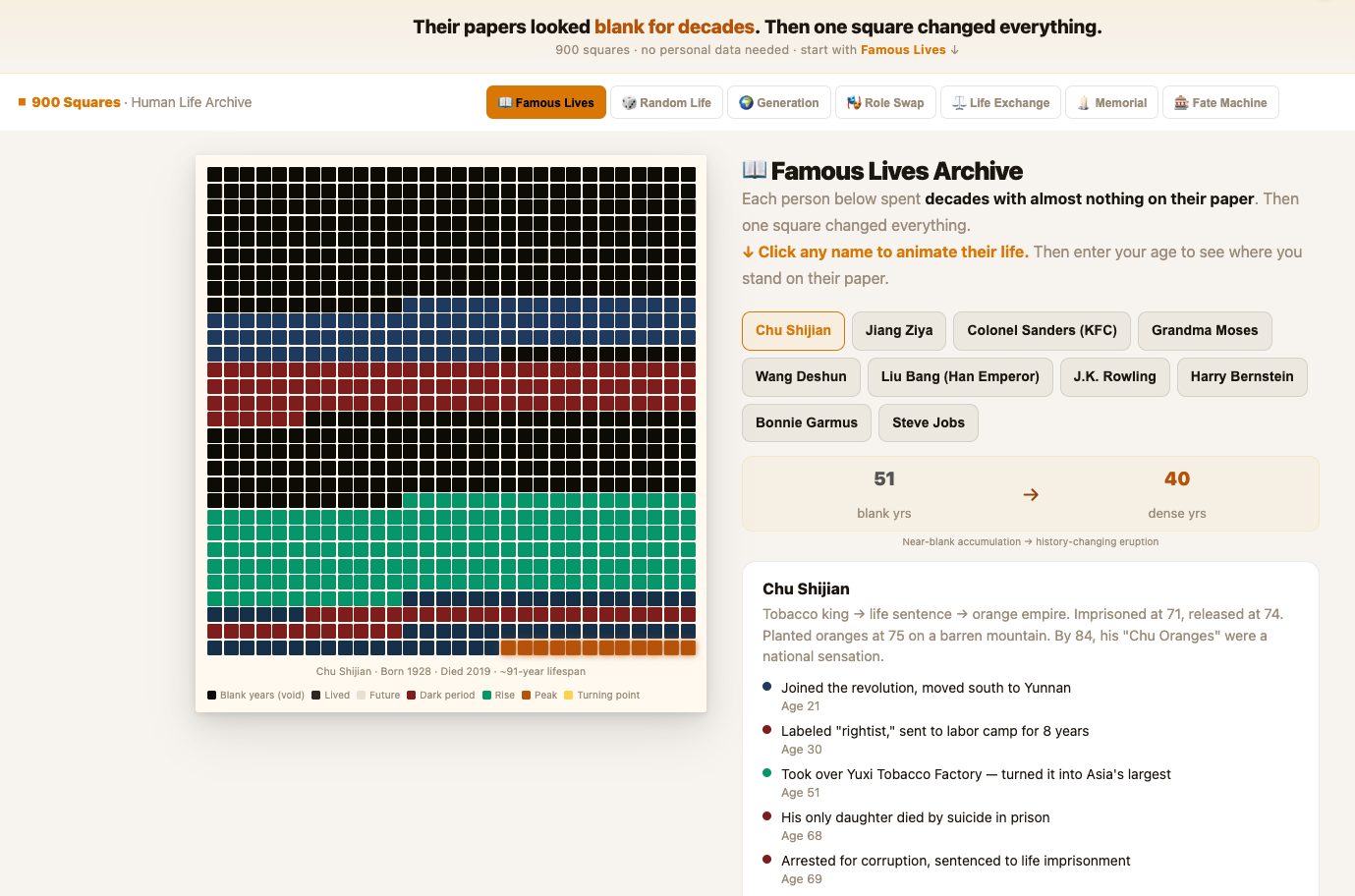
The first lens is the one most people try first: watch a famous life animate on the grid.
Chu Shijian built one of China’s largest cigarette empires, went to prison at 71, and started an orange farm at 74. By his 80s, “Chu oranges” were selling out across the country. On the grid, you watch 74 years of squares fill in slowly — decades of building, then prison, then that tiny orange square appearing near the end. Then everything that follows.
Grandma Moses. Colonel Sanders. Each one has the same shape: long stretches of unremarkable months, then a single square where something shifts, then the squares that follow look completely different from the ones before.
You enter your own age. The grid marks where you stand on their paper. That number — how old you are versus when their turning point came — is the thing people screenshot and send to friends.
Then It Gets Stranger
The second lens is Random Life. The tool assembles a stranger’s paper — birth year randomized, life events drawn from real patterns, blank years distributed the way blank years actually distribute in real lives.
You don’t know whose life it is. But you recognize it anyway. The years of drifting in your 20s. The thing that happened at 34 that changed everything. The long plateau in your 40s. People stop and stare at random lives the way they stare at strangers on trains.
The Generation lens shows the average paper for Post-80s, Post-90s, Post-00s — when people in your cohort typically hit major milestones, and where you sit relative to that average. This one is less comforting. Comparison has a way of doing that.
Role Swap — The Lens That Took the Longest to Build
Eight different roles. Migrant worker. Caregiver. Artist. ICU nurse. Entrepreneur. Stay-at-home parent. Monk. Athlete.
Same 900 squares for each one. Completely different events filling them in. The caregiver’s grid has years that disappear into someone else’s illness. The migrant worker’s grid has years that disappear into repetitive labor in unfamiliar cities. The artist’s grid has long early stretches of nothing recognized, then sudden late color.
What I wanted to show — and what took the most iteration to get right — is that the grid doesn’t judge any of these papers. A life spent caring for a parent isn’t a lesser life than one spent building a company. The squares fill in differently, but they all fill in.
The Fate Machine
This one is short, and it’s the one I’m most quietly proud of.
The Fate Machine generates a paper based on where you were born, which decade, which circumstances. You didn’t choose any of it. Neither did most people whose lives look very different from yours.
I didn’t add commentary to this lens. I didn’t add a lesson. I just let the grid speak.
Collective Memorial — What the Tool Became That I Didn’t Plan
The sixth lens shows each square of the grid labeled by age — and beneath it, what people across the world have said about being that age. Age 7: the things seven-year-olds say about time. Age 23: the loneliness and momentum of early adulthood. Age 61: what people notice about themselves when they can finally see the shape of their life.
I didn’t call it “Collective Memorial” at first. I called it something more neutral. But when I was testing it — clicking through the ages, reading what people had said about each one — I found myself crying at around age 84. Not because anything was sad. Because it was true.
That’s when I renamed it.
Life Exchange — The Uncomfortable One
The seventh lens asks you to pick life “packages.” Not careers or goals — actual packages, the way life actually comes bundled. High achievement often comes with the package that includes long work hours, missed dinners, and a partner who eventually leaves. Deep presence with your children often comes with the package that includes financial constraint and other people’s surprise at your choices.
The grid shows you what you’re actually building when you make a choice — not the highlight, but the whole paper.
Two Features That Live Outside the Lenses
The Golden Zone. Enter your parents’ current ages. The tool calculates how many months of real overlap you probably have left — before distance, health, or time makes regular contact impossible. It highlights those squares in gold on the grid. Most people have never calculated this number. Seeing it is different from knowing it abstractly.
The Regret Shield. Three risk checks based on the most common deathbed regrets in end-of-life research. Not motivational. Not a checklist. Just three questions that most people would rather not sit with, placed where you’ll actually see them.
The Thing I Didn’t Expect
I built this tool with AI. I have no coding background. The entire thing — seven lenses, 900-cell grid, Golden Zone calculator, all of it — was built through iteration and conversation.
What I didn’t expect was how much of the tool’s weight came not from code but from decisions: which famous lives to include, what the Role Swap roles should be, what language to use in the Collective Memorial, when to let the grid speak without commentary.
Those decisions took longer than the code.
The tool is free. No sign-up. No personal data required. If it stays with you after you close it, that’s what it was supposed to do.
Part of the Life Trilogy — three tools, one grid, different angles:
• Life Paper — famous lives and 7 lenses
• Life A4 — your own 900-square paper
• Life Clock — black holes and felt time
If this moved you, a coffee keeps me building.
Leave a Reply