
This is not a post about getting rich. It’s about slowing down enough to think.
I used to check stocks every morning.
Before coffee. Before breakfast. Sometimes before I was fully awake — eyes half-open, phone already in my hand, scrolling through price changes I had no plan for.
I told myself I was “staying informed.” But looking back, I was just anxious. And anxiety isn’t a strategy.
Then I read something that stopped me cold.
The Rule I Couldn’t Stop Thinking About
Warren Buffett once said something that sounds simple — almost too simple — but I’ve been thinking about it for months:
“Imagine you had a punch card with only 20 slots. Every time you bought a stock, you punched a hole. When the card was full, you could never buy another stock again — for the rest of your life.”
Twenty. That’s it. Not 200. Not 2,000. Twenty.
Most active investors make dozens of trades a year. Some make hundreds. Buffett is essentially saying: what if you couldn’t?
What if every decision cost you something permanent?
What This Question Actually Does to Your Brain
The first time I applied this question to a stock I was considering, I froze.
I had been watching a Chinese consumer company for two weeks. I had convinced myself it was a good buy — solid brand, decent margins, cheap valuation. I was ready to buy.
Then I asked myself: If I only had 20 investments in my entire life, is this one of them?
I didn’t buy it.
Not because the company was bad. But because when I imagined that constraint — 20 slots, permanent, no take-backs — I realized I wasn’t actually confident. I was just impatient. I wanted to feel like I was doing something.
The punch card question exposed that immediately.
I Started Keeping a List. Then I Built a Tool.
I started writing down my “candidates” — stocks I thought might be worth one of my 20 punches.
At first it was a notebook. Then a spreadsheet. But neither felt right.
A notebook doesn’t force you to think. A spreadsheet doesn’t remind you what you’re committing to.
So I built a tool.
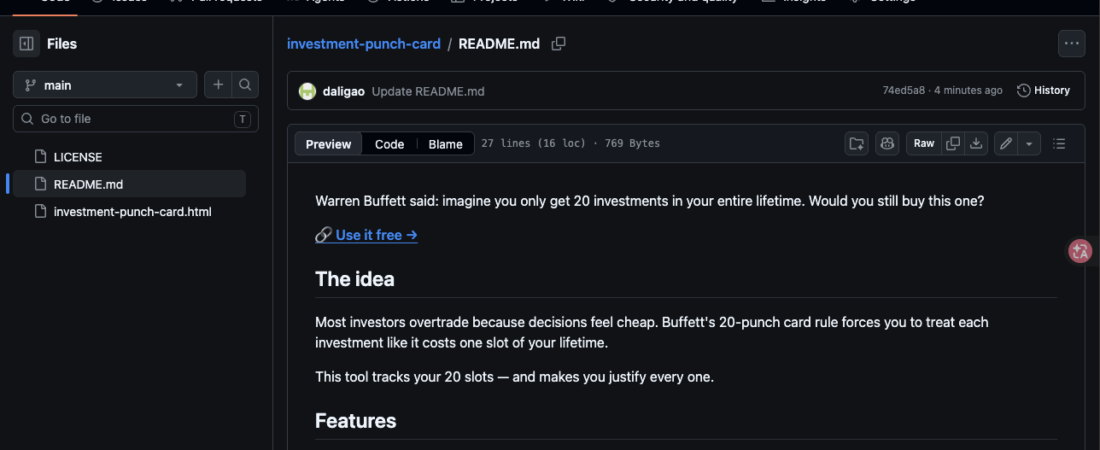
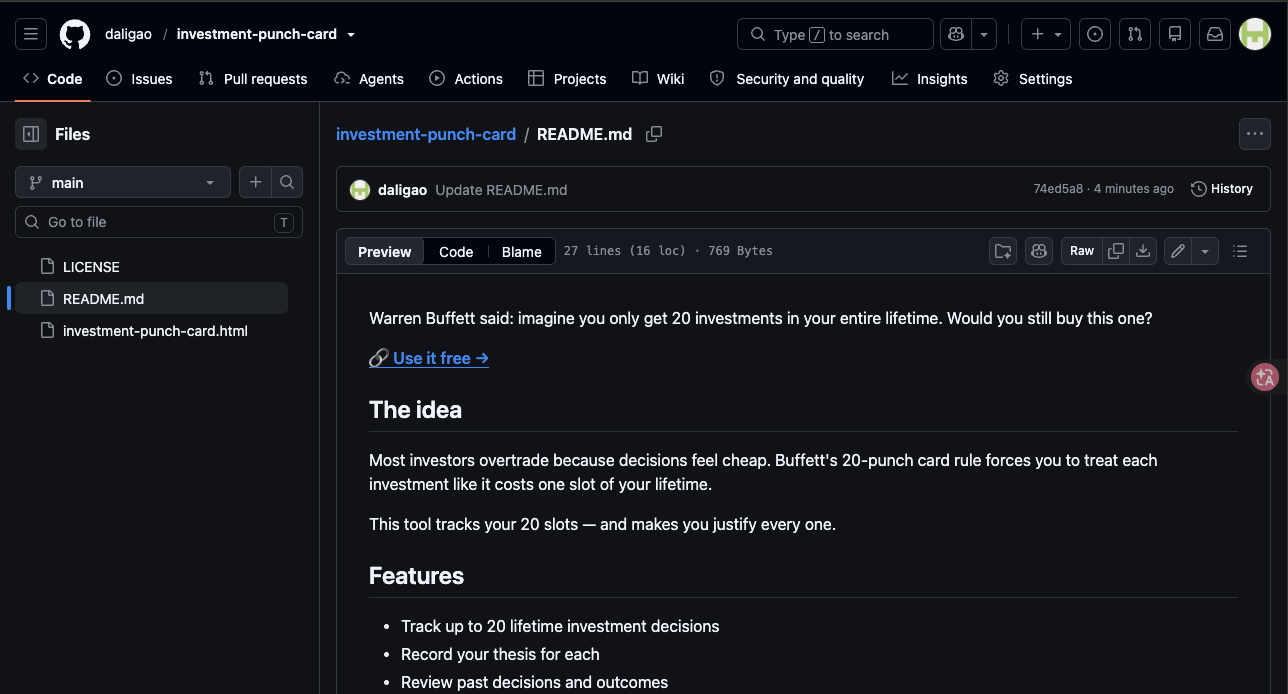
It’s called the Investment Punch Card, and it works like this:
- You have 20 slots — represented visually as holes on a card
- Before you punch a hole, you go through a ritual: Have you slept on this for at least one night? Can you explain the business to a non-investor? Have you written your buy thesis and identified what would prove you wrong?
- Once you punch a hole, it’s permanent — even if you sell the stock later, the slot is spent
- Each hole stores your thesis, your entry notes, and your exit record
The permanence is the point. It’s not a portfolio tracker. It’s a commitment device.
How Many Holes Have I Punched?
I’m going to be honest with you, because that’s the whole point of this blog.
I’ve punched 3 holes so far.
I’ve been investing for about two years. In that time, I’ve rejected dozens of stocks I was “pretty sure about.” Three made it through my own version of the punch card test.
I’m not telling you those three are good investments. I have no idea. The market will decide that.
What I can tell you is this: I know exactly why I own each of them. I wrote it down. I can still explain it today. And none of them were bought because I was bored or anxious or because someone in a group chat said “this one’s going to move.”
That’s new for me.
The Checklist Before I Punch a Hole
I borrowed this from the tool, but here’s what I ask myself before committing to any investment now:
Survival (60 points) — Will this company exist in 10 years? What’s the moat? What’s the worst-case year?
Growth (10 points) — Is there a real reason revenue or earnings could expand?
Culture (10 points) — Do the founders act like owners? Is there evidence they think long-term?
Commitment (10 points) — Am I willing to hold this through a 40% drawdown without panicking?
Resources (10 points) — Do I have enough information to actually form a view, or am I guessing?
The tool requires a score of 95 or above before you can punch. That’s not a typo. Ninety-five.
Most stocks don’t make it.
What I’ve Rejected (And Why That Matters)
Since I started using the punch card framework, I’ve said no to:
- A logistics company that looked cheap but whose moat I couldn’t explain
- A tech stock that was trending in every group chat I’m in (which, in hindsight, should have been a warning sign)
- A company with great products but management I didn’t trust after reading three years of annual reports
None of these were obviously bad investments. They might go up. They might be great.
But I couldn’t reach 95. So I didn’t punch.
The punch card doesn’t tell you what to buy. It tells you when you’re not sure enough to buy.
This Won’t Make You Warren Buffett
I want to be clear about what this tool is and isn’t.
It’s not a prediction engine. It won’t tell you which stocks will go up. It won’t protect you from being wrong — I fully expect some of my three holes to be mistakes I’ll have to live with.
What it does is slow you down at the moment when slowing down is hardest: when you want to buy something.
Buffett’s punch card rule is really a question about conviction. Do you believe in this enough to spend one of your 20 lifetime slots on it?
If the answer is anything other than “yes, absolutely” — then maybe wait.
The Tool Is Free and Open Source
I built this for myself, but it’s available for anyone to use.
It runs entirely in your browser. No login. No data sent anywhere. Your card is stored locally on your device.
The source code is on GitHub if you want to fork it or build your own version:
github.com/daligao/investment-punch-card
Or try it directly on GitHub Pages:
daligao.github.io/investment-punch-card
Related Reading
- What Makes a Stock a 10x Candidate? I Asked AI to Help Me Build a Filter
- Before I Buy a Stock, I Go to the Supermarket
- I Fed 20 Financial Reports to AI. It Ignored My Question and Found a Better One.
🛠 Related Tool
My AI Investment Operating System — Free 5-Step Builder
8 AIs debated investing philosophies across 7 experiments. This free tool turns their consensus into your personalized AI investment coaching system — with a copy-paste Prompt Library.
Build My AI Investment OS →
Leave a Reply