Last week, a friend called me in a panic.
His employer had transferred him from Guangzhou to Shenzhen — 120 kilometers away — without his agreement. When he refused to show up at the new location, the company docked his pay, stopped his social insurance contributions, and eventually kicked him out of the company WeChat groups. He had already filed for labor arbitration. The hearing was in three weeks. His boss had an HR department. He had me.
I am not a lawyer. I am just someone who spends too much time with AI tools — the kind of person who builds AI tutors for his son’s math problems and turns word files into study apps when real specialists feel too expensive or too far away. Apparently, I also write legal defenses now.
So I did what I do: I fed everything into Claude — the arbitration application, the labor contract, the company transfer notice, the email chains, the social insurance records — and started building a defense.
Four hours later, we had a 3,000-word arbitration response that cited specific labor law articles, addressed each of the seven claims point by point, and identified the exact paragraphs in the labor contract that supported the company’s right to reassign him within Guangdong province. I felt genuinely useful. My friend felt genuinely relieved.
Then I read what I had written more carefully.
The defense was good. Maybe too good. And it was written for the company.
Both Sides Get the Upgrade
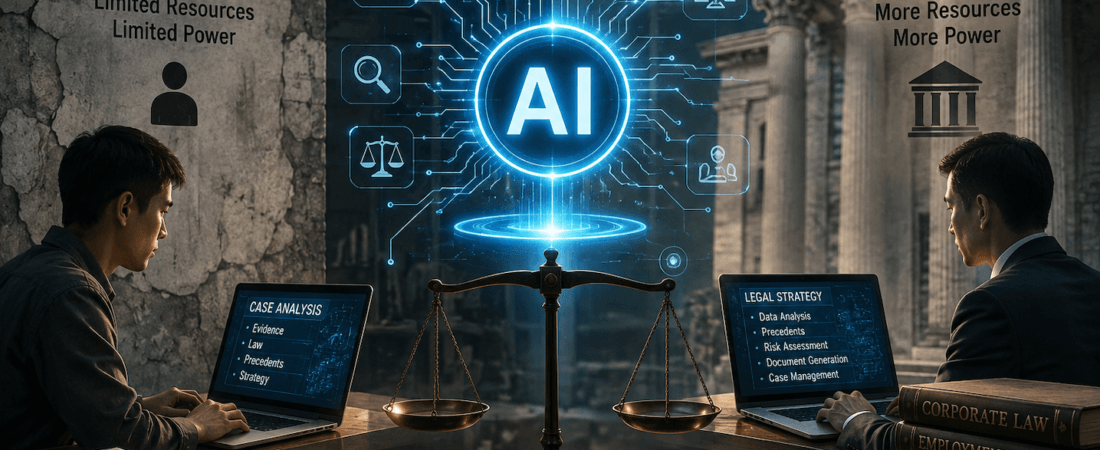
Here is the thing nobody talks about when we celebrate AI democratizing access to legal knowledge: both sides get the upgrade.
My friend could not afford a lawyer. The AI helped him. That is the feel-good version of the story. But his employer — a mid-sized medical equipment company — absolutely can afford lawyers. They also have an HR department that has been preparing documentation since the dispute began. And after this case closes, they will be better at writing transfer notices, contract clauses, and attendance policies that are harder to challenge. Because they will have learned from this fight. With AI helping them learn faster.
The individual goes through this once, maybe twice in a lifetime. The company does it every time an employee pushes back.
That asymmetry does not disappear when AI gets cheaper. It compounds.
The Number That Stayed With Me
I kept thinking about the win probability I estimated while reviewing the case.
If the company supplements the missing two months of social insurance contributions before the hearing — something I flagged as their single most important action — their chances of defeating the economic compensation claim jump to roughly 60 to 70 percent. That felt like good news when I was writing the defense. Then I remembered: I was writing the defense for the company’s side.
The employee in this case might be entirely right on the merits. He did not want to move to another city. He kept showing up to his original office. He documented everything carefully. He filed his arbitration claim within the legal window. He did everything correctly.
And he might still lose — not because he is wrong, but because the company has more time, more money, more institutional memory, and now, increasingly, better AI-assisted preparation.
There is a word for that. It is not justice.
The Slope of the Advantage Curve
To be fair, this is not entirely new.
Wealthy defendants have always had better lawyers. Corporations have always had legal departments. The information gap between employer and employee in a dispute has always been enormous. Someone walking into a labor arbitration without help is not a new problem.
What AI changes is the slope of the advantage curve.
Before, a small company might have had one overworked HR generalist handling disputes badly. Now that same HR generalist has a tireless co-pilot that reads case law, drafts notices with correct legal language, and flags procedural risks before they become liabilities. The floor for institutional competence just rose significantly — and it rose faster for organizations that run disputes repeatedly than for individuals who encounter one once in a decade.
The individual gets a one-time boost. The institution gets a permanent upgrade.
AI is becoming a tool ordinary people can use to solve problems that once required specialists. But the same tool, used systematically by an institution, scales in ways a single person never can.
I Still Do Not Know How This Ends
My friend goes to his hearing soon. He has a solid defense — the one I helped write. He has his documentation. He has the law, which in some respects genuinely is on his side.
But I find myself less excited about the AI-assisted future of legal access than I was four hours into that document session.
Democratizing a tool is not the same as democratizing power. When both a single employee and a corporation get access to the same AI, the party that uses it more often, trains their people on it more systematically, and has the budget to use the best version of it will extract more value. Every time.
The employee might win this round. The company will definitely get better at winning the next one.
That is the uncomfortable thing I keep sitting with. AI did not level this playing field. It just made the game faster — and speed tends to favor whoever was already ahead.
Frequently Asked Questions
Yes — AI can read contracts, identify relevant law, and draft formal responses that would otherwise require a lawyer. In this case, Claude processed over 50 pages of documents and produced a 3,000-word legal defense in four hours. The barrier is no longer access to information. The barrier is whether the other side is using AI even more effectively.
Not entirely. AI can draft arguments and cite law, but it cannot appear in court, read the room, negotiate in real time, or take legal responsibility for advice. It works best as a preparation tool — organizing documents, identifying weak points, and structuring arguments before a hearing. Think of it as a very well-read research assistant, not a licensed advocate.
In one sense, yes. Someone with no legal background can now understand a labor contract, spot procedural mistakes, and draft a credible defense — things that previously required hiring a professional. In another sense, the same accessibility applies to corporations, which use AI more often and more systematically. The gap may narrow at the bottom while widening at the top.
Absolutely, and this is the underreported side of the story. Companies that handle multiple disputes per year can train their HR teams on AI tools, build institutional knowledge, and refine their documentation practices after every case. An individual faces one dispute in a decade. The company faces one every month. Repeated use compounds the advantage in ways a single AI session for an individual cannot match.
Related Reading
- My Friend’s Company Got Hacked: How AI Cut 14-Server Triage from 8 Hours to 40 Minutes
- I Asked 8 AIs: What Will Humans Still Be Better At in 2040?
- I Asked 4 AIs Which One Lies the Most. They Named Names.
- My Son Was Struggling With Math. I Built a Free AI Tutor.
- From 30MB of Word Files to a 400KB App: How AI Changed My Son’s Gaokao Prep
If you have navigated a labor dispute — with or without AI — I would genuinely like to hear how it went. Leave a comment below.
Leave a Reply