My 16-year-old was staring at his physics homework like it owed him money.
Not the answer. The whole problem. He didn’t know where to begin, and I didn’t either — not because the problem was hard, but because neither of us knew what “beginning” even looked like.
I thought about how I used to approach hard problems at his age: skip them, copy someone else’s work, and tell myself I’d understand it “later.” Later never came. I graduated with a vague sense that I was bad at math, which turned out to be partially true and partially a symptom of never having been taught how to actually think through a problem.
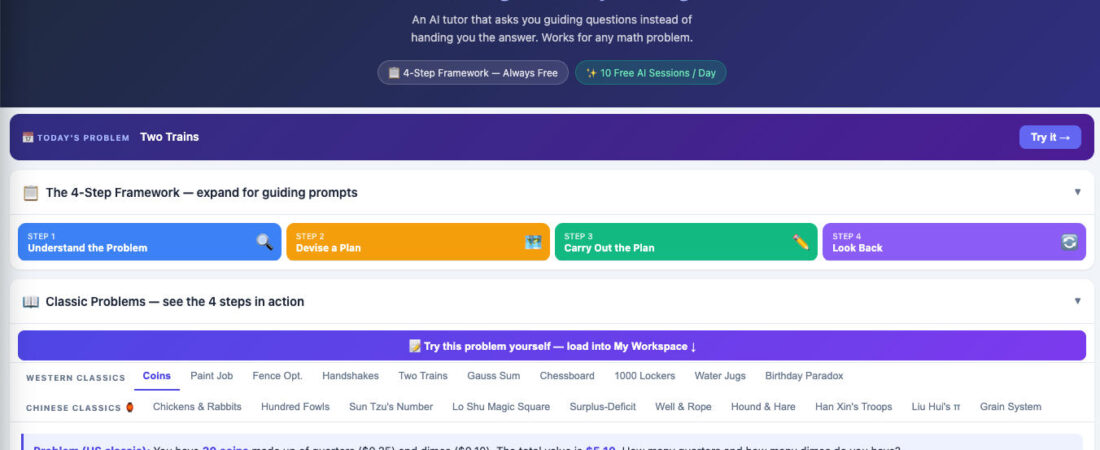
So I did what I do when I want to understand something properly: I started reading. I found a book called How to Solve It by George Polya, a Hungarian mathematician who spent his career thinking about how thinking works. His answer was deceptively simple: four steps. Understand the problem. Make a plan. Carry out the plan. Look back.
That’s it. Four steps. The entire discipline of problem-solving, compressed into one framework that works on math, physics, and honestly most things in life.
I thought: my son needs this. And so does everyone else.
What I Built
I made a free tool called the Polya Method Math Tutor. It has two parts.
Part one is a structured workspace: you paste your problem, then fill in what you understand, what your plan is, what you’ve tried, and what you’d check. The four steps, as a form. No math knowledge required to start — you just have to write something in each box.
Part two is an AI tutor. But here’s the constraint I built in deliberately: it never gives you the answer. You can ask it anything, and it will respond only with questions. “What do you know so far?” “Have you seen a problem like this before?” “What happens if you try a simpler version?”
The AI is wired to behave like a patient senior student — not Google, not Wolfram Alpha, not the back of the textbook.
I also added 20 classic problems with full worked solutions: ten Western classics (Gauss’s sum, the Birthday Paradox, the Locker Problem) and ten ancient Chinese problems that most English-language math sites have never touched — Chickens & Rabbits from 300 CE, Han Xin’s Troop Count, Liu Hui’s approximation of π from 263 CE, and the world’s first recorded use of Gaussian elimination, from China, about 2,000 years before Gauss.
I made it, tested it with my son, then uploaded it. Then I did something interesting: I asked two different AIs to review it.
The Chinese AI’s Take
I showed the tool to Doubao, one of China’s leading AI assistants. Its analysis was sharp. It opened with: “The concept is solid. But the product is missing its conversion funnel.”
From there it evaluated the tool as if I were building a SaaS business:
- The daily session limit (10 free AI sessions per day) creates friction without a paid tier to absorb it — so I’m losing users with nowhere to upgrade them
- There’s no progress system, no achievement layer, no “teacher mode” for premium users
- The “More free tools” link in the footer is invisible and will convert at near-zero
Its final verdict: “As an SEO asset, already qualified. As a monetizable SaaS product, still missing the conversion path and core experience loop.”
All of this was completely correct — and completely beside the point for what I was building.
The American AI’s Take
The AI I used to build the tool (Claude, made by Anthropic) had a different read. When I shared the same feedback, it focused on:
- How to make the tool more useful for the user who’s already there
- LocalStorage so your work doesn’t disappear if you close the tab
- A “Problem of the Day” to give people a reason to come back without needing a login
- A print button so teachers and parents can turn it into a paper worksheet
- A share button so someone who solved a problem can copy their four-step reasoning and send it to a friend
None of these suggestions involved a paywall. The entire direction was: make the free thing better and more shareable.
What the Disagreement Reveals
Here’s what’s interesting: both AIs were giving me correct advice — just for different tools.
Doubao assumed I was building a product. It evaluated my decisions through the lens of “is this a viable business?” and found them wanting. It was doing exactly what a good product advisor would do.
Claude assumed I was building a resource. It evaluated my decisions through the lens of “does this help the person using it?” and found ways to improve.
The same tool. Two completely different success metrics.
I’ve been thinking about this a lot. It’s not really a China vs. America thing — it’s more about context. The Chinese internet ecosystem runs on super-apps and subscription funnels; naturally, an AI trained in that context looks at any tool and asks “where’s the business model?” American tech culture has its own obsession with growth and retention, but the open-source and free-tools tradition is strong enough that “make a good thing and share it” is still a recognized play.
I also think there’s something personal here. I’m building this because my son needed it, and I figured other people might too. I’m not trying to build a business out of it. That context matters — and the AI that helped me build it understood that context, while the AI I showed it to afterward didn’t have that context and applied a different frame.
Neither of them was wrong. I just needed to know which frame fit my situation.
What I’m Actually Trying to Do
The tool is free. The 10-session daily limit is there because the AI calls cost real money per request, and without some limit I’d be paying for everyone’s homework indefinitely. It’s not a monetization strategy; it’s a cost-control decision.
My son, meanwhile, has started using it for actual homework. Not every day. Not perfectly. But when he’s stuck on a problem and staring at it blankly, he now has a slightly better process than “give up.” He pastes the problem, tries to write something in box 1, and usually by the time he reaches box 2 he’s figured out at least part of it himself.
That’s the whole point.
I translated the thing into English not because I had a grand plan but because if a framework is useful, it probably doesn’t need to be in Chinese to be useful. The 20 problems include ones I grew up hearing about — Chickens & Rabbits, Han Xin’s army — and I’ve never seen them properly documented in English before. So now they are.
If you’re a teacher who wants to print a worksheet: there’s a print button.
If your kid is stuck on something: there’s an AI that will ask them questions instead of doing their homework.
If you’re a Chinese AI looking for the subscription upsell: I’m sorry, there isn’t one.
Related Reading
- What Good Math Education Actually Looks Like — Based on Jo Boaler’s Research
- Polya’s How to Solve It on Wikipedia
Try the Tools Mentioned in This Post
- Polya Method Math Tutor — Free. 20 classic problems including 10 ancient Chinese classics. AI that asks questions, never gives answers.
- Mathematical Mindsets Guide — Based on Stanford Professor Jo Boaler’s research on why math education fails most students.
Leave a Reply