
Mike Tyson earned an estimated $400 million during his boxing career. At his peak, he was the highest-paid athlete on the planet. By 2003, he had filed for bankruptcy.
Allen Iverson made $154 million in NBA salary alone — not counting endorsements. By his mid-forties, he was reportedly unable to afford basic expenses.
These aren’t edge cases. Studies consistently show that a significant percentage of professional athletes face serious financial distress within two years of retirement. The money was real. The outcomes were catastrophic. And in almost every case, the collapse wasn’t caused by one catastrophic mistake — it was caused by a sequence of individually reasonable-looking decisions that compounded badly.
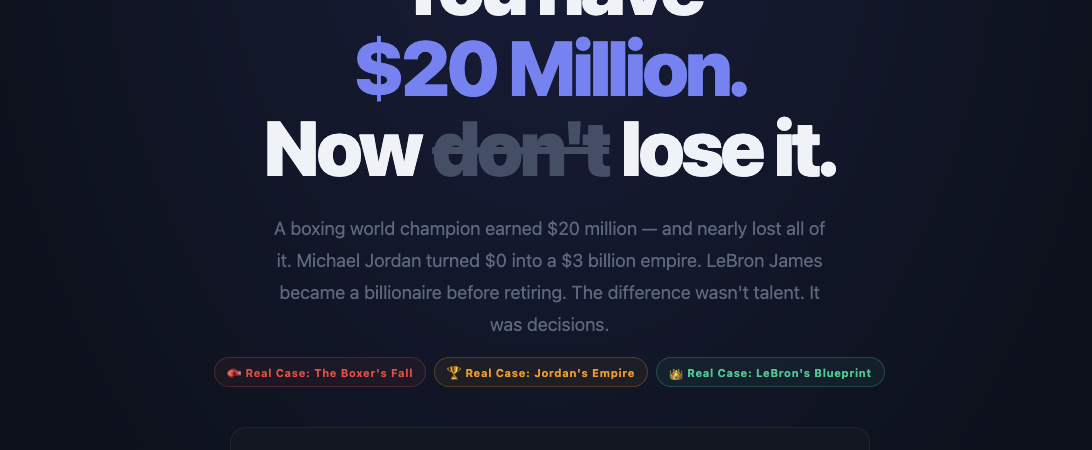
I built a simulator to explore exactly that sequence. You start with $20 million. You make five decisions. Then you see where you end up.
Why Athletes Keep Going Broke (And Why It’s Not About Stupidity)
The conventional narrative about athlete bankruptcy is that it’s a failure of intelligence or character. That’s wrong, and it misses the actual mechanics of the problem.
Most professional athletes come from backgrounds where $20 million is an abstraction so large it might as well be infinite. The real financial education they receive during their career comes from agents, financial advisors, and entourages — many of whom have misaligned incentives. An advisor who earns a percentage of assets under management benefits from you deploying capital into complex vehicles, regardless of whether those vehicles are right for your situation.
Add to this the psychology of sudden wealth: the pressure to support family, the lifestyle expectations that come with fame, the near-total absence of financial education in professional sports, and the compressed career window that makes everything feel urgent. The decisions that look foolish in retrospect often felt like the only reasonable options at the time.
This is the environment I tried to recreate in the simulator. Not “here’s a quiz with obvious right answers,” but “here’s the actual pressure, the actual competing demands, the actual information asymmetry — what do you do?”
The Five Decision Points
The simulator is structured around five decisions that mirror the real inflection points in athlete financial histories:
The Big Launch. You’ve just retired. Your advisor is pitching you on three different deployment strategies for the $20M: a signature gym business, a real estate portfolio, or a diversified index fund approach. The gym has the highest upside and the highest risk. The index funds feel boring. The real estate is somewhere in between. What you choose here affects everything that follows.
The Team. Someone needs to manage your money. Do you hire a celebrity financial manager who handles other athletes and charges premium fees? A lower-profile but technically strong advisor? Or do you try to manage it yourself with a simple system? The right answer depends on your financial knowledge and your ability to stay engaged — and most people overestimate both.
The Opportunity. A “can’t miss” investment opportunity arrives. A friend from your playing days is launching a restaurant chain and needs an equity partner. The returns could be exceptional. The failure rate for celebrity-backed restaurants is also exceptional. This is where the real-world cases diverge most sharply: the athletes who said yes are in the bankruptcy filings; the ones who said no are the ones who still have money.
The Pressure Point. A family situation or lifestyle expansion creates immediate cash demand. Do you liquidate investments at an unfavorable moment, take on debt, or restructure? This decision forces you to confront the difference between illiquid wealth (assets on paper) and liquid cash (money you can actually spend), a distinction that has destroyed more wealthy people than almost any other.
The Long Game. Twenty years after retirement, with your earning years long behind you, you face the compound consequences of every previous decision. The ending you reach — one of six possible outcomes — is determined entirely by the cumulative logic of your earlier choices.
The Real Cases Behind the Simulator
Every decision in the simulator is grounded in documented real-world outcomes. A few examples:
Mike Tyson’s spending velocity: At peak earnings, Tyson was reportedly spending $400,000 per month on personal expenses — a Bengal tiger cost him $70,000 to purchase and tens of thousands more to maintain annually. The issue wasn’t the income; it was the complete absence of a system to manage outflows relative to the inevitable end of high earning years. The simulator’s burn rate mechanics are directly inspired by this pattern.
Allen Iverson’s loyalty cost: Iverson was known for carrying an entourage of 50+ people, covering expenses for family and childhood friends. The loyalty was admirable; the structure was financially unsurvivable. When his career ended, the infrastructure he’d built couldn’t be sustained on retirement income. The simulator’s “team” decision captures this exact trade-off.
The restaurant investment pattern: Celebrity restaurant investments have a failure rate significantly higher than the general restaurant failure rate. The combination of high startup costs, thin margins, complex operations, and the celebrity premium on everything from real estate to staffing creates a structural disadvantage. Yet athlete investors keep entering this market, often because the social dynamics — appearing successful, supporting community — make the investment feel like the right call regardless of the economics.
P2P lending exposure: Some athletes in the 2010s were directed by advisors into peer-to-peer lending platforms that offered high yields but carried default risk that wasn’t clearly disclosed. When loan defaults increased, the portfolios collapsed faster than traditional investments would have. The simulator includes a version of this event as a random risk.
What the Data Says About the Right Answers
Across the documented cases of both athlete financial success and failure, a few patterns emerge consistently:
Complexity is the enemy. The athletes who maintained wealth overwhelmingly used simple, boring structures: index funds, diversified real estate in familiar markets, minimal leverage. The ones who lost everything were almost always in complex structures — multiple business ventures, leveraged positions, illiquid alternatives — that they didn’t fully understand.
The lifestyle lock-in happens fast. Once you’ve lived at a certain level — certain neighborhoods, schools for children, family expectations — the cost to maintain it becomes sticky even as income disappears. Every financial decision made during peak earning years implicitly determines the baseline cost of living for decades afterward.
The best advisors cost more in fees and less in outcomes. The athletes with the best long-term financial outcomes tended to use fee-only advisors (who charge a flat fee regardless of assets managed) rather than commission-based advisors. The fee-only structure removes the incentive to recommend complex products.
Equity compounds; income streams stop. The single biggest structural difference between athletes who maintain wealth and those who don’t is whether they converted income into equity positions during earning years. Real equity — ownership stakes in businesses, real estate purchased and held — generates returns that don’t depend on continued performance. Spending income on lifestyle generates nothing.
Three Characters. Three Very Different Outcomes.
The simulator gives you three starting archetypes, each based on a different real psychological profile I saw in the case studies:
The Champion — instinct-driven, trusts gut over spreadsheets, values loyalty heavily. High risk of entourage-related financial strain. Also high potential upside if instincts happen to align with fundamentals.
The Strategist — equity-focused, reads term sheets, asks questions advisors don’t expect. Lower risk of catastrophic loss. Also lower peak outcomes because they’re inherently skeptical of high-upside opportunities.
The Empire Builder — wants compounding, thinks in decades, willing to sacrifice liquidity for ownership. The profile most aligned with how wealth actually grows — also the most demanding to execute correctly, because it requires patience that’s almost impossible to maintain when you’re surrounded by people expecting you to spend.
Different characters hit different decision branches. The same decision that’s clearly right for a Strategist might be wrong for a Champion — not because the math is different, but because the psychology is. This was intentional: the point isn’t to find the “correct” path, it’s to understand which type of thinking your natural instincts map to, and what the downstream consequences of that thinking tend to be.
Related Reading
- AI Startup Simulator — Same format: real cases, 5 decisions, 5 endings. You raised $10M from a16z. Can you avoid becoming the next Builder.ai?
- $20M Investment Simulator — The tool this post is about.
The uncomfortable truth that both Mike Tyson’s story and the simulator both reveal: the problem was never intelligence. It was the absence of a structure that made good decisions the path of least resistance rather than the path of most effort.
Most of us will never have $20 million. But the decision patterns — spend versus invest, complexity versus simplicity, loyalty versus financial discipline — scale down perfectly to any income level. The people who end up financially secure in their seventies made different habits, not different amounts of money.
Try the simulator and see which ending you get. Most people don’t end up where they think they will.
🛠 Related Tool
My AI Investment Operating System — Free 5-Step Builder
8 AIs debated investing philosophies across 7 experiments. This free tool turns their consensus into your personalized AI investment coaching system — with a copy-paste Prompt Library.
Build My AI Investment OS →
Leave a Reply