I almost built a visa website. Then I spent $11 on a hot pot domain instead.
Every time I finish one website, I can’t help but start thinking about the next one.
So far, I’ve built three:
ChineseFortuneTools.com — a collection of tools for exploring Chinese traditional culture, including the Chinese zodiac, BaZi, Feng Shui, lunar calendar, lucky dates, and other interactive tools.
ChineseNameCraft.com — a Chinese name generator designed to help foreigners create meaningful Chinese names using Chinese naming traditions, character meanings, Five Elements, Feng Shui, and AI.
ChinaRules101.com — a practical guide to Chinese social rules, etiquette, customs, relationships, dating, family, business culture, and all the little things that foreigners may not learn from a textbook.
At this point, I already have several websites trying to answer different questions about China:
- Chinese culture
- Chinese names
- Chinese social rules
- Chinese fortune-telling and traditional culture
- And a few experiments around making money online
So naturally, I started asking the dangerous question:
What should the next website be?
I spent a surprisingly long time discussing this with AI.
And the answer kept changing.
The Missing Website
At first, I thought the next site should be something much more practical.
We considered several ideas.
ChinaWords101
The idea was simple:
Explain Chinese words, slang, internet expressions, food terms, and everyday phrases to foreigners.
It sounded great at first.
The amount of content is basically unlimited.
“内卷.”
“躺平.”
“破防.”
“上头.”
“凡尔赛.”
“社恐.”
And then there are thousands of food names, cultural expressions, relationship terms, workplace phrases, and internet memes.
The problem?
The more I thought about it, the more it started looking like a dictionary.
And dictionaries are useful.
But useful doesn’t necessarily mean profitable.
Someone searching for:
What does 内卷 mean?
might read the explanation and leave.
They probably aren’t going to buy a Chinese name.
They probably aren’t going to pay $9.99 to learn more Chinese social rules.
That made me hesitate.
I didn’t want another website that mainly creates pages because I can create pages.
I wanted a website where the user’s search could naturally lead to a commercial decision.
Then There Was ChinaEntry101
This one was much more interesting.
ChinaEntry101.
The concept was:
Everything foreigners need to know about entering China.
Visas.
Entry requirements.
Border procedures.
Travel documents.
Transit.
Customs.
Mobile payments.
SIM cards.
Transportation.
And eventually all the annoying questions foreigners actually have before coming to China.
From a business perspective, I liked it.
A lot.
Because the user intent is extremely valuable.
Someone searching:
China visa requirements
isn’t casually browsing.
They have a problem.
They may be planning a trip.
They may be moving to China.
They may be coming for business.
They may need a hotel, insurance, flights, tours, transportation or other services.
That’s exactly the kind of traffic you want if you’re trying to build a business.
But there was another problem.
Information maintenance.
China entry rules change.
Visa policies change.
Transit policies change.
Airlines change requirements.
Different nationalities have different rules.
Different entry situations can have different requirements.
Suddenly I wasn’t just building a website.
I was volunteering to become a part-time China immigration information department.
And I’m one person.
I don’t have a research team checking government websites every morning.
So ChinaEntry101 went into the “maybe later” folder.
Then We Started Talking About Food
At some point I brought up something much more familiar:
Chinese hot pot.
I’ve eaten it.
I’ve watched people eat it.
I’ve bought the ingredients.
I’ve seen how much food goes into the pot.
And most importantly, I realized something:
Chinese hot pot isn’t just a dish.
It’s almost an entire ecosystem.
There are:
- soup bases
- beef
- lamb
- seafood
- mushrooms
- vegetables
- tofu
- noodles
- dipping sauces
- hot pot cookers
- utensils
- restaurants
- regional styles
- different cooking techniques
And then there is the enormous question foreigners have:
What exactly am I looking at?
What is 毛肚?
What is 鱼豆腐?
What is 黄喉?
Why are people putting lotus root in boiling soup?
How long should I cook this?
What kind of hot pot should I try?
What ingredients should I buy?
Can I make it at home?
Where can I buy the ingredients?
Suddenly I saw something that ChinaWords101 didn’t quite have.
Commercial intent.
The “What Should I Buy?” Question
Imagine someone discovers Chinese hot pot for the first time.
They search:
Chinese hot pot
Then:
Chinese hot pot ingredients
Then:
best hot pot soup base
Then:
hot pot cooker
Then:
where to buy hot pot ingredients
That’s a completely different user journey from someone searching for the meaning of a Chinese slang word.
The user is moving toward a purchase.
And that is where the idea became much more interesting.
What if the website didn’t just explain hot pot?
What if it helped someone actually make one?
We Started Thinking Bigger
The original idea was something like:
ChinaHotPot101.com
It was clear.
It explained exactly what the website was about.
But then I asked the AI team:
Is there a shorter domain?
We started looking.
And then something happened that I wasn’t expecting.
hotpot101.com Was Available
was available.
And not for some crazy premium-domain price.
The normal registration price was around $11.
I checked again.
Still available.
I checked the domain history.
Nothing obviously scary jumped out.
Then I thought:
Wait.
Why hasn’t somebody already registered this?
It was exactly the kind of moment where you start wondering whether you’re missing something.
Maybe there’s a reason.
Maybe the keyword isn’t valuable.
Maybe the competition is too strong.
Maybe the domain is worthless.
Or maybe…
someone simply hadn’t taken it yet.
So I Bought It
I bought:
HotPot101.com
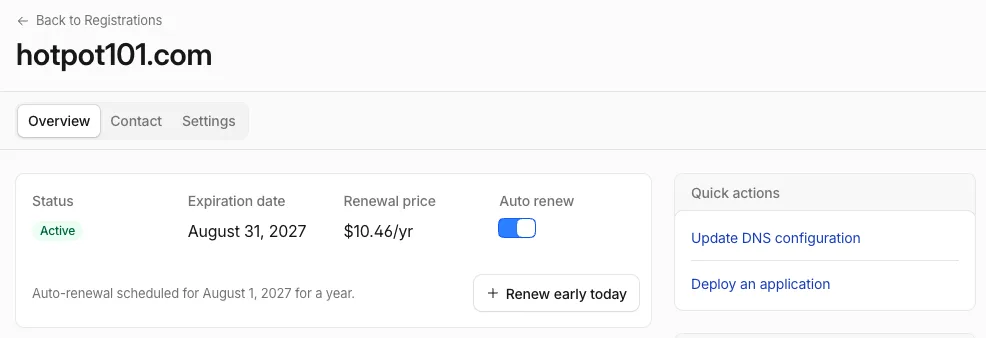
For roughly $11.
At that moment, the project changed.
It was no longer:
“Maybe I’ll build a hot pot website.”
It became:
“Okay. Now I have to see what I can actually build with this.”
And that’s where HotPot101 started becoming much more interesting.
What Will HotPot101 Actually Be?
I don’t want it to become another recipe blog.
There are already plenty of those.
I also don’t want it to become a giant encyclopedia that nobody reads.
The direction I’m considering is much closer to a:
Chinese Hot Pot Discovery Platform
The basic journey would be:
Discover → Understand → Choose → Buy → Cook → Eat
For example, imagine someone searches for:
What is maodu?
HotPot101 could explain:
Maodu (毛肚)
Beef tripe.
Then show:
- what it is
- what it tastes like
- its texture
- how long to cook it
- which broth works best
- whether beginners should try it
- what similar ingredients are available
And then:
Where can I buy it?
That’s where content becomes commerce.
The First Tool I Want to Build
One of the ideas I’m most excited about is:
Hot Pot Ingredient Decoder
Imagine seeing a Chinese hot pot menu for the first time.
You see:
毛肚
You have no idea what it means.
You enter it into HotPot101.
The website explains it in plain English.
But I don’t want to stop at translation.
It could tell you:
Texture: Very crunchy
Flavor: Mild
Cooking time: About 10–20 seconds
Best with: Spicy Sichuan broth
Beginner friendly: Yes, if you like crunchy textures
That is much more useful than a dictionary.
Then There Is the Slightly Crazy One
Can I Hot Pot It?
This idea came from one simple observation:
Almost anything can go into a hot pot.
Okay, maybe not literally everything.
But a surprising number of things work.
So imagine typing:
Cheese
And HotPot101 answers:
Can you hot pot cheese?
🟡 Technically yes.
Then it explains:
- whether it’s traditional
- whether it works
- how to cook it
- which broth to use
- what alternatives might be better
Try:
Corn
Ramen
Dumplings
Lobster
Broccoli
Spam
Egg
That could become a fun little feature.
And maybe, more importantly, something people actually share.
The Bigger Idea: Build My Hot Pot
This is where I think the site could eventually become a real business.
Imagine a visitor clicks:
Build My Hot Pot
The site asks:
How many people?
2.
How spicy?
Very spicy.
Meat or vegetables?
Mostly meat.
Experience?
First time.
Then it generates:
Your Hot Pot
Broth
Sichuan Mala
Meat
- Beef slices
- Lamb
Vegetables
- Napa cabbage
- Lotus root
- Enoki mushrooms
Noodles
Sweet potato noodles
Dipping Sauce
Sesame + garlic + soy
And then:
Your Shopping List
Including recommended products and where to buy them.
Now we have something much more interesting than an article.
We have a decision-making tool.
And That’s Where the Money Could Come From
I’m not pretending I know yet how much this website will make.
I don’t.
That’s the whole point of the experiment.
But the potential business model is much clearer than it was with some of the other ideas.
Affiliate
Hot pot cookers.
Soup bases.
Sauces.
Utensils.
Ingredients.
Noodles.
Starter kits.
Later
Premium AI tools.
Party planners.
Shopping list generators.
Restaurant discovery.
Travel recommendations.
Potential partnerships.
The important thing is that the user’s intent naturally moves toward spending money.
There’s Another Part I Like
Chinese hot pot isn’t just Sichuan hot pot.
China has an enormous variety of regional styles.
Sichuan.
Chongqing.
Chaoshan beef hot pot.
Beijing copper-pot hot pot.
Yunnan mushroom hot pot.
Coconut chicken hot pot.
Cantonese styles.
And many more.
So HotPot101 could eventually become a map of Chinese hot pot.
Click a region.
Learn the style.
Discover the ingredients.
Find restaurants.
Learn how to make it at home.
And maybe eventually plan a trip around it.
Why I Think This Project Is Different
I’ve built websites before where the main question was:
What content can I create?
This time I’m trying to start with a different question:
What problem can I solve?
A foreigner discovers Chinese hot pot.
They don’t know what anything is.
They don’t know what to order.
They don’t know what to buy.
They don’t know how long to cook it.
They don’t know which soup base to choose.
They don’t know where to find the ingredients.
That’s a real problem.
And there are many ways to solve it.
But I Have No Idea If Google Will Like It
This is the part I can’t predict.
The domain is great.
The idea is interesting.
The commercial possibilities are there.
But none of that guarantees traffic.
Google doesn’t care that I like the domain.
Google doesn’t care that I spent $11.
Google doesn’t care that several AIs thought it was a good idea.
The website still has to earn its place.
That’s what makes this experiment interesting.
So This Is Going To Be a Bigger Project
I’m not planning to throw 500 AI-generated articles onto it.
The first version will probably focus on:
- high-quality ingredient guides
- hot pot styles
- home cooking
- shopping guides
- interactive tools
- restaurant discovery
- strong internal linking
- useful visual content
And then I’ll watch the data.
What does Google show?
What do people search?
Which pages get impressions?
Which tools get used?
Do people click shopping links?
Do people come back?
Does anyone actually care?
Those answers will determine what I build next.
The Next Experiment Begins
So the website that almost became:
ChinaWords101
didn’t happen.
The website that looked potentially more profitable:
ChinaEntry101
also didn’t happen.
Instead, I ended up buying:
HotPot101.com
for about $11.
Now comes the hard part.
Building it.
Getting it indexed.
Getting someone to visit.
Getting someone to actually use it.
And eventually…
maybe getting someone to buy something.
I have no idea where this experiment will end.
But that’s exactly why I want to build it.
Let’s see what happens.
Next on Ordinary Man Trying
I’m going to document the actual build of HotPot101:
- the website architecture
- the database
- the AI tools
- the SEO strategy
- the first 50–100 pages
- the shopping/affiliate strategy
- the launch
- and, most importantly, the Google Search Console data
If you want to see whether an $11 domain can turn into a real website business, follow along.
The next post will be about how I’m actually going to build HotPot101 from scratch.
The first thing I’m building is the Ingredient Decoder. If that doesn’t get any traction, I’ll know pretty quickly.
Leave a Reply