Thirty days ago, I launched this blog with no audience, no backlinks, and no idea what I was doing.
Last week, I thought I had killed it.
I stared at Google Search Console showing a total of 3 clicks over 28 days, and wondered if I had made a catastrophic mistake that search engines would never forgive.
Then I asked AI. And it told me something I didn’t expect.
But before I get to that — here’s the full self-diagnosis. Real numbers, three search engines, one very embarrassing mistake, and what I’m actually going to do about it.
The 30-Day Traffic Report (Google Analytics)
First, the raw numbers. Period: June 17 – July 15, 2026. 28 days.
| Metric | Number |
|---|---|
| Active users | 484 |
| Page views | 2,439 |
| Pages per session | 5.04 |
| Average engagement time | 1 min 8 sec |
| Total events | 5,685 |
484 users in 30 days. Not viral. Not dead either.
But the traffic sources tell a more interesting story.
Where Did the Traffic Actually Come From?
| Source | Active Users | Share |
|---|---|---|
| Direct (link sharing, bookmarks) | 416 | 86% |
| Bing organic search | 33 | 6.8% |
| GitHub referral | 17 | 3.5% |
| 4 | 0.8% | |
| Yandex | 4 | 0.8% |
| Google organic search | 1 | 0.2% |
Yes. One user from Google in 28 days.
Meanwhile, Bing sent 33. That’s 33× more organic traffic than Google — from a search engine most people think is irrelevant.
86% of traffic came direct: people clicking links I shared, or bookmarks. That’s not SEO. That’s me manually distributing my own content. Not scalable, but it kept the lights on while the search engines made up their minds.
The Mystery: Warsaw, Poland
When I looked at the city breakdown, the top result surprised me:
| City | Users |
|---|---|
| Warsaw, Poland | 91 |
| Boardman, Oregon (AWS data center) | 34 |
| Aspen, Colorado | 18 |
| Frankfurt | 17 |
| Guangzhou | 8 |
| Shenzhen | 8 |
Warsaw is my #1 city. 91 users — nearly 19% of all traffic — from Poland. I still don’t fully understand why. My best guess: something I put on GitHub got shared in a Polish tech community. If you’re reading this from Warsaw, genuinely curious how you found me.
(Boardman, Oregon is where Amazon runs data centers. Those 34 “users” are bots. I’m not counting them as wins.)
What People Actually Read
| Page | Views |
|---|---|
| Homepage | 607 (25%) |
| Tools index | 336 (14%) |
| Building in public experiment | 136 |
| Wander China planner | 123 |
| Major Vote (English) | 97 |
| Major Vote (Chinese) | 55 |
People came for the tools more than the writing. The Wander China trip planner and the Major Vote tool together pulled nearly 300 views. The building-in-public experiment post got 136 views, which surprised me. People do want to watch the experiment unfold.
The article with the longest average reading time? A piece about fixing my kitchen exhaust fan with AI help: 13 minutes 37 seconds. Two people read it from start to finish. That made my day.
The Google Story: 3 Clicks, a Sandbox, and a Panic Attack
Here’s what Google Search Console actually showed me over 28 days:
- Total clicks: 3
- Total impressions: ~140
- Pages indexed (site:ordinarymantrying.com): 4
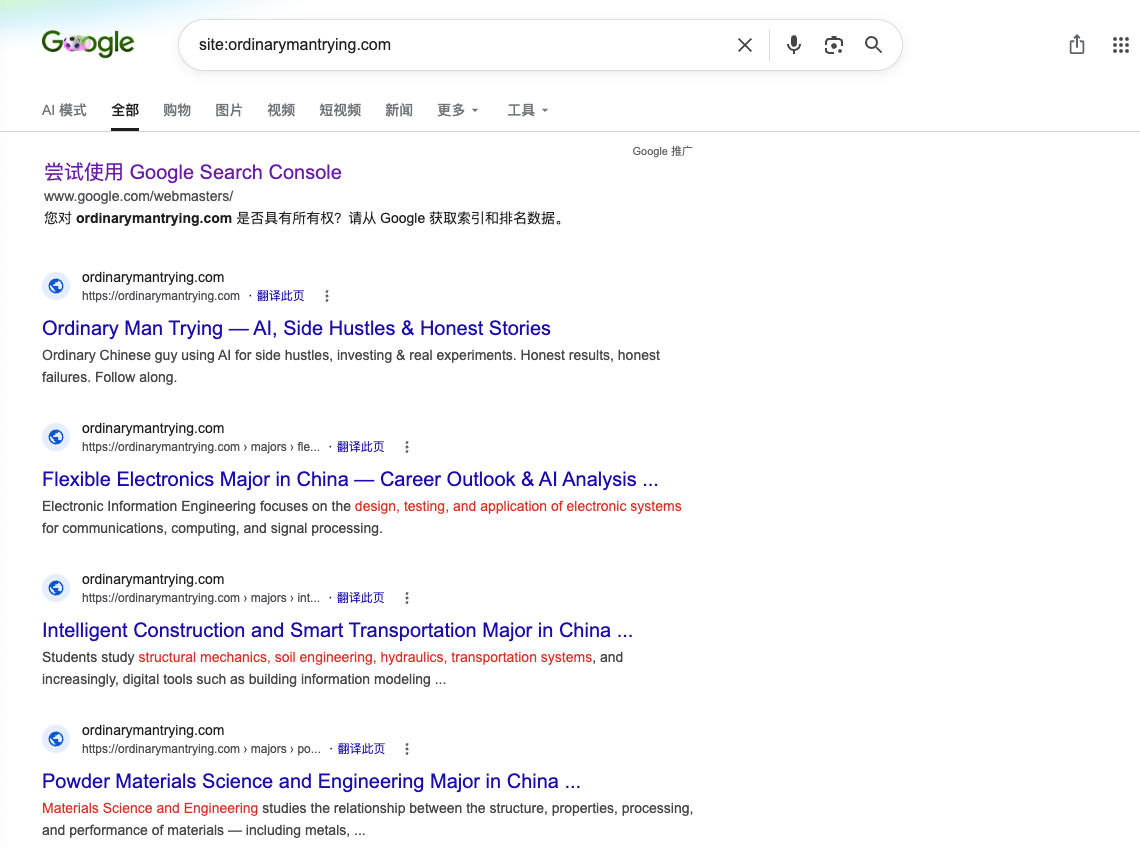
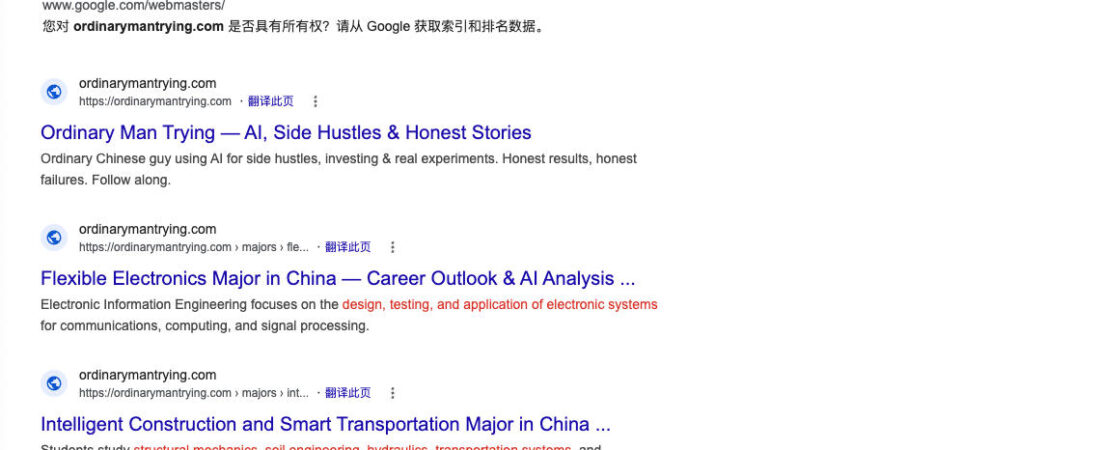
Four pages. Homepage, and three pages about obscure Chinese university majors (Flexible Electronics, Intelligent Construction, Powder Materials Science). That’s what Google decided to keep of the entire site.
But the timeline was what really scared me.
The Traffic Timeline
| Period | Daily Impressions | What Was Happening |
|---|---|---|
| June 18–20 | 4–8 | Google discovers the site |
| June 21–23 | 16 → 43 | Peak — Google testing the content |
| June 24 onward | Drops to 1–5 | Impressions collapse |
| July 4–8 | 0 | Five days of complete silence |
| July 9–13 | 1–6 | Slight recovery |
Google noticed me, got excited for a moment (43 impressions on June 23rd), and then went quiet for five straight days. When it came back, it brought almost nothing.
The Content Farm Mistake
A few weeks before I launched this blog, I had built a Chinese-language tool to help high school students pick university majors — 757 individual pages, one for each accredited major in China. It was genuinely useful content, with AI disruption scores, salary data, and career paths.
Then I translated the whole thing into English.
757 English pages about Chinese university majors, published all at once, with very similar structures. Pages like:
- Flexible Electronics Major in China — Career Outlook & AI Analysis
- Powder Materials Science and Engineering Major in China
- Intelligent Construction and Smart Transportation Major in China
To a human reader, these are useful reference pages. To a Google algorithm looking at a brand-new site that just published 757 templated pages in a short period, this probably looked exactly like a content farm.
The impressions peak on June 23rd was Google briefly surfacing some of those pages. The collapse afterward was Google pulling back.
When I saw the five days of zero impressions, I genuinely panicked. I asked AI: “Is my website dead? Did I make a mistake that can’t be fixed? Is a month of work wasted?”
The answer: not dead. Recoverable. But I had to stop adding thin templated content and focus on things Google could trust — original writing, real experience, content that no one else could replicate.
That conversation changed how I think about this whole project.
The Bing Story: The Search Engine That Actually Helped
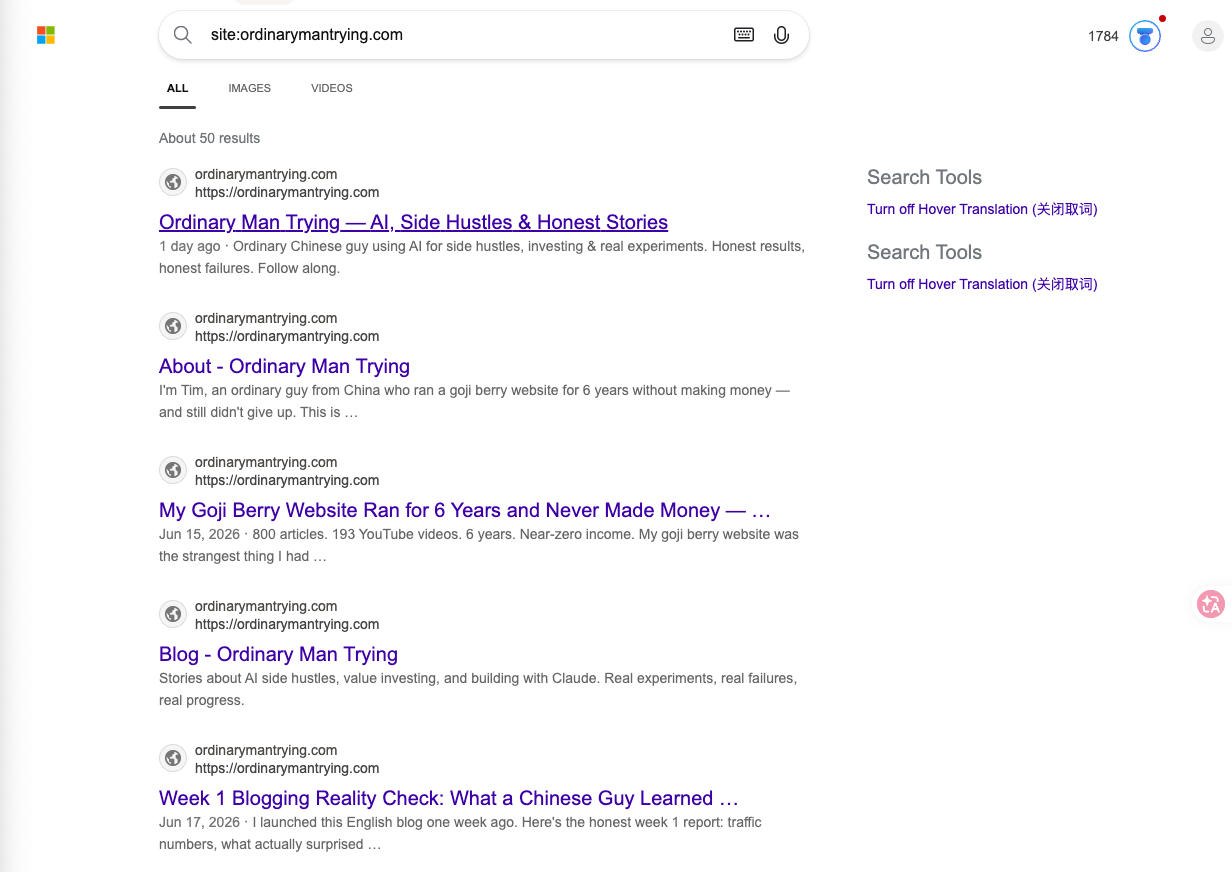
Bing indexed about 50 pages in 28 days and sent me 33 users. That’s not much in absolute terms, but relative to Google’s 1 user, it felt like a lifeline.
More importantly: Bing told me what was wrong.
Bing Webmaster Tools gave me specific technical warnings that Google never mentioned:
- H1 tags too long on several pages
- Meta descriptions too long — getting cut off in search results
- Broken links — old URLs that no longer pointed anywhere
I found five dead links in my own content, pointing to old paths like /investment-punch-card/investment-punch-card.html (the tool moved to /tools/investment-punch-card.html months ago, but the old links never got updated). Fixed all of them with 301 redirects in the same week.
Bing’s best performing keyword for me: “recent 2026 gaokao english paper” — position 2, with a 50% click-through rate. Small number, but it showed me what the content’s real audience is.
My takeaway on Bing: for a new site, Bing is faster to index, faster to give feedback, and more transparent about what it wants. It’s not where most of your audience will eventually come from — but in the first 90 days, it’s genuinely useful.
The Yandex Story: The Tireless Crawler
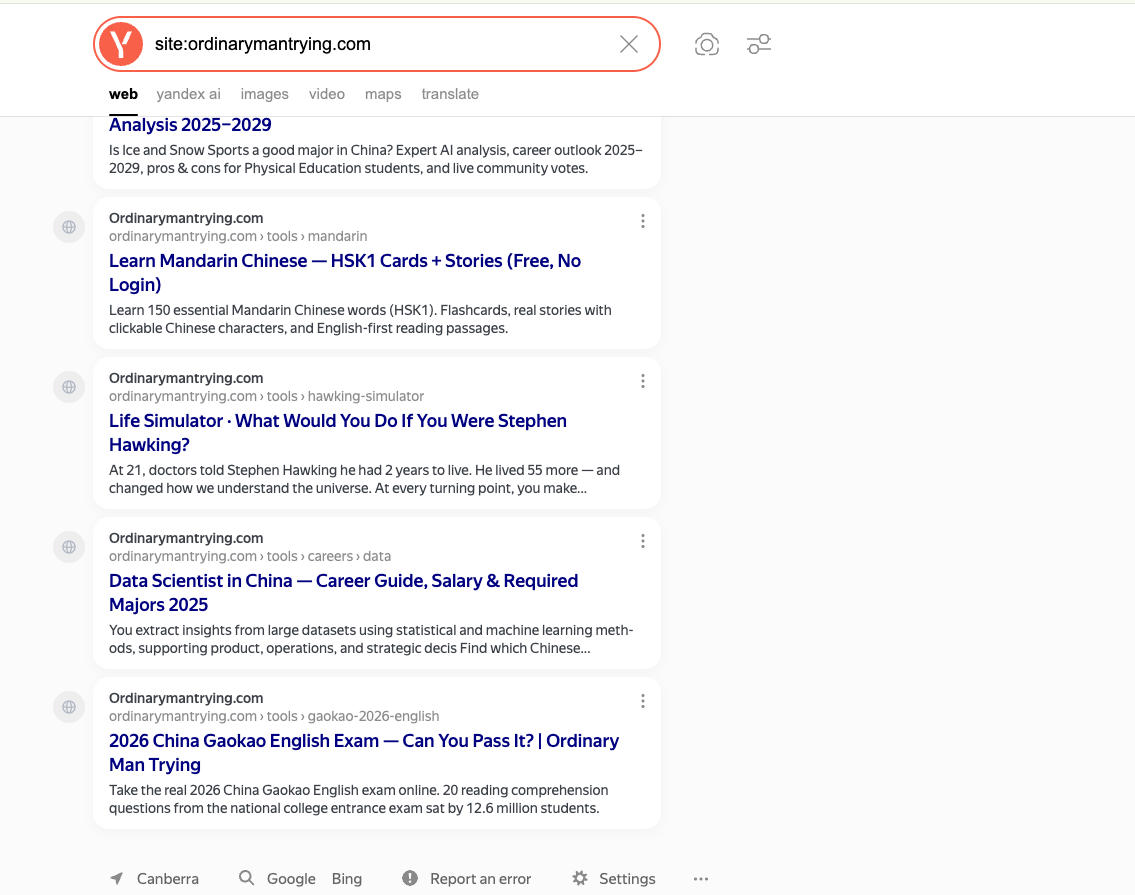
Yandex surprised me the most. It crawled hundreds of pages — the entire simulators collection, every career guide, every majors page, the Mandarin learning tools, the Wander China city guides.
But it sent me 4 visitors.
Four. In 28 days.
Yandex is primarily a Russian-language search engine, so the low referral traffic makes sense — my content is in English, targeting an international audience that doesn’t use Yandex as their primary search tool. But here’s what I actually found valuable: the Yandex crawl data works as a free technical audit.
It flagged three pages that had recently changed from 200 (OK) to 404 (broken) — old WordPress pages I had deleted that Yandex had already indexed. Nothing critical, but useful to know.
If you want to know what your site actually looks like to a crawler — which pages exist, which return errors, which paths lead nowhere — Yandex Webmaster’s URL report is one of the more honest diagnostic tools available.
Three Search Engines, One Month: The Summary
| Platform | Pages Indexed | Organic Users | Best Feature |
|---|---|---|---|
| ~4 | 1 | Long-term authority (be patient) | |
| Bing | ~50 | 33 | Honest technical feedback, faster indexing |
| Yandex | Hundreds | 4 | Aggressive crawling, good for technical audits |
Google is where most of the internet’s search traffic lives — roughly 90% globally. But for a new site in month one, Google is also the most suspicious, the most conservative, and the least communicative. You will not know what it’s thinking.
Bing is underrated for new sites specifically. It indexes faster, gives you clearer signals, and rewards fresh content more visibly. I’m not saying Bing replaces Google — it doesn’t, ever. But in the first 90 days, Bing is a useful practice ground.
Yandex: set it up, ignore it, check it occasionally as an audit tool. Don’t expect traffic unless your audience uses Russian search.
What I Learned (The Hard Version)
1. Volume without quality is a trap, even if the content is technically accurate.
My 757 major pages were accurate. They had real data. But publishing them all at once on a new site, with similar structure, signaled pattern rather than depth. Google couldn’t tell the difference between a content farm and a legitimate reference library — and it defaulted to caution.
2. The Google sandbox is real, and it’s okay.
A new site being ignored by Google for the first 3–6 months is normal. It’s not a death sentence. It’s Google saying: “Show me more before I decide.” The answer is to keep publishing, keep building, and stop checking Search Console every day hoping for a miracle.
3. Bing will tell you things Google won’t.
If you’re not using Bing Webmaster Tools, start. The technical diagnostics are genuinely useful and the feedback is more explicit than what Google provides. Fix the H1s. Fix the meta descriptions. Fix the broken links. These are small things that take an afternoon and affect every search engine.
4. The traffic that matters most right now isn’t search traffic.
86% of my 484 users came direct — from links I shared, communities I participate in, tools people bookmarked. That’s real humans choosing to visit, not algorithms deciding to rank. For month one, that’s what growth actually looks like.
5. Watch the time-on-page, not just the pageviews.
Two people read my kitchen exhaust fan article for 13 minutes. That’s not a traffic win. That’s a content win — two people found exactly what they needed and read to the end. That’s the kind of thing search engines reward eventually. Build more of that.
What’s Next
- Fix all technical issues Bing flagged (H1 length, meta length — already started)
- Remove or consolidate the thinnest of the majors pages rather than let them drag down site quality signals
- Write 4–6 longer, experience-based articles that Google can’t mistake for AI templating
- Keep building the Wander China city guide series — it’s the tool with the clearest audience and the clearest search intent
- Stop panic-checking Search Console
Month 2 report will have updated indexation counts and whether Bing’s gaokao ranking held.
If you’re building a blog right now and wondering if you made the same mistakes I did — you probably did. That’s fine. The difference between a failed website and a successful one isn’t usually talent. It’s whether you kept going after month one felt like nothing.
This is me keeping going.
Related Reading
- I Built This Blog in 4 Days Using AI — And Now I’m Running a Live Experiment in Public
- Digital Ghosts: What 8 Years of Failed Hustle Taught Me
- My Goji Berry Website Ran for 6 Years and Never Made Money
Try These Free Tools
Some of the tools I built while running this experiment — free, no login required:
- Wander China — AI China Trip Planner — Plan a multi-city China itinerary in minutes
- Which Chinese Major Will Matter in 4 Years? — Vote and see what others think
- DayDayUp — Daily habit tracker, no account needed
Month 2 update coming in August. Subscribe or bookmark to follow along.
Leave a Reply