Latest posts
-
What Is the Matthew Effect?
Two papers on identical findings are published. One by a Nobel laureate, one by an unknown researcher. The Nobel laureate’s paper gets cited 100x more often—not because it’s better written, but because Nobel laureates’ names attract attention. The Original Discovery Named after Matthew 25:29 in the Bible: ‘For unto every one that hath shall be…
-
What Is the Butterfly Effect?
In 1989, a Libyan passport officer decided to stamp one more visa without proper paperwork. This led to the bombing of Pan Am Flight 103, which killed 270 people and changed aviation security forever. The Original Discovery Edward Lorenz, a meteorologist, discovered this principle in 1960 while running weather simulations on an early computer. He…
-
What Is Goodhart’s Law? When Metrics Stop Working
Goodhart’s Law: when a measure becomes a target, it ceases to be a good measure. Here’s why metrics get gamed, real examples, and what to do instead.
-
What Is the Pareto Principle (80/20 Rule)? How to Find the Vital Few
The Pareto Principle (80/20 Rule) says 80% of results come from 20% of causes. Here’s the origin, real examples, and how to use it to work smarter.
-
What Is the Streisand Effect? Why Trying to Hide Something Makes It Viral
The Streisand Effect: attempts to suppress information online make it spread faster. Named after a 2003 lawsuit that turned a private photo into global news.
-
What Is the Halo Effect? How One Trait Colors Everything
The Halo Effect means a positive impression in one area shapes how we judge everything else. Here’s the science, examples, and why it’s so hard to avoid.
-
What Is the Bystander Effect? Why More Witnesses Means Less Help
The Bystander Effect shows that people are less likely to help in emergencies when others are present. Here’s the psychology, the Kitty Genovese case, and how to override it.
-
What Is Murphy’s Law? More Than Just Bad Luck
Murphy’s Law isn’t just a joke. It’s an engineering principle with a real origin, a specific mechanism, and practical uses. Here’s what it actually means.
-
What Is Confirmation Bias? Why We Find What We’re Looking For
Confirmation Bias makes us seek out information that confirms what we already believe. Here’s the science, real examples, and how to fight it.
-
What Is Survivorship Bias? The Data You Never See
Survivorship Bias makes us focus only on successes while ignoring failures. The WWII bomber story, startup myths, and how to correct for missing data.
-
What Is the Sunk Cost Fallacy? Why We Can’t Let Go
The Sunk Cost Fallacy makes us stick with bad decisions because of past investment. Here’s the psychology, real examples, and how to stop doing it.
-
What Is the Dunning-Kruger Effect? (With Real Examples)
The Dunning-Kruger Effect explains why beginners are overconfident and experts are uncertain. Here’s the science, real examples, and why it matters.
-
I Made a 40-Level Psychology Quiz. Here’s Which Laws Most People Get Wrong. (AI Generated)
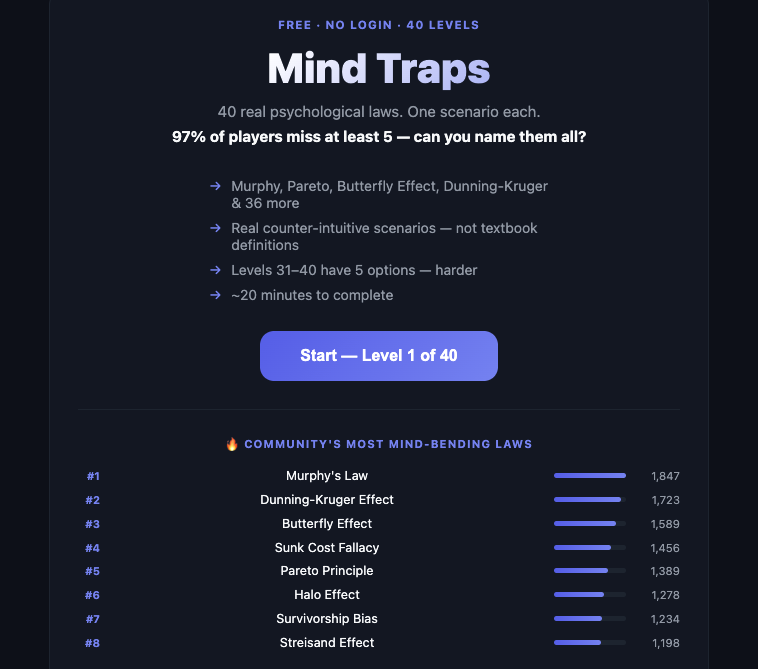
A free 40-level psychology quiz where you read a real scenario and name the law — Murphy’s Law, Dunning-Kruger Effect, Sunk Cost Fallacy, and 37 more. No login, no install.
-
I Built 100 Historical Figure Life Simulators. Here’s What I Learned About Decision-Making.
I started with one. It was a Nelson Mandela simulator. You make the same 8 decisions he made — before you see what he actually did. Should he advocate armed resistance? Should he accept the conditional release offer after 21 years in prison? Should he negotiate with the apartheid government at all? The point wasn’t…
-
Three AIs Reviewed My Website. They All Found the Same Problems.

I ran one prompt through GPT-5 Mini, Gemini 2.5 Flash, and Seed 2.0 Mini. They scored my website 7, 8, and 9 — and all found the exact same problems. Here’s what they agreed on, what surprised me, and the prompt you can steal to do this in 15 minutes.
-
I’ve Published 100 Articles. Nobody Asked Me To. Here’s Why I Didn’t Stop.
I’ve now published 100 articles on a blog that took me 18 months to build from zero. Nobody assigned these. Nobody is waiting for them. Here’s the honest answer to why I kept going — and what I found on the other side of 100.
-
I Gave My Life a Density Score. Here’s What the Number Revealed.
I built a tool to score how densely I’ve been living — not by productivity or achievement, but by my own definition of what a full life looks like. The score surprised me. Here’s the method and the result.
-
How Many Times Will You See Your Aging Parents Again? I Did the Math.
If your parents are in their 70s and you see them twice a year, you might have fewer than 20 visits left. I built a calculator for this number. Here’s what happened when I ran it for myself.
-
I Calculated How Much Time I’ve Wasted. Then I Stopped Feeling Guilty About It.
I spent an afternoon calculating exactly how much time I’ve wasted in my life — scrolling, procrastinating, going nowhere. The number was enormous. It also turned out to be beside the point.
-
I Ran 25 Historical Life Simulators. Here’s the Decision Pattern That Keeps Showing Up.
After building 25 interactive life simulators for historical figures — from Darwin to Frida Kahlo — I noticed the same decision pattern in almost every life. Nobody saw it as a pattern at the time.