A cheap server, too many website ideas, and one business idea I’m still not sure anyone actually wants.
There is an old Chinese business story about selling combs to monks.
Monks traditionally shave their heads, so selling them combs sounds absurd. The story is usually told as a lesson in creative sales: perhaps the monks can give the combs to visitors, perhaps they can engrave Buddhist messages on them, perhaps there is a market if you are clever enough.
I have always thought there was another lesson hiding inside that story:
Sometimes being clever enough to invent a use for a product doesn’t mean people actually want the product.
I started thinking about this because I am about to buy a server.
Not a very expensive server. That’s actually the problem.
It is cheap enough that I have almost no excuse not to buy it.
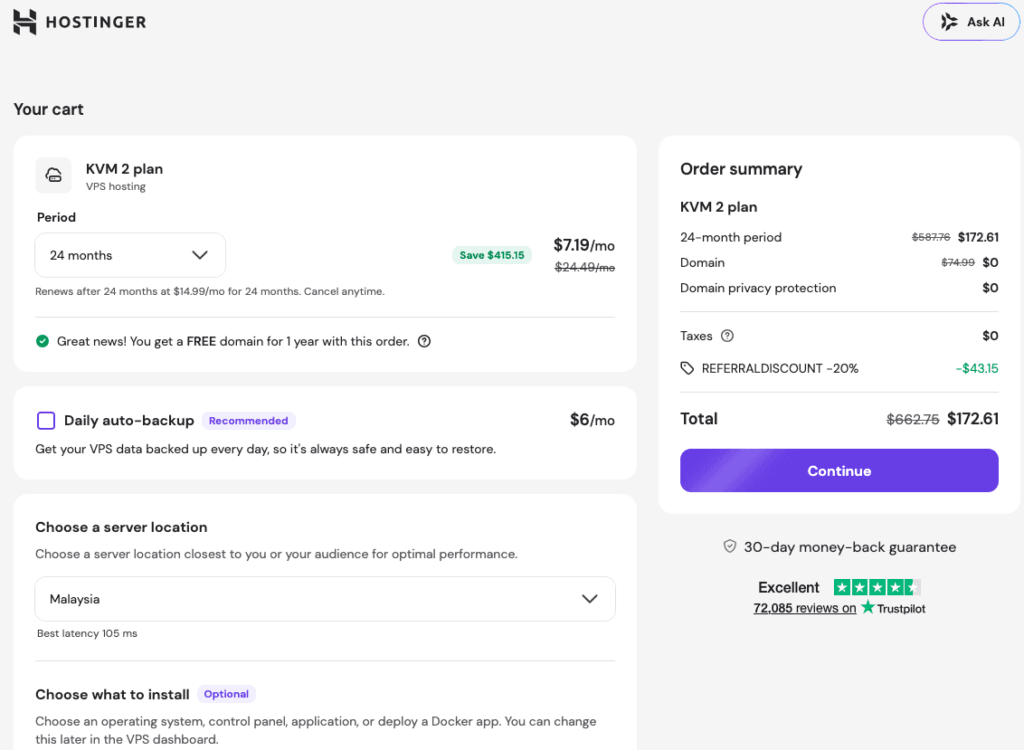
For roughly the price of a second-hand laptop I had been considering, I can rent a VPS for about two years and use it to host multiple websites, databases, tools and experiments.
The funny thing is that I hesitated over buying the laptop.
The server feels different.
The laptop would mostly be a purchase.
The server feels like an experiment.
I have a regular job and some long-term investments, so I don’t need these websites to pay my rent next month. I can afford to let them lose money for years.
If I spend a few thousand RMB over several years and nothing works, I can call it tuition.
I will have learned SEO, servers, web development, product design, AI-assisted coding, databases and probably a few painful lessons I don’t even know exist yet.
If one website works, that’s a different story.
So lately I have been asking AI a dangerous question:
What else should I build?
The Rule I Gave AI
I don’t want to build random websites just because a domain name is available.
I am still relatively new to SEO, but one lesson has already become very clear to me:
I would rather take a small subject and go very deep than take a giant subject and become another mediocre website in the middle of it.
So AI and I gradually came up with a rough filter.
A new project should ideally have:
- a real problem people already have
- a narrow enough topic that a small operator can become genuinely useful
- structured data, not just articles
- interactive tools
- some resistance to being replaced by a one-sentence AI answer
- and, very importantly, a realistic way to make money
That last requirement caused some casualties.
First We Found Chinese Grocery
At one point, we became excited about a site for foreigners shopping for Chinese ingredients.
This seemed promising.
Walk into a Chinese or Asian supermarket and there are entire shelves of things like:
light soy sauce
dark soy sauce
doubanjiang
black vinegar
Shaoxing wine
fermented tofu
sesame paste
Sichuan pepper oil
For someone who didn’t grow up cooking Chinese food, the shelf can look like a chemistry experiment.
So we imagined a site that could explain products, compare sauces, suggest substitutes, build a Chinese pantry and tell users what they could cook with the ingredients they already owned.
It sounded useful.
But it also sounded too big.
“Chinese Grocery” could eventually mean sauces, noodles, frozen dumplings, snacks, rice, drinks, canned food, spices, hot pot bases and hundreds of other categories.
That violated my own rule.
If I am one person working with AI in my spare time, maybe I should not try to become the Wikipedia of the Asian supermarket.
So we narrowed it down.
Then We Found Chinese Condiments
This version felt much better.
Forget the supermarket.
Just become extremely good at Chinese seasonings and sauces.
Soy sauce.
Vinegar.
Doubanjiang.
Fermented black beans.
Oyster sauce.
Sesame oil.
Chili oil.
Shaoxing wine.
Suddenly I could see the SEO structure.
Light soy sauce vs dark soy sauce.
Chinese black vinegar vs rice vinegar.
What can I substitute for Shaoxing wine?
Which doubanjiang should I use for mapo tofu?
What is the difference between Chinese sesame paste and tahini?
This looked like exactly the kind of small niche I like.
A focused database.
Comparison tools.
Substitution tools.
A “Which one should I buy?” finder.
Maybe hundreds of tightly related pages instead of thousands of generic ones.
For a while, AI and I were both very pleased with ourselves.
Then I asked a less exciting question:
How does this website make money?
And the idea suddenly became much weaker.
Imagine an American user searches:
light soy sauce vs dark soy sauce
They land on my site.
They read the explanation.
They finally understand the difference.
Success!
Then, on the way home from work, they stop at the local Asian supermarket and buy a $4 bottle.
I make:
$0.
That doesn’t make the website useless.
It might still make money from advertising, affiliate links or sponsorships if it eventually gets enough traffic.
But the commercial connection is weak.
There is a difference between:
“This person needs information.”
and
“This person is about to spend money.”
I am starting to think that difference matters a lot.
So Chinese Condiments went into the “maybe later” pile.
Not because the problem is fake.
Because I wasn’t convinced the business model was strong enough.
Then We Found the Chinese Seal
This idea came from something I had already built.
I run another small project called ChineseNameCraft, where English-speaking users can get a Chinese name.
Suppose someone named Emma receives the Chinese name:
安雅
AI asked me a simple question:
What if, after getting her Chinese name, Emma could turn it into a traditional Chinese-style seal?
That immediately felt different.
The user would not just read something.
They would make something.
Enter the name.
Choose a style.
Choose a layout.
Choose a red-character or white-character seal.
Generate the design.
Download it.
And then, perhaps:
Have this seal carved in stone.
Suddenly the commercial path became much shorter.
The user isn’t reading an article about seals and later being shown a random product.
They are looking at their own personalized design.
The object they could buy already belongs to them psychologically.
That is interesting.
We went deeper.
What about English-name seals?
What about bilingual seals?
What about side engraving?
Gift boxes?
Different stones?
A real carved seal shipped to the customer?
Even better, building the product would require creating a library of carefully designed Chinese seal glyphs.
Perhaps 300 characters at first.
Eventually 1,000.
Multiple visual styles.
SVG vector assets.
A layout engine.
Suddenly the project had another layer.
Even if the seal business never became huge, those glyphs could be reused later for:
invitations
Chinese New Year designs
couplets
pet tags
personalized gifts
posters
other Chinese-style products
The website code could be copied.
The button that says “Generate” could be copied.
But a carefully reviewed library of hundreds or thousands of original vector glyphs would actually be an asset.
At this point I became very excited.
And then I ruined the mood with another question.
Does Anyone Actually Want a Chinese Seal?
That is the problem.
A dog owner already understands why a dog needs an ID tag.
A tea drinker already buys tea.
Someone learning a game already wants to play it.
But how many people wake up in Europe or America and think:
I really need a Chinese personal seal today.
Probably not many.
And that brought me back to the monks and the combs.
Maybe we had found a clever product.
Maybe we had found a beautiful product.
Maybe we had found something technically interesting.
But had we found demand?
Or were AI and I simply getting better and better at explaining why people should want something they had never wanted before?
That is a dangerous trap.
Low competition can mean opportunity.
It can also mean nobody cares.
Those two situations look surprisingly similar from far away.
This Is Where AI Can Be Dangerous
One thing I have noticed during these conversations is that AI is extremely good at expanding an idea.
Give it a small spark and within minutes you have:
a brand
a database
a tool
a premium version
a marketing strategy
a subscription plan
an affiliate program
a five-year roadmap
It can make almost any idea sound exciting.
That is useful.
It is also dangerous.
The more detailed the imagined business becomes, the more real it starts to feel.
But a beautifully described business model is still imaginary until somebody clicks the button.
And an even more beautifully described business model is still imaginary until somebody pays.
So I am trying to learn a new habit:
Whenever an idea starts sounding brilliant, ask what the customer was already trying to do before I arrived.
That question has killed several of my ideas.
I think that is healthy.
So Am I Going to Build the Seal Project?
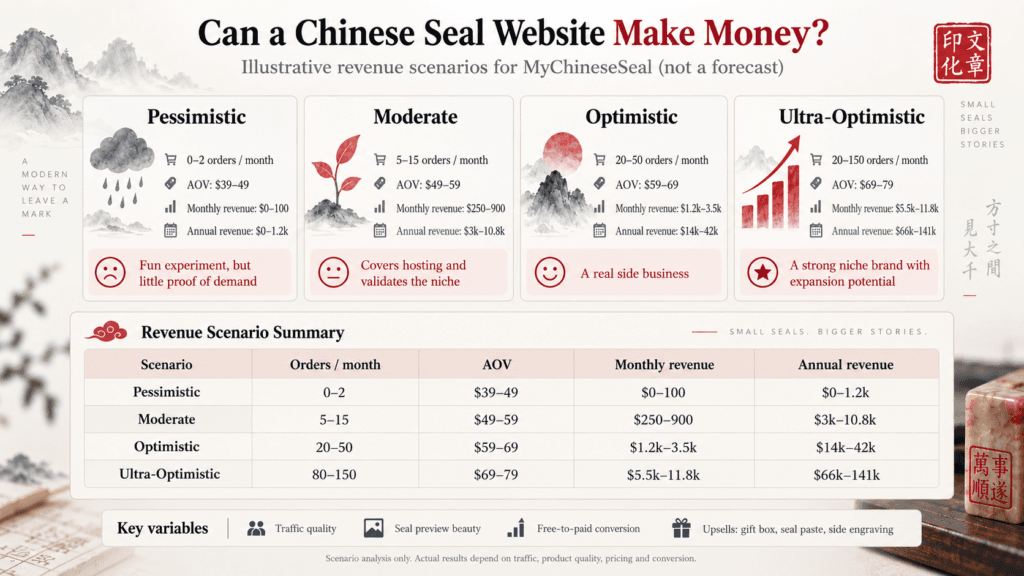
Probably.
But not in the way I first imagined.
I don’t think the correct first move is to spend months building a giant standalone seal website and then wait for Google to send strangers.
I already have a much better testing ground.
ChineseNameCraft.
Someone who has just created a Chinese name is probably one of the most qualified potential customers in the world for a personalized Chinese seal.
So the first experiment can be very small.
A user receives a Chinese name.
Then they see:
See Your Name as a Chinese Seal
They generate one.
Then:
Have This Seal Carved in Stone
And I watch.
Do people generate it?
Do they download it?
Do they click the physical-product button?
Does anyone ask how much it costs?
Does anyone actually pay?
If thousands of highly relevant users see it and nobody even clicks “Buy,” that tells me something important.
AI and I were wrong.
That is fine.
If people start buying them, that tells me something else.
Maybe there is a tiny business hiding there.
Failure Is Part of the Budget
This is also why I am comfortable buying the server.
I am not betting my life on one domain.
I am buying myself an inexpensive laboratory.
I can host multiple experiments.
Some will get no traffic.
Some will get traffic and make no money.
Some might make a little money.
One might surprise me.
And because I have a normal source of income, I have something that many startup founders do not have:
time.
I don’t need a website to become profitable in three months.
I can let a useful site exist for five years.
I can improve it slowly.
I can learn what Google thinks of it.
I can watch what users actually use.
I can abandon ideas without pretending they succeeded.
That is the experiment.
I Don’t Know the Ending Yet
This is one reason I wanted to write this article now instead of after I know what happens.
Most business stories are written backward.
Someone succeeds, then explains why the success was inevitable.
Everything suddenly looks obvious.
The good decisions were strategic.
The mistakes were valuable lessons.
The founder always seems to have known where things were going.
That is not what this feels like from the inside.
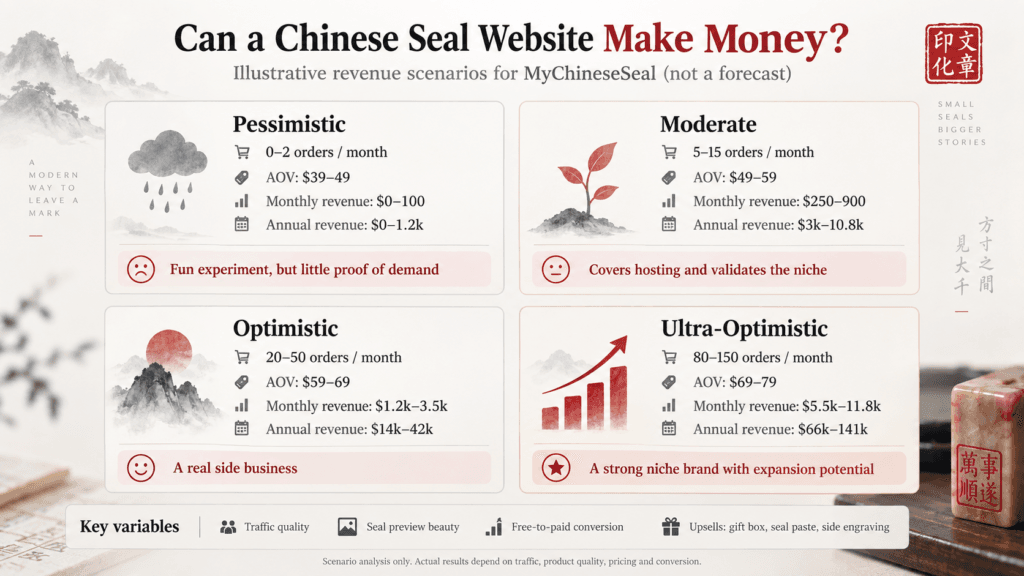
Right now I genuinely do not know whether the Chinese seal idea is smart.
Maybe it becomes a nice little business.
Maybe I sell one seal a week.
Maybe people love designing them but nobody wants the physical product.
Maybe it becomes a useful feature for another website and never deserves its own domain.
Maybe I sell exactly zero.
All of those outcomes are possible.
Five years from now, this article can still be here.
I can come back and add the result.
Maybe the update will be:
I Sold My First Chinese Seal
Or perhaps:
Apparently the Monks Didn’t Want My Combs
Either ending would teach me something.
So for now, instead of pretending I know the answer, I am going to let time, Google and real customers answer it for me.
Am I building a niche product, or am I selling combs to monks?
We’ll find out.
PS:Turn your ideas into reality for just $7.2/month. Click here to get it with a 20% discount — I’ll earn a small commission. :https://www.hostinger.com/
Leave a Reply