✍️ AI-generated post — tools, ideas and data are real; writing drafted by AI. Read the human voice behind this site →
I want to be specific about what “zero coding background” means.
I mean: I had never written a line of code before this project. I didn’t know what a div was. I didn’t know what an API was. I didn’t know what a repository was.
I now have 47 free tools live on the internet, a GitHub account with multiple repositories, and a website that gets real traffic. I built all of it using AI as a development partner — mostly Claude, occasionally others.
This is what I actually learned in the process.
The First Tool Took a Weekend
The first tool was Life A4 — your life on a 900-square grid, one square per month. I had the idea after reading about “life in weeks” visualizations and wanting something I could actually print.
I described what I wanted to an AI. It wrote the HTML. I didn’t understand the code. I just described what was wrong and asked it to fix it. Iterated 30 times over two days. The tool worked.
That weekend changed how I thought about what was possible.
What Building With AI Actually Looks Like
It’s not magic. It’s closer to having a very patient, very knowledgeable collaborator who doesn’t get tired.
You describe what you want. The AI writes code. Something doesn’t work. You describe what’s wrong. The AI fixes it. You describe the next feature. Repeat.
The bottleneck is never the AI. The bottleneck is always clarity — being able to describe precisely what you want and precisely what’s wrong. That’s a skill that improves with practice.
After 47 tools, I’m much better at it than after 1.
The Decisions AI Can’t Make
This is what surprised me most.
AI can write code for any feature you describe. It cannot tell you which features matter. It cannot tell you which tool ideas are worth building. It cannot tell you what will resonate with people who are nothing like you.
The 47 tools that exist are the 47 ideas I thought were worth building. There were probably 200 ideas I discarded. The AI had no opinion on which 47 to keep.
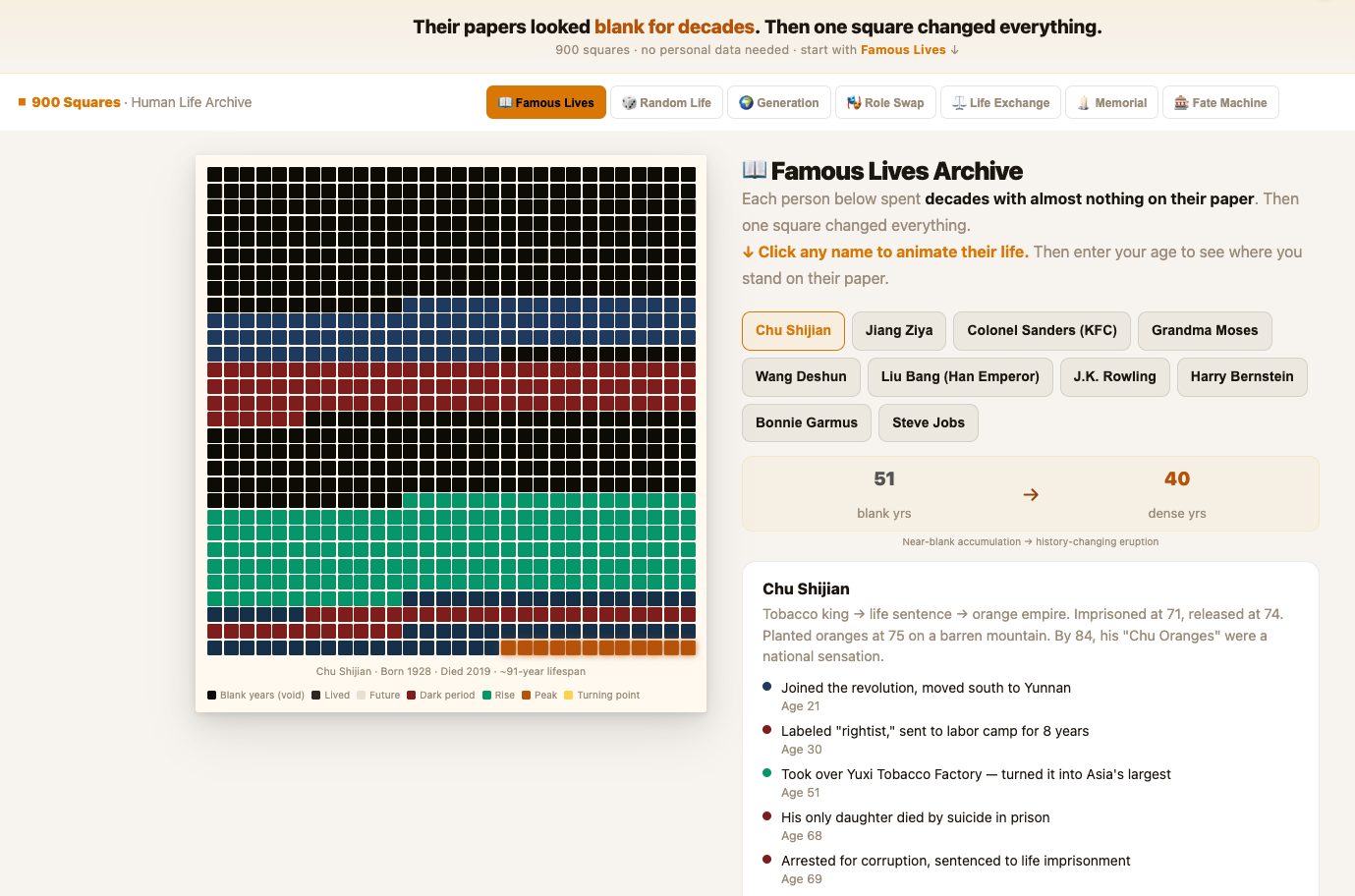
The Life Paper tool has 7 different lenses — Famous Lives, Role Swap, Fate Machine, Collective Memorial, and others. Every one of those lenses came from a question I was asking myself. Which lives would be most instructive to see on a grid? What would it look like to see a caregiver’s life versus an entrepreneur’s? What would it mean to show what people said about being each age?
Those are human questions. The AI answered them in code.
What 47 Tools Taught Me About Ideas
Most ideas are worse than they seem. A few are much better.
The AQ Kids resilience quiz builder gets 100% engagement from every visitor — every person who opens it interacts with it. I built it almost as an afterthought. The tools I spent the most time planning sometimes get the least engagement.
The pattern I’ve noticed: tools that ask a question the user is already asking themselves perform better than tools that introduce a new question. Life A4 works because people already wonder “how much time do I have left.” Life Clock works because people already feel like time is speeding up and want to understand why.
The AI builds whatever you describe. You have to know which questions people are already asking.
The Numbers (Honest)
101 monthly active users. 25 seconds average engagement time. Zero revenue so far.
The site has been live for less than six months. The tools are genuinely free — no sign-up, no paywall, no tracking. The plan is to earn through Google AdSense, affiliate book recommendations, and Ko-fi donations from people who found something useful.
None of that is happening yet at meaningful scale. I’m sharing the real numbers because the building-in-public experiment is only useful if the numbers are real.
What I’d Tell Someone Starting Now
Start with a tool you personally need. Don’t build for a hypothetical user — build for the problem you actually have.
Don’t wait until you understand the code. You don’t need to. Describe what you want with precision and the AI will handle the implementation.
The hardest part isn’t building. It’s deciding what to build. Spend your energy there.
And be honest about the process. I label my AI-written blog posts as AI-written. I share real traffic numbers. I wrote about the time I almost built a WeChat Mini Program and got talked out of it by the AI showing me the monetization math.
Authenticity compounds the same way domain authority does. Slowly, then noticeably.
Want to build your own tools?
I compiled the exact AI prompts I used
10 tested prompts — quiz tools, calculators, simulators, flashcards, SEO meta tags, GitHub README and more. No coding needed.
Free tools on this site (no sign-up, no install):
• Life Paper — famous lives on a 900-square grid
• Life A4 — your own life on the same grid
• Life Clock — black hole months & life density
• AQ Kids — resilience quiz builder for children
• All 47 tools →
Leave a Reply