
✍️ AI-generated post — tools, ideas and data are real; writing drafted by AI. Read the human voice behind this site →
The Stoics had a practice called memento mori — “remember you will die.”
It wasn’t morbid. It was practical. The Roman emperor Marcus Aurelius reminded himself of death every morning not to feel sad, but to feel awake. When you remember that time is finite, you use it differently.
The problem is that in 2026, this is hard to feel. Modern life is very good at hiding finitude. Calendars roll over automatically. Subscriptions renew. Notifications arrive. The sense that time is running out requires deliberate effort to maintain.
That’s what these three tools are for.
The 900-Square Version
The simplest way I’ve found to feel time is to see it.
75 years. 900 months. 900 squares on a grid. Each square is one month of a human life.
When you look at it all at once — past squares filled, future squares blank — the abstract concept of “life is finite” becomes concrete. Not terrifying. Just real.
The three tools at ordinarymantrying.com are three angles on this same grid:
Life Paper — The Lives of Others
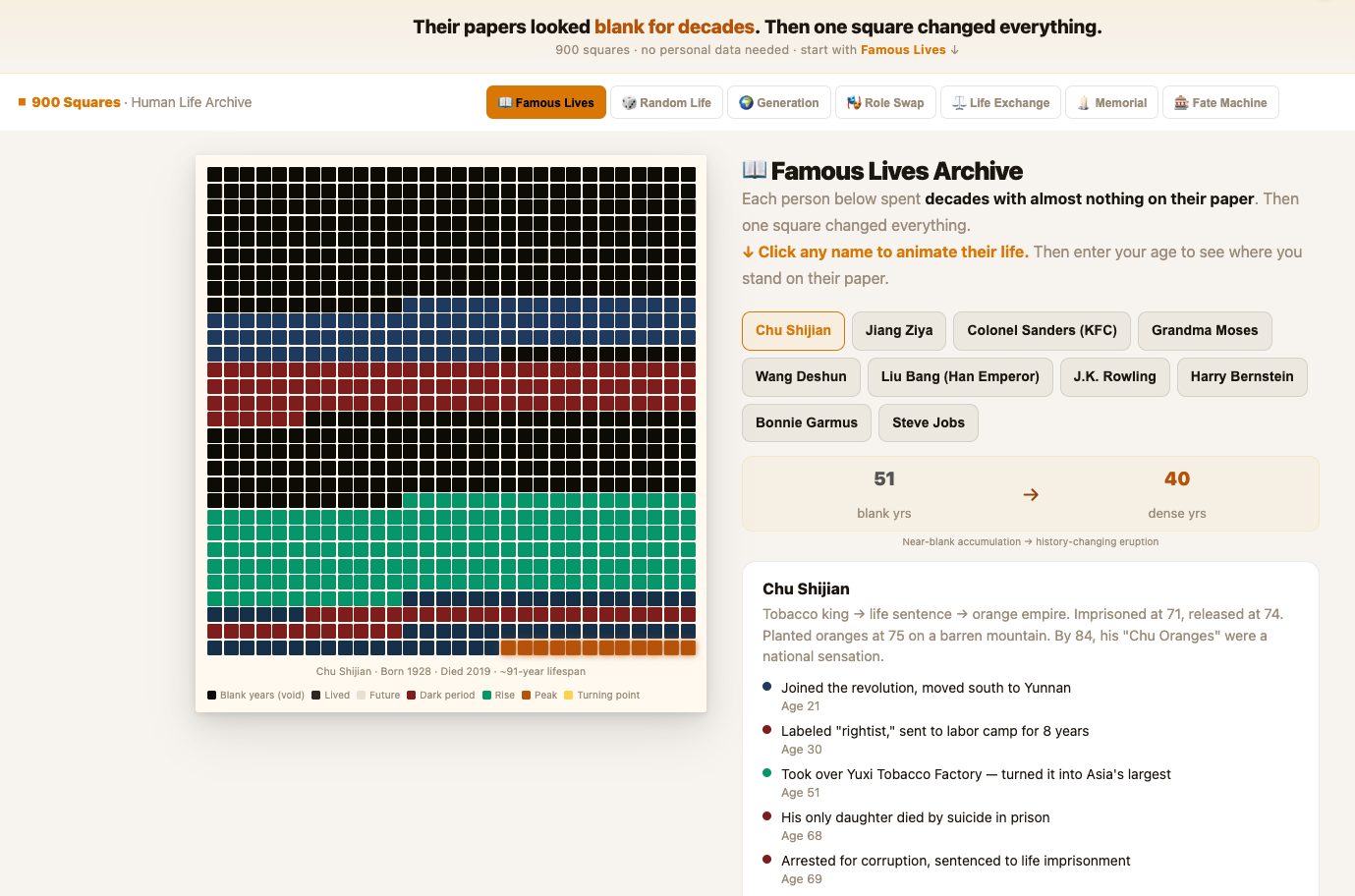
Life Paper doesn’t ask for your personal data. Instead, it shows you famous lives on the grid.
There are 7 lenses: Famous Lives, Random Life, Generation, Role Swap, Life Exchange, Collective Memorial, and Fate Machine. The most powerful for memento mori practice is probably Collective Memorial — what people from around the world said about being each age, sorted by the square they were in when they said it.
The Stoic practice here: contemplate the lives of those who came before you. Marcus Aurelius recommended looking at historical figures to understand that even the most powerful lives end. The grid makes this visual.
Life A4 — Your Own Paper
Life A4 asks for one thing: your birth month. Then it shows your life on the same 900-square grid.
Past months in gray. Present month in orange. Future months blank.
The Golden Zone feature calculates how many months you likely have left with your parents. This is the most immediately confronting number — not a philosophical abstraction, but a specific count affecting specific relationships you have right now.
The Stoic practice here: negative visualization. Seeing the blank squares isn’t pessimism — it’s the precondition for gratitude. What you can lose, you can also appreciate.
Life Clock — The Quality of Time

Life Clock asks the question the other two tools don’t: not just how much time has passed, but how much of it was lived.
The Black Hole percentage measures months so routine they left no distinct memory. The Life Density score rates how “alive” your time has been. The felt-time toggle shows how time actually feels versus how it measures.
The Stoic practice here: negative visualization applied to attention. It’s not enough to know that time passes — Marcus Aurelius also warned against spending time on things unworthy of a rational mind. This tool measures whether you have.
The Modern Memento Mori Practice
The Stoics used physical objects — skulls, hourglasses, coins — to keep death visible in daily life. The Daily Stoic sells memento mori medallions for exactly this purpose: a physical reminder that fits in your pocket.
A browser tool is different. It’s not always present. But it’s precise in a way a medallion isn’t — it shows your specific squares, your specific Golden Zone, your specific black hole percentage.
The practice I’d suggest: open one of these tools at the start of each month. Not to feel sad — to feel oriented. One square is about to be added to your past. What do you want it to contain?
Free, No Sign-Up, Works in Any Browser
All three tools are free. No account required. No personal data saved. They run entirely in your browser.
• Life Paper — famous lives and 7 lenses, no personal data needed
• Life A4 — your own 900-square paper with Golden Zone
• Life Clock — black hole months and Life Density score
Memento mori.
Leave a Reply