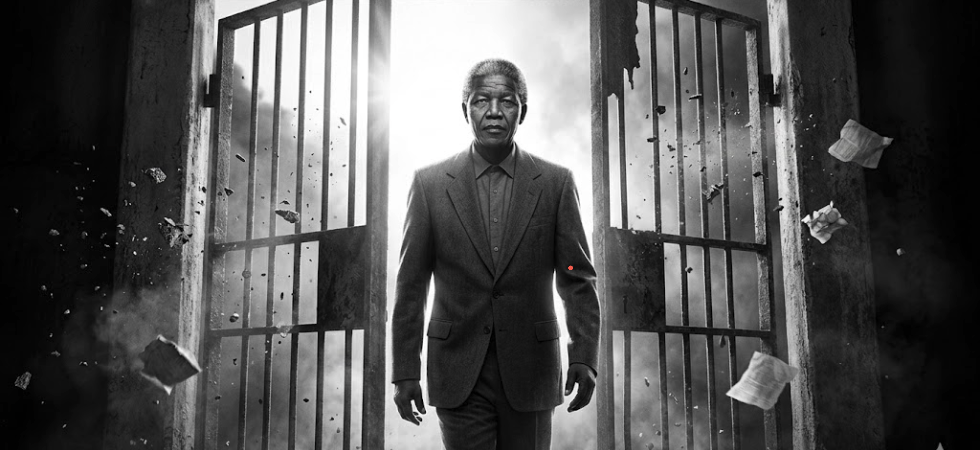
In 1985, Nelson Mandela had been imprisoned on Robben Island for 21 years.
South African President P.W. Botha offered him a deal: unconditional release, if Mandela would publicly renounce violence as a political strategy.
Mandela refused. He had his daughter read his response aloud at a public rally, because he was not allowed to speak publicly himself. One line from that statement became famous:
“I cannot and will not give any undertaking at a time when I, you, the people, are not free. Your freedom and mine cannot be separated.”
He served five more years in prison before being released in 1990. He became South Africa’s first democratically elected president in 1994.
The Decision Almost Nobody Understands
When you read that Mandela refused early release, the tendency is to nod and say yes, obviously. Principle over comfort. That’s easy.
It is not easy.
Mandela had already spent 21 years in prison. He was 66 years old. He did not know when — or if — he would be released. He did not know if the anti-apartheid movement would succeed. The certainty of five more years of imprisonment versus the possibility of some leverage for the movement — that is not an obvious calculation.
What made it clear for Mandela: he didn’t see his freedom as separate from his people’s freedom. The offer wasn’t freedom. It was release under conditions that would have compromised the movement’s moral position. Accepting it would have meant the movement spoke with the state’s permission. He saw through the structure of the offer in a way that required both clarity and courage.
The Decision That Preceded It: Going Underground
Before imprisonment, in 1961, Mandela made a different kind of decision. The African National Congress had committed to nonviolent protest. Mandela argued — and eventually convinced enough of the leadership — that after the Sharpeville Massacre, where police killed 69 peaceful protesters, nonviolence alone was insufficient.
He went underground and helped form Umkhonto we Sizwe, the armed wing of the ANC. This was the decision for which he was ultimately arrested and sentenced to life imprisonment.
The question the simulator poses: when peaceful means have failed and violence has been used against you, do you maintain your position, adapt your tactics, or abandon your principles? These are three different things. Mandela changed tactics while preserving principles. Most people can’t distinguish between them clearly under pressure.
The Decision at His Own Trial
At the Rivonia Trial in 1964, Mandela faced the death penalty. His statement from the dock is one of the most studied political speeches in history. He did not deny the charges. He explained his reasoning. He argued for the justice of the cause. And he ended with:
“It is an ideal which I hope to live for and to achieve. But if needs be, it is an ideal for which I am prepared to die.”
He received life imprisonment instead of execution. The simulator asks: when you are facing the maximum possible punishment, do you minimize, negotiate, or state your position fully?
The Decision to Reconcile
After 27 years in prison, after everything that had been done to him and to his people, Mandela chose reconciliation over retribution. The Truth and Reconciliation Commission — which he established under Archbishop Desmond Tutu — offered amnesty to perpetrators who testified fully about their crimes.
Mandela argued that the alternative — prosecution and retribution — would have destabilized the young democracy and likely led to cycles of revenge violence. History has largely supported his judgment. South Africa’s transition avoided the civil war that many expected.
Would You Have Made These Calls?
The Nelson Mandela simulator includes these decisions — the ones where the choice wasn’t obvious, where reasonable people would have chosen differently, where the weight of the situation should have bent him toward the easier path. He didn’t bend.
The simulator takes 7 minutes. You commit to each decision before you see the options.
→ Play the Nelson Mandela Life Simulator (free, 7 minutes)
There are 9 other simulators — Warren Buffett, Elon Musk, Marie Curie, Jobs, and others: → See all 10 simulators
July 18 is Nelson Mandela International Day, established by the United Nations in 2009. It’s a good day to think about the kinds of decisions that define a life.
Related Reading
- 10 Legends, 10 Real Decisions: Free Interactive Simulators
- Warren Buffett’s 7 Real Decisions — Would You Have Made the Same?
- Building in Public: The Live Experiment
- Browse All 25 Life Simulators — Full Collection & Guides
Share your experience or thoughts below.
Leave a Reply