🎯 Challenge — Before You Read
How would you score on the real 2026 Gaokao English exam?
12.6 million students sat this exam. Before reading about what AI predicted — take the actual 20-question reading section yourself. No signup. Instant score.
Take the Test First →Every June, China holds the most consequential exam in the world.
The 高考 — Gaokao — is the national college entrance examination. 12.6 million students sat for it in 2026. Two days determine where you spend the next four years, which degree you get, and in many families, which life trajectory you’re on. There is no retake culture. There is no test-optional admissions. There is just the score.
For the English section, the highest-stakes component is the writing section: 40 points out of 150. Two tasks — one short opinion essay, one longer story continuation. Students spend months preparing specific vocabulary, sentence structures, and topic knowledge hoping to recognize what appears.
Six days before the 2026 exam, I asked AI to predict what they would need to write about.
What I Asked AI to Do
The task I gave AI was specific: analyze the last five years of Gaokao national English exam writing prompts, identify patterns in what had already been tested, eliminate those topics (unlikely to repeat), and predict the three highest-probability themes for 2026.
AI produced two documents. One was a sentence pattern toolkit — high-level grammar structures like inverted conditionals, subjunctive mood, and non-predicate verb phrases used as sentence openers. These, it explained, work for any writing topic regardless of what actually appears.
The second document was the prediction with confidence ratings. Here is what AI predicted:
Hot Topic 1: AI and Technology in Campus Life — ★★★★★ (Highest probability)
Predicted direction: Inviting a foreign teacher to a “Campus Tech Innovation Week,” or writing about AI-assisted learning.
Hot Topic 2: Green/Low-Carbon Lifestyle — ★★★★☆
Predicted direction: Recommending a community eco-friendly campaign, or writing an advocacy letter about low-carbon living.
Hot Topic 3: Cultural Confidence and Intangible Heritage — ★★★★☆
Predicted direction: Inviting a foreign teacher to a traditional handicraft workshop, or introducing youth volunteer programs.
The format prediction was consistent across all three: invitation letters or recommendation letters. AI noted this format had appeared frequently in recent years and was likely to continue.
Five stars. The AI was confident.
What Actually Appeared
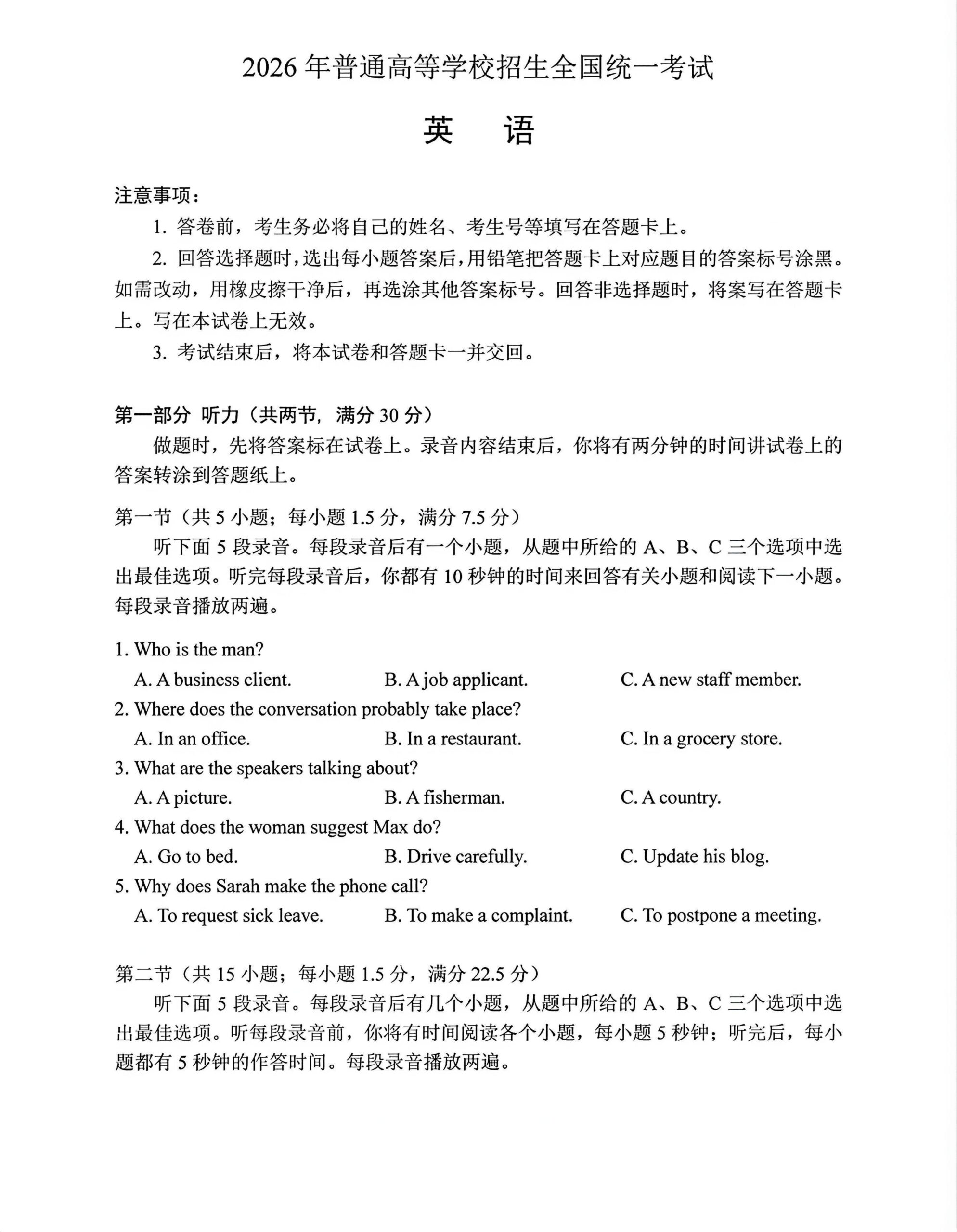
The 2026 Gaokao English paper arrived. The writing section was on pages 13–15.
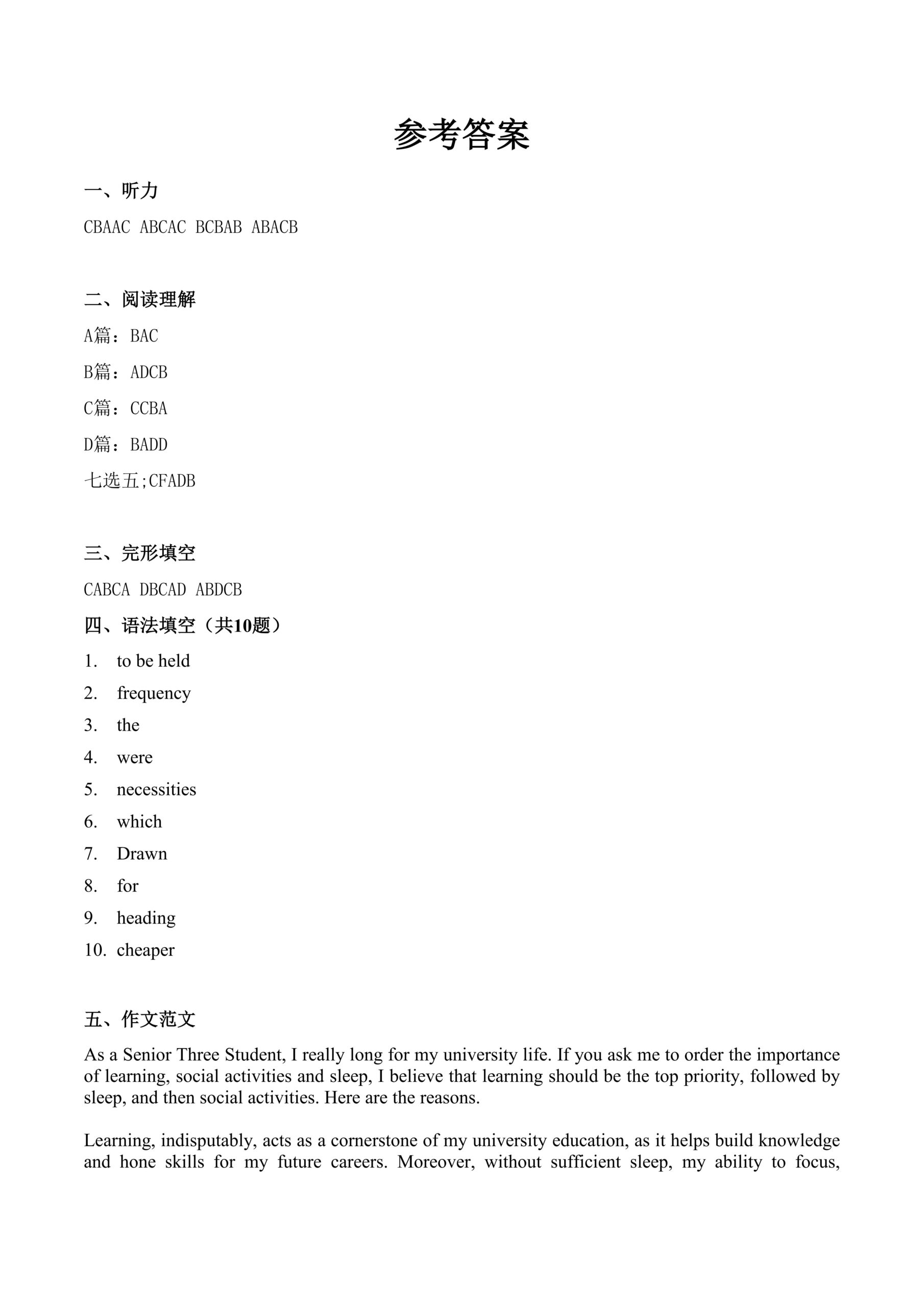
Task 1 (15 points): An opinion essay for a school newspaper English column. Prompt: Rank the three elements of university life — studying (学习), sleeping (睡眠), and socializing (社交) — in order of importance, and explain your reasoning.
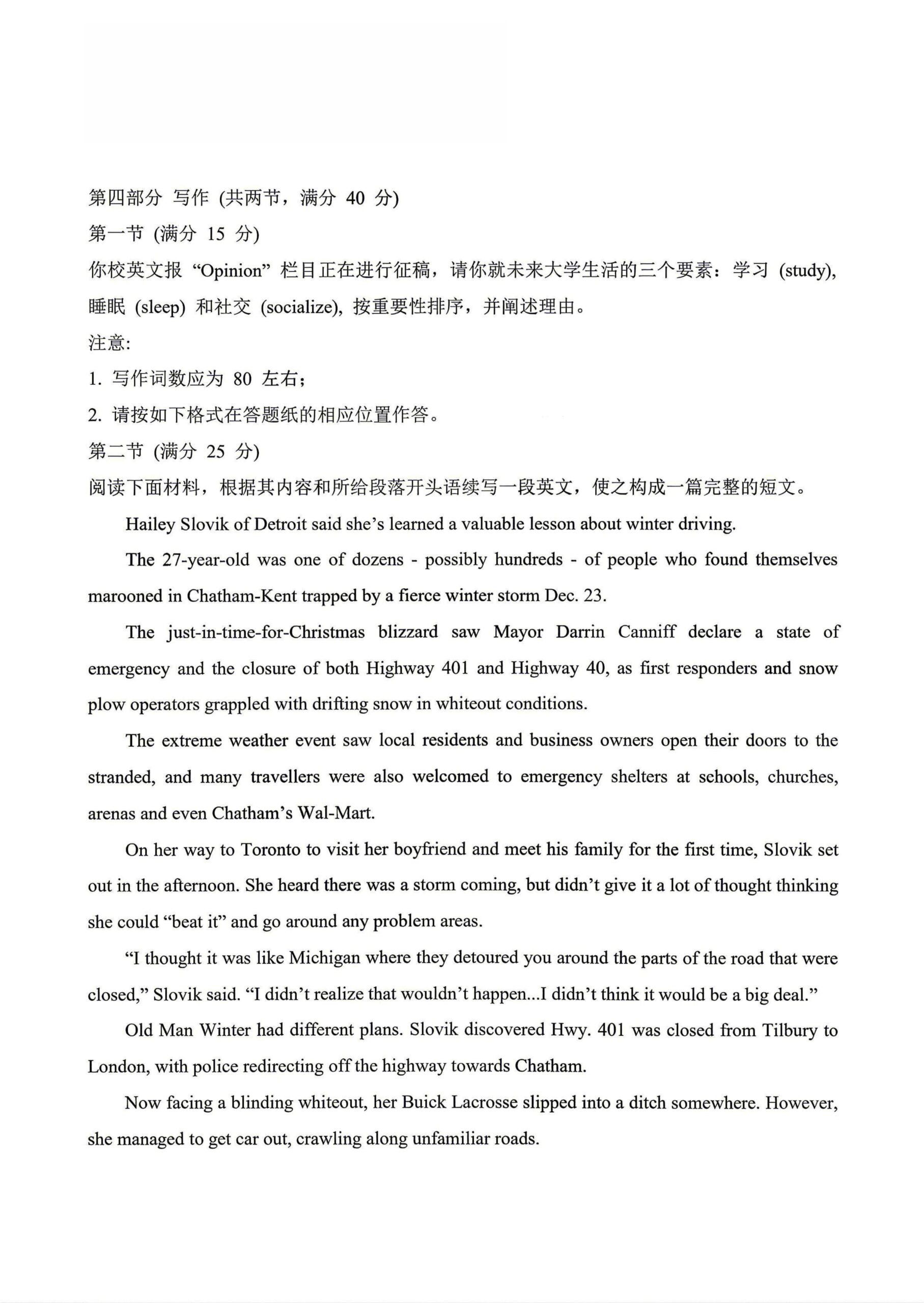
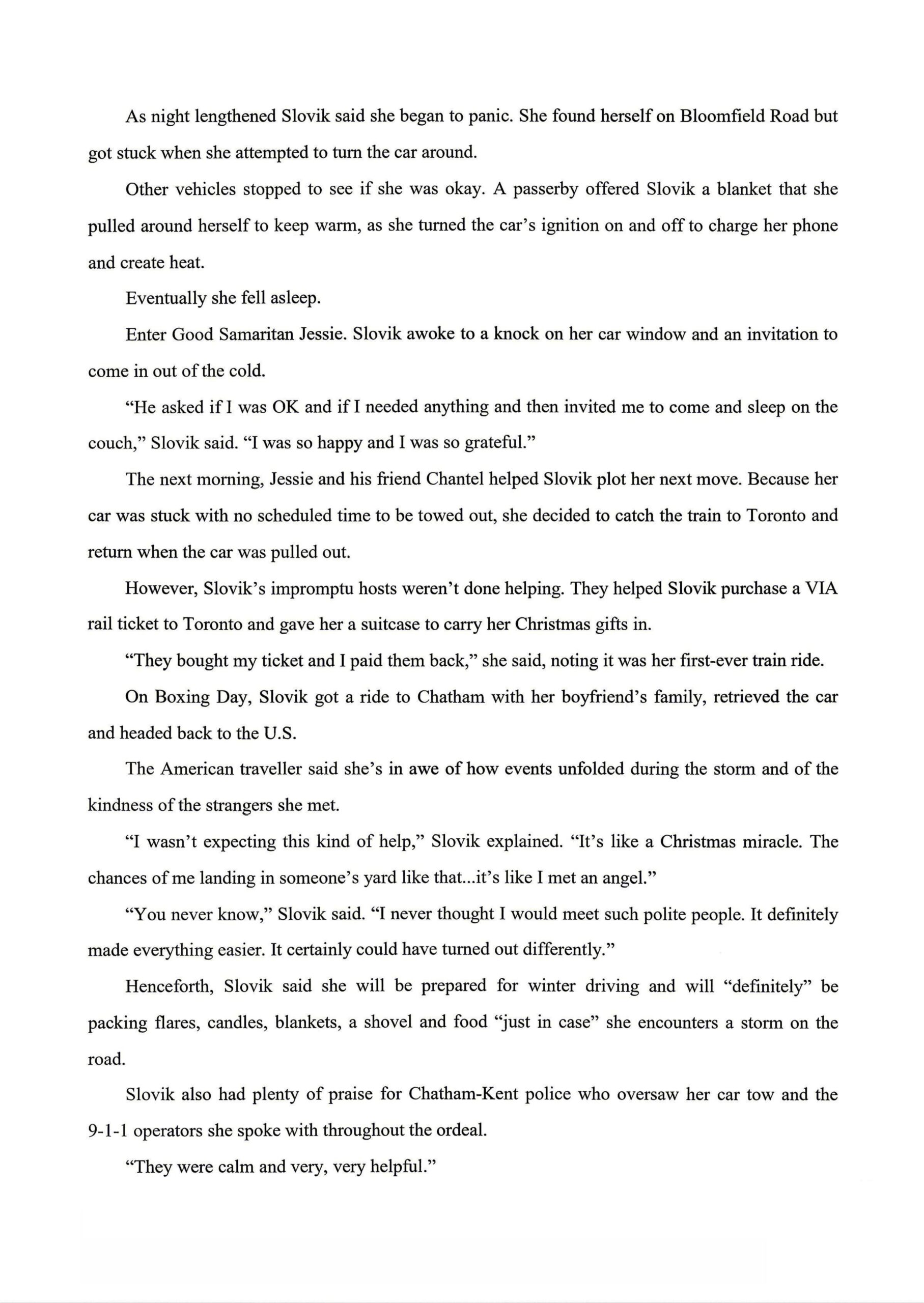
Task 2 (25 points): A story continuation. The provided passage was about an American traveler named Hailey Slovik, caught in a blizzard in Ontario, Canada on December 23rd. Her car slid into a ditch. Strangers opened their homes to her. She needed to catch a train to Toronto to meet her boyfriend.
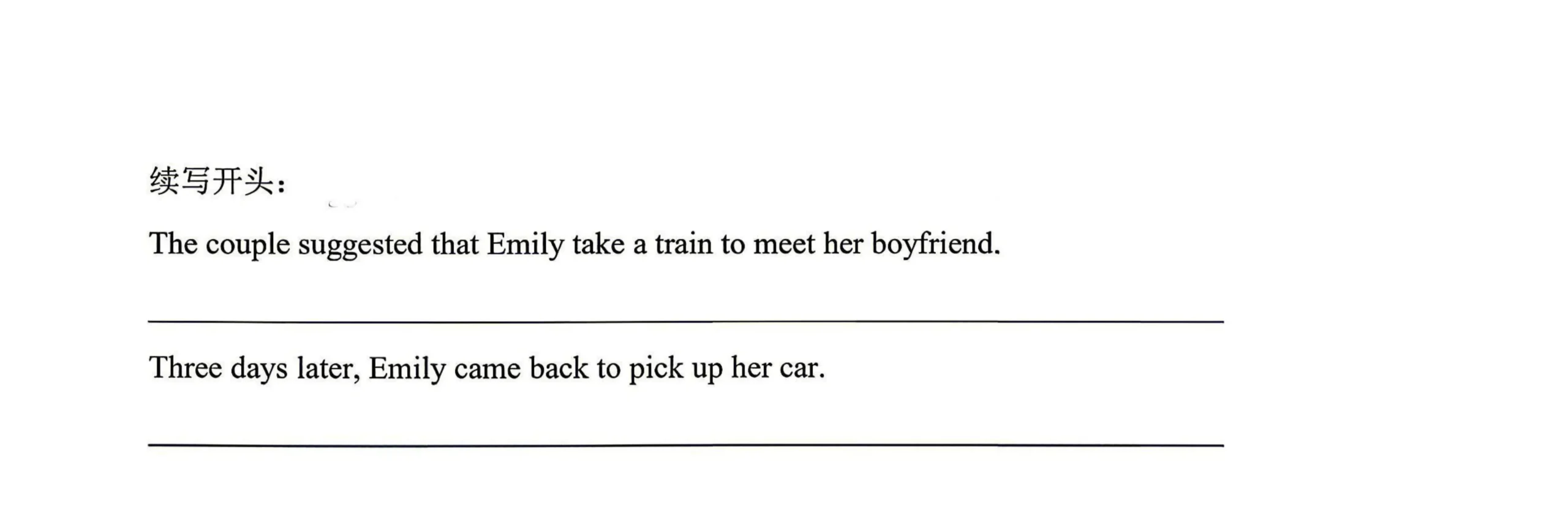
The two continuation prompts: “The couple suggested that Emily take a train to meet her boyfriend.” / “Three days later, Emily came back to pick up her car.”
Scoring AI’s Predictions
Let me go through this carefully.
Format prediction (letters): ❌ Wrong. AI predicted invitation letters and recommendation letters. What appeared: an opinion essay and a story continuation. No letters anywhere.
Topic 1 — AI/Technology campus events (★★★★★): ❌ Wrong. The actual Task 1 was about university study/sleep/social priorities. No AI. No technology. No campus events.
Topic 2 — Green/low-carbon: ❌ Wrong. The actual Task 2 was set in a Canadian snowstorm. Winter weather, human kindness — no environmental message.
Topic 3 — Cultural heritage: ❌ Wrong. No intangible cultural heritage. No handicraft workshops. No youth volunteers.
Grammar structures (倒装句, 虚拟语气, 非谓语作状语): ✅ Universally valid. These sentence patterns work in any English writing task. Always worth learning.
The score: 0 out of 3 topics correct. 0 out of 1 format correct.
Why AI Got It Wrong
This is the interesting part.
AI’s topic predictions failed for a structural reason, not a knowledge reason. Gaokao questions are sealed. No AI has access to them before the exam — and the actual humans writing the questions are isolated from public discussion during preparation.
What AI can do: analyze patterns in what has already appeared. What it cannot do: know what an individual exam committee decided in a closed room.
The 2026 topics — university life priorities, a Canadian blizzard — came from somewhere. They reflect what a small group of people thought was interesting, current, and testable for 2026’s cohort. AI had no window into that room.
The five-star confidence rating was a prediction, not a fact. AI presented it as such — but confidence ratings have a way of feeling like certainty, especially to a stressed student reading them six days before an exam.
What AI Got Right
The grammar toolkit turned out to be the genuinely valuable part.
Sentence openers like “There is no denying that…” and “Only in this way can we…” work in opinion essays. They work in story continuations. They work in letters, speeches, any extended English writing. These patterns are topic-agnostic. AI taught them correctly.
And AI wrote something else that I found worth keeping: a letter to the student preparing for the exam. Not a prediction. Not a toolkit. Just a letter.
It said, roughly: You have prepared for twelve years. The exam will test what you know. What you cannot prepare for is the specific question — and that is true of everyone sitting in the same room. Go in prepared, not predicted.
That was the most honest thing it produced across the entire exercise.
What This Tells Me — And One Bigger Question
AI is genuinely useful for building transferable skills. Sentence patterns, essay structure, reading technique — these compound over time and apply to whatever actually appears on the day.
AI is unreliable for predicting specific content that comes from a sealed human decision. It can tell you the shape of the likely question. It cannot tell you the question.
The students who used AI’s grammar toolkit: probably helped.
The students who only memorized AI’s predicted topics: probably not.
That’s the clean conclusion. But sitting with it as a parent of a child who will sit a future Gaokao, I keep turning over a bigger question.
Will our children even need to learn English?
AI translation is already good enough for most daily conversations. Real-time tools handle meetings. Reading assistants handle most text. If my child has AI on their phone that translates anything instantly — does spending years on English grammar still make sense once the exam is behind them?
I think the Gaokao English exam is partly testing something that is becoming less essential: the ability to produce correct English sentences in a world where AI can produce them faster and better. That part may matter less in future careers.
But the reading comprehension section tests something that won’t be automated away: the ability to move through a complex text under pressure, infer unstated meaning, reason carefully, and distinguish what the author actually said from what you assumed. Those are thinking skills — dressed in a foreign language to make them harder. That part stays valuable regardless of what translation tools exist.
Whether we’ll still run high-stakes national exams on those skills in English specifically — twenty years from now — is a genuinely open question.
And yes: Gaokao English is genuinely hard for most Chinese students.
The reading section involves five academic-style passages on science, culture, and human interest — all under time pressure, all at a vocabulary level well above everyday conversation. The writing section demands formal grammar structures most students have never used in real life. A score above 130 out of 150 puts a student near the top tier nationally. The gap between a 115 and a 130 is built over years, not weeks.
When I put the 20-question reading test together from the actual 2026 paper, I expected it to be manageable. It wasn’t.
The 12.6 million students who took the 2026 Gaokao have their scores now. I hope the ones who used AI as a skill-builder rather than a crystal ball came out ahead. For my child’s future cohort — that’s still the plan I’m working with.
Claude Opus 4.8 also wrote something I found worth keeping: a letter to the student — and a grammar toolkit of sentence patterns that work regardless of what actually appears. I asked it to write that for a friend’s child who sat the 2026 exam. Read the letter and the toolkit →
Have you used AI to prepare for an exam? I’m curious — especially from parents in the same position.
📝 Now Your Turn
You’ve seen what AI predicted. Now test your own English level.
Take the actual 2026 Gaokao reading comprehension section — 20 questions, click-to-answer, instant scoring. See if you’d make the cut.
Try the 2026 Gaokao English Test →Share your experience or thoughts below.
Try the Exam Yourself
I built an interactive version of the real 2026 Gaokao English reading section — 20 questions, instant scoring, no login required.
The source code is open and free to fork:
github.com/daligao/gaokao-2026-english-exam
Or play it directly on GitHub Pages:
daligao.github.io/gaokao-2026-english-exam
Related Reading
- My Niece Is Competing for One of China’s Most Sought-After Jobs. I Used AI to Build Her a 30-Page Study Guide. It Took 20 Minutes.
- I Asked AI to Help Me Start a Side Hustle on China’s Biggest App. My Account Was Banned Before I Got a Single Follower.
- My Friend Is 45 and Works in IT. He Asked Me What to Do. I Asked AI. Here’s the Roadmap.
Leave a Reply