Two indie products, two pricing models, and one uncomfortable question: if AI makes everything easy to build, what is actually worth paying for?
October 13, 2026 · The One-Person Business Experiment
A few days ago, I was browsing V2EX, a Chinese developer community, when I discovered an independent developer’s project called TextToPoster.
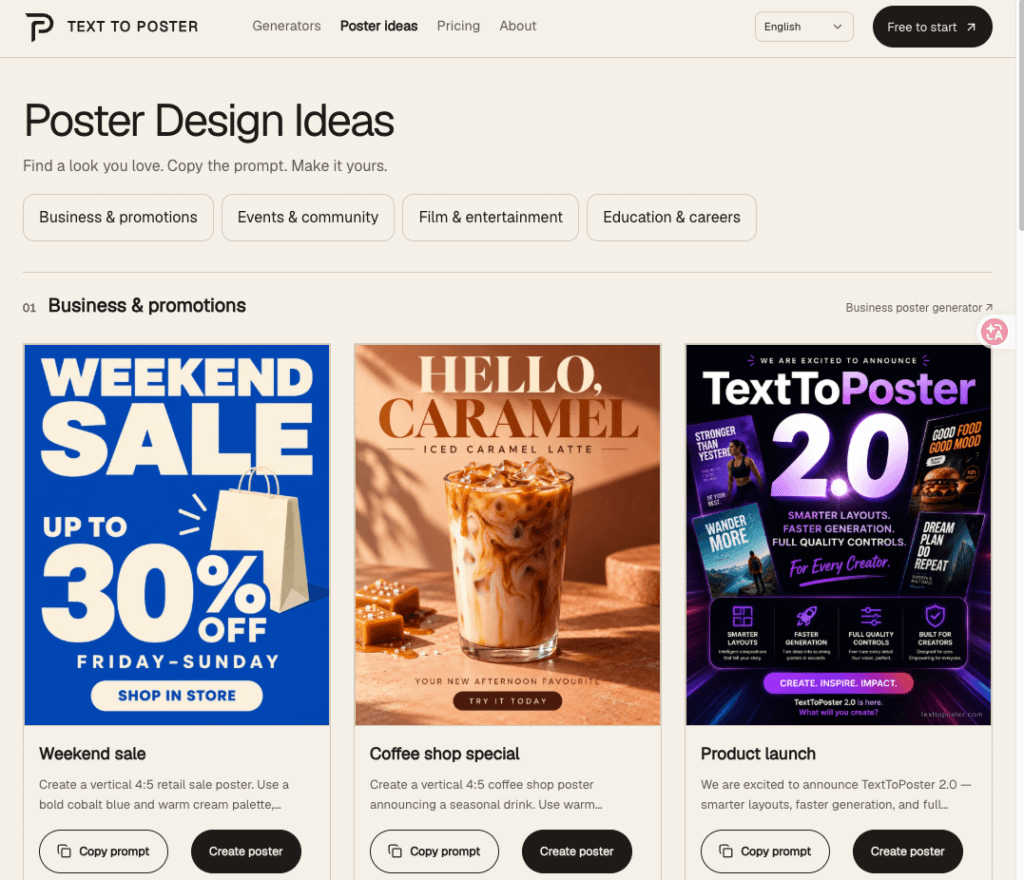
It was a simple idea: enter some text, choose a visual direction, and let AI turn it into a poster.
The website looked polished. It had an attractive interface, design examples, free trials, user accounts, AI image generation, and subscription plans.
Then I found out the developer had built another website, Designhint, a collection of design prompts combined with an AI image-generation workspace.
My immediate reaction was admiration, followed by a slightly uncomfortable comparison.
I had also built a small online product, CutDone.
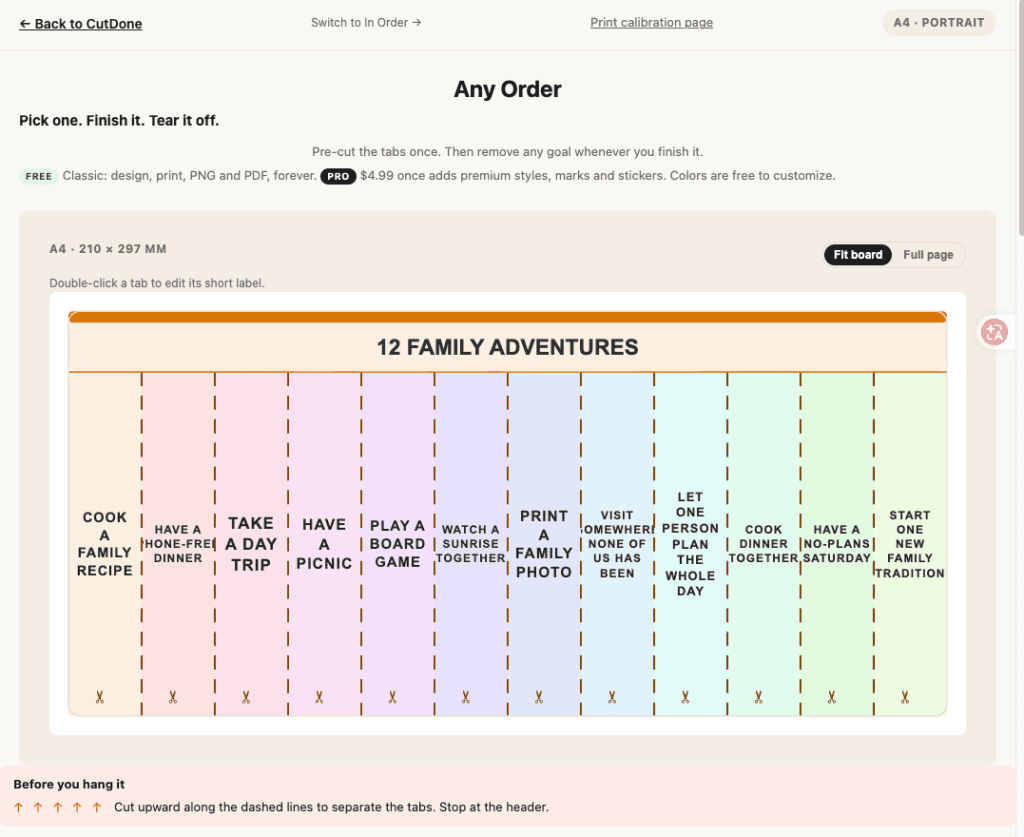
Free:
Pro:
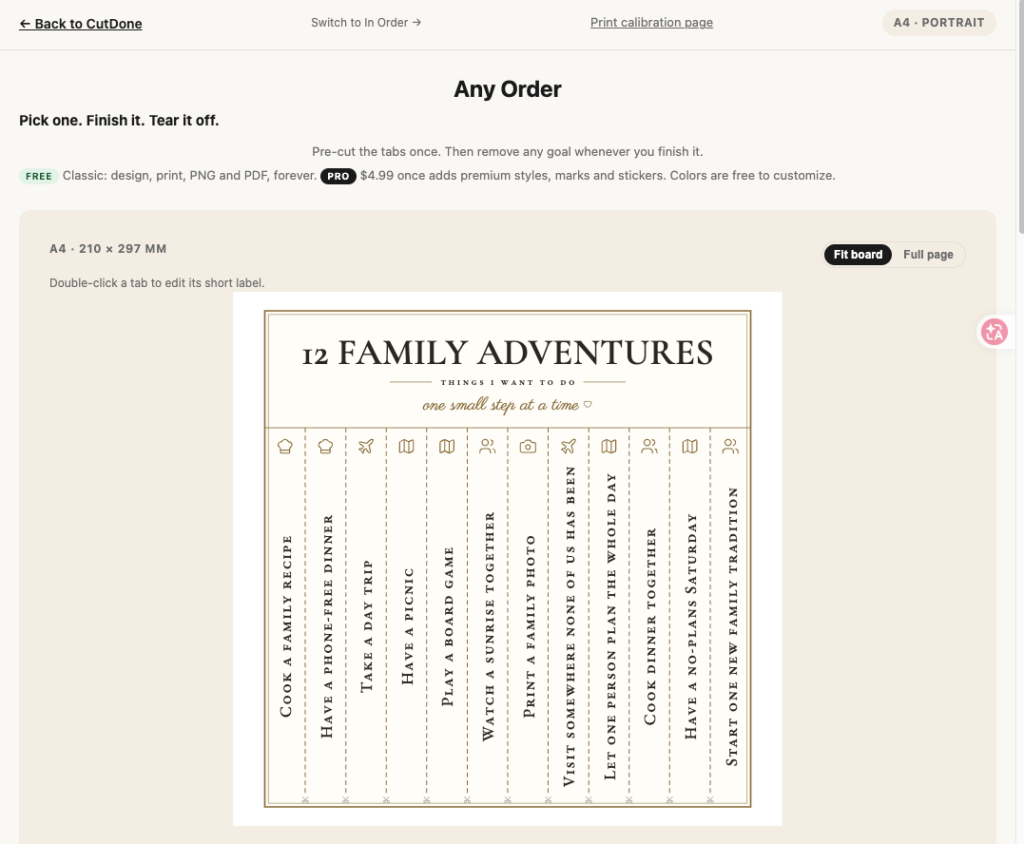
Mine was less visually impressive. It didn’t generate beautiful images on demand. It helped people create printable goal lists, complete tasks, and physically tear or cut off finished items.
The products were different, but their businesses had something important in common.
Both were small, AI-assisted online tools built by independent developers. Both offered free functionality and paid upgrades. Both needed search traffic, users, and eventually customers.
So I started asking ChatGPT questions.
Which business had better economics? Which was more likely to attract users? Which could convert visitors into paying customers? And which would survive as AI became more powerful?
The deeper we went, the more interesting—and uncomfortable—the answers became.
1. Two Different Products, Two Different Business Models
First, the basic comparison.
| TextToPoster | CutDone | |
|---|---|---|
| Main purpose | Generate AI posters | Create printable goal lists |
| Immediate appeal | See a beautiful image | Create and physically use a checklist |
| Free offering | Limited image generation | Free editing and printing |
| Paid pricing | From $9.90/month | $4.99 one-time |
| Main variable cost | AI image generation | Occasional AI text generation |
| Repeat-use potential | Potentially high for designers and marketers | More occasional or goal-dependent |
| Main challenge | Standing out from general AI image tools | Explaining why a physical list is useful |
| Primary business model | Credits and subscriptions | Free tool with optional Pro upgrade |
At first glance, TextToPoster has the stronger commercial proposition.
Someone who regularly creates marketing images might use it dozens of times a month. A business can justify paying $9.90 monthly if the service saves enough time.
CutDone has a different problem.
A person might make a goal list once, print it, and not return for weeks.
Even if they love the product, why would they pay $4.99?
That question bothered me more than I expected.
A product can be useful without creating a compelling reason to purchase it.
And a product that costs almost nothing to operate can still earn almost nothing.
2. The Cost Difference Was Surprising
One of CutDone’s biggest advantages is its low monetary cost.
Its domain costs me approximately ¥75 per year.
I use Cloudflare for hosting and backend infrastructure, and some DeepSeek text-generation requests cost approximately ¥0.01 each under my current usage.
Of course, the domain is not my entire business expense. There are payment fees, possible usage-based costs, development tools, and the value of my own time.
Still, the operating model is unusually lightweight.
Even if few people visit the website, I can afford to keep experimenting.
TextToPoster has different economics.
According to the developer’s public introduction, the website uses an external AI image service through APIMart. Its current pricing page identifies GPT Image 2.5 as its image engine.
Initially, I guessed that image generation might cost the developer around ¥0.03 per image.
But when I looked at APIMart’s published pricing, I found that some GPT Image 2.5 image endpoints were listed from approximately $0.0085 per standard 1K image, with higher published prices for certain higher-resolution outputs.
That is a public API price, not the developer’s verified internal cost. Discounts, model selection, quality settings, failed requests, and other processing steps can change the actual figure.
Also, comparing one DeepSeek text request with one AI image is not an apples-to-apples comparison.
The meaningful difference is not simply one cent versus three cents.
It is that CutDone’s core printable tool can operate without an AI call, while AI image generation is central to TextToPoster’s product.
That makes their marginal-cost structures fundamentally different.
Can one paying customer cover 100 free users?
This was the first calculation I wanted to understand.
Suppose 100 people try an AI poster generator, and one pays $9.90 for a monthly subscription.
That is a 1% visitor-to-paid conversion rate.
Using the illustrative $0.0085 image cost, consider two scenarios.
| Scenario | Free images generated | Estimated image API cost | Revenue from one subscriber | Remaining before other costs |
|---|---|---|---|---|
| Each of 100 users generates 2 images | 200 | $1.70 | $9.90 | $8.20 |
| Each of 100 users generates 10 images | 1,000 | $8.50 | $9.90 | $1.40 |
These are hypothetical scenarios, not actual usage data. The second scenario assumes everyone registers or otherwise qualifies for enough free generations.
And the calculation is incomplete.
The paying subscriber may continue generating images. Payment fees, storage, other API calls, support, and infrastructure also cost money.
But the exercise revealed something important.
A 1% conversion rate might be profitable under one usage pattern and unprofitable under another.
Conversion rate alone cannot tell us whether an AI business makes money.
You also need to know how much free users consume, how much paid users consume, and how long subscriptions last.
TextToPoster might have excellent unit economics. It might not.
Without access to its actual billing and usage data, I cannot know.
But I now understand what I would need to measure if I operated that kind of business.
3. Then I Compared the Revenue Potential
CutDone costs $4.99 for a one-time Pro purchase.
TextToPoster’s entry subscription is $9.90 per month.
Let’s imagine both websites receive 1,000 visitors in one month.
What happens at different visitor-to-paying-customer conversion rates?
| Conversion rate | Paying customers | CutDone sales at $4.99 | TextToPoster first-month subscriptions at $9.90 |
|---|---|---|---|
| 0.2% | 2 | $9.98 | $19.80 |
| 0.5% | 5 | $24.95 | $49.50 |
| 1.0% | 10 | $49.90 | $99.00 |
| 2.0% | 20 | $99.80 | $198.00 |
| 5.0% | 50 | $249.50 | $495.00 |
These are simulations, not measured conversion rates for either website.
The figures exclude expenses. For TextToPoster, they include only the first month of subscriptions and assume all customers choose the entry plan.
Nevertheless, the structural difference is obvious.
TextToPoster can potentially earn more from every new customer, especially if subscribers remain active for several months.
But that recurring revenue is conditional.
If users only need a few posters, they might purchase a one-time credit pack or cancel quickly. If heavy users consume all their credits, the platform must pay for that usage.
CutDone has lower revenue per customer, but its variable costs are potentially much lower.
Neither model is automatically superior.
One favors higher revenue per customer and repeat usage.
The other favors simplicity, low costs, and long-term survival.
The next question is whether either website can attract enough customers in the first place.
4. The SEO Numbers Were a Reality Check
TextToPoster initially looked like a more successful website than mine.
But attractive design and commercial success are two different things.
I checked a Semrush organic keyword report for the domain.
At the time of my research, the report showed:
- 12 ranking keywords.
- Estimated organic search traffic of zero.
- Several relevant keywords ranking between positions 64 and 97.
- No meaningful estimated organic traffic from the listed pages.
This does not prove the website has no visitors.
Semrush traffic estimates are incomplete. Visitors may arrive through social networks, direct visits, referrals, and other search engines.
Still, those rankings suggest that Google was not yet supplying substantial measurable organic traffic.
CutDone has a different SEO strategy.
It contains hundreds of ready-made printable lists, goal ideas, and specialized landing pages.
I have also seen its “2027 goals” keyword reach Google’s top-ten results temporarily.
That was exciting for a young website.
But I learned to be careful about celebrating rankings too early.
A keyword can appear near the top one day and disappear later. A sitemap containing hundreds of URLs does not mean hundreds of pages receive organic traffic.
And a page view is not the same as a paying customer.
The real comparison is not:
Which website has more pages?
It is:
Which website attracts visitors with an actual problem, then helps enough of them solve that problem?
TextToPoster’s individual design examples may attract people searching for poster inspiration.
CutDone’s templates may attract people looking for printable goals, checklists, or challenges.
Both strategies make sense.
Neither guarantees commercial success.
I now believe small website owners, myself included, spend too much time counting published pages and too little time measuring what visitors do after arriving.
5. I Tried to Recreate One of His Posters Using ChatGPT
Then something interesting happened.
I found a retail sale poster example on TextToPoster’s inspiration page.
It used bold typography, a blue-and-cream color scheme, a shopping bag, and a large discount message.
Instead of paying to generate it on the specialized website, I took the idea into ChatGPT and asked for a similar poster.
The result was remarkably close in visual concept and overall effect.
It was only one informal experiment, not a comprehensive quality benchmark.
But it raised a question I couldn’t ignore.
If ChatGPT can already produce a similar result, what will happen to specialized AI poster generators in two or three years?
At first, I thought the answer was simple.
Maybe these tools exist mainly for people who don’t know how to use AI.
But that explanation is too dismissive.
People pay for convenience all the time.
A busy marketer may not want to experiment with prompts, compare multiple AI models, manage generations, or manually prepare deliverables.
A dedicated tool can package all those steps into a faster workflow.
Designhint makes a related bet: curated design prompts, examples, multiple models, and image tools in one place.
That can save time.
The commercial question is whether the saved time is valuable enough for customers to continue paying.
And there is a long-term risk.
As ChatGPT and other general-purpose AI products become easier to use, some of that convenience advantage may disappear.
A specialized product needs to offer more than access to a model.
It needs to become meaningfully better at a particular job.
6. Then I Realized CutDone Faces Exactly the Same Threat
This was the most uncomfortable moment in the entire analysis.
I had been thinking that TextToPoster could eventually be replaced by general-purpose AI.
Then I asked myself:
Why couldn’t ChatGPT replace CutDone too?
A user could ask:
“Create a printable 2027 goal tracker with ten detachable tasks. Make it attractive and fit on A4 paper.”
AI can already help create something resembling that.
Its output and printing reliability may not match a purpose-built tool, but those capabilities will improve.
So perhaps my product is not protected simply because it has a special printable layout.
I cannot build a long-term business around the assumption that ChatGPT will never learn to do what my website does.
That would be a dangerous assumption.
But the comparison also helped clarify what CutDone should actually sell.
It should not sell the ability to generate a checklist.
It should deliver the easiest possible experience of taking a goal from someone’s mind and placing it into their physical environment.
Imagine two workflows.
Using general-purpose AI:
Describe a checklist, generate a layout, inspect it, correct the text, adjust the paper dimensions, export it, and make sure it prints properly.
Using a specialized product:
Choose a goal, edit a few lines, print it, and start using it.
If CutDone consistently makes the second experience easier, it has a reason to exist.
Not because AI cannot create a checklist.
But because users may prefer a workflow that has already been designed for them.
Of course, that advantage must be demonstrated, not assumed.
7. My Biggest Weakness Might Be Product Presentation
One thing TextToPoster does very well is make its value obvious.
You see beautiful poster examples.
You immediately understand what the website produces.
CutDone is more difficult to explain.
A printable strip of paper does not seem particularly exciting on a screen.
The interesting part happens afterward.
You print the list, put it on your wall or refrigerator, complete a task, and physically remove it.
The paper gets shorter.
That small ritual is the idea behind the product.
But visitors cannot experience it just by reading a paragraph.
This made me realize that I may have been trying to solve a marketing problem with more programming.
I had been building more templates, more pages, and more functionality.
What I actually needed might be much simpler:
Real photographs of my own product being used.
Not polished AI-generated mockups.
Real paper.
A real printer.
A real wall.
A real pair of scissors.
Maybe a short video showing someone removing a completed task.
For an AI image generator, the generated image is the proof.
For CutDone, the proof might be the physical experience.
Until I show that experience properly, expecting strangers to understand the product—and then pay for it—may be unrealistic.
8. The Missing Steps Between a Website and a Business
This comparison exposed another weakness in my thinking.
I had invested heavily in building the product.
But I had not invested the same effort in building the business around it.
These are different jobs.
A functioning website needs code, hosting, a database, design, and testing.
A functioning business needs customers.
Between those two, there is a chain of events:
Discovery → Understanding → First use → Successful outcome → Perceived paid value → Purchase → Recommendation
Each stage can fail independently.
Someone might discover CutDone through Google but leave because the homepage doesn’t explain the idea clearly.
Someone else might open the designer but never finish a list.
Another person might make a list and click Print, but have trouble printing it.
And someone who successfully prints a free list might be completely satisfied without purchasing Pro.
That final possibility is particularly important.
CutDone’s free version is genuinely useful.
I want people to be able to create and print basic lists without registering or paying.
But if the free experience already solves the user’s problem, what exactly makes the paid version worth $4.99?
Is it better visual design?
More personalization?
AI-generated plans?
A special occasion?
I have hypotheses, but not enough evidence yet.
My next task is not to invent more features.
It is to discover which part of the existing product people value enough to pay for.
9. Which Business Would I Rather Own?
After all this analysis, I still cannot declare a winner.
If I were trying to maximize potential subscription revenue, TextToPoster might be the more attractive business model.
Its users could have recurring professional needs, a higher willingness to pay, and reasons to use the product repeatedly.
But it also operates in an intensely competitive market where general-purpose AI platforms are improving rapidly.
If I wanted a very low-cost experiment that I could keep running for years, I would choose CutDone.
Its domain is inexpensive, free printing doesn’t inherently require costly AI generation, and I can afford to let the product grow slowly.
Yet CutDone has its own weaknesses: low purchase frequency, a small one-time price, and an experience that requires more explanation.
Low costs give me time.
They do not give me customers.
And a more expensive competitor is not necessarily a less profitable one.
There is another distinction I have started to appreciate.
Revenue potential, profitability, and probability of survival are three different things.
A business may have enormous revenue potential and still fail.
Another may earn only a few dollars per month while surviving for years.
Survival is useful because it creates opportunities to learn and improve.
But survival alone is not success.
10. What I Am Going to Do Differently
Instead of endlessly comparing features, I want to run a more practical experiment with CutDone.
First, I will make real printed lists and photograph them in ordinary settings.
Second, I will measure the complete user journey, from opening the website to editing a list, clicking Print, exploring Pro, and purchasing.
A print click is only a proxy for printing, not proof that a physical sheet actually came out of the printer. I will need real user feedback to understand that part.
Third, I will focus on a few specific use cases rather than assuming everyone who sets goals needs my product.
My 2027 Goals pages offer one timely opportunity. Other possibilities include savings challenges, family activities, and habit tracking.
Fourth, I want to observe actual strangers using the website.
If ten people try CutDone and nobody understands it, that tells me something important.
If ten people love printing it but nobody buys Pro, that tells me something different.
And if a few people voluntarily recommend it to others, that may be more meaningful than a temporary Google ranking.
Finally, I will publish what happens.
Not just the improvements.
The disappointing results too.
The Bigger Lesson: AI Has Made Products Cheap, Not Customers Easy
When I first began experimenting with AI-built websites, my attention was almost entirely on what I could create.
Could I build a working product?
Could I deploy it on Cloudflare?
Could I add payments?
Could I make hundreds of landing pages?
Could I keep the annual cost extremely low?
For CutDone, I have answered many of those questions.
Now I face a harder set.
Can I attract the right users?
Can I help them reach a useful outcome?
Can I persuade a small percentage to pay without ruining the free experience?
And can I do this repeatedly, rather than once by accident?
The developer behind Designhint and TextToPoster may already be solving some of these problems better than I am.
Or he may be facing the same difficulties.
I don’t know his real traffic, payment conversions, acquisition costs, or profits. A polished website and a subscription pricing page cannot answer those questions.
But examining his products forced me to think more carefully about my own.
And perhaps that is the most valuable outcome of the exercise.
I began by comparing two websites.
I ended up examining two business models—and discovering how much I still need to learn about running one.
The cost of building software is approaching zero for many small projects. The cost of finding people who truly value it is not.
My domain costs about ¥75 a year.
That gives me plenty of time to find out whether CutDone can become a real business.
It doesn’t guarantee that it will.
And from now on, I want to spend less time asking what else AI can help me build, and more time finding out what people actually want to use.
Sources and notes
Research conducted in October 2026. Pricing and product features may change.
- TextToPoster — Website
- TextToPoster — Pricing
- Designhint — AI Image Generation
- Designhint — Pricing
- Developer’s TextToPoster introduction on V2EX
- APIMart — Public AI Model Pricing
- CutDone — Printable Goal Lists
- CutDone — 2027 Goals
The TextToPoster organic ranking figures came from a Semrush snapshot reviewed during this analysis. They are third-party estimates, not verified site analytics.
The conversion and cost tables are hypothetical business-model exercises, not actual sales or internal financial results from TextToPoster, Designhint, or CutDone.
CutDone operating-cost observations come from my own development experience.
Leave a Reply