
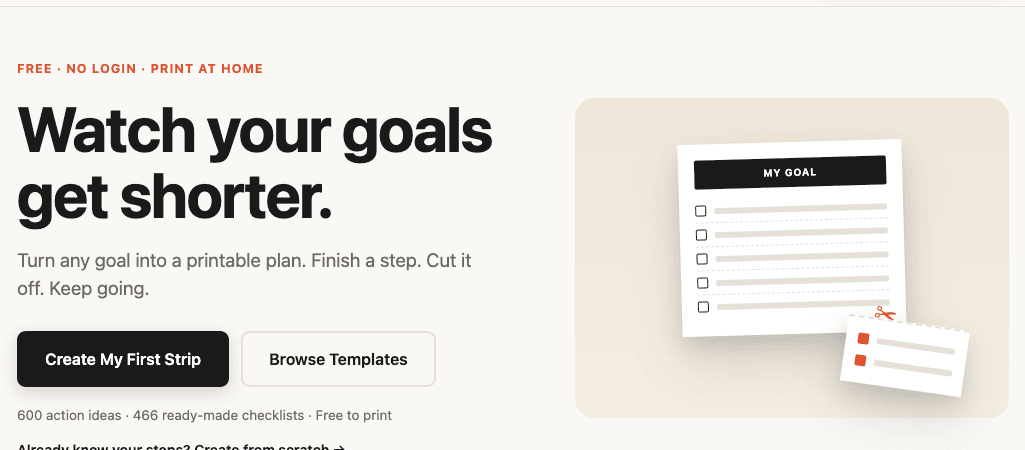
I recently finished building a paid version of one of my small products, CutDone.
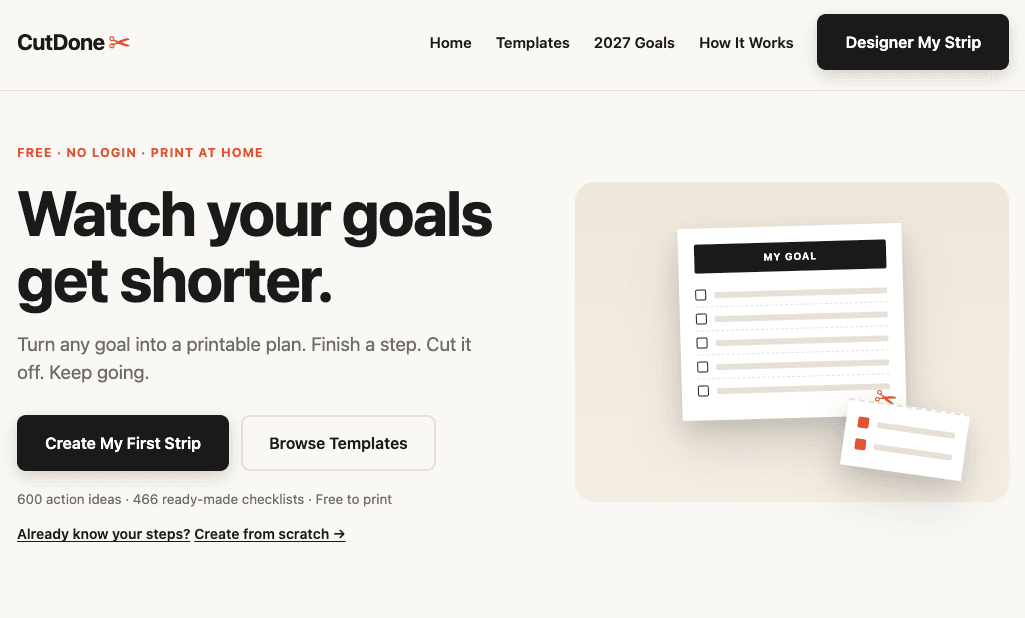
The product itself is simple.
You create a printable goal list, customize the style, preview the result, and if you like what you made, you can unlock the Pro version to print it beautifully or export it as PNG and PDF.
No subscription.
No account.
One payment.
The development was mostly done.
The payment system was connected.
The email receipt system was working.
Then I ran into a question that looked simple at first:
How much should I charge?
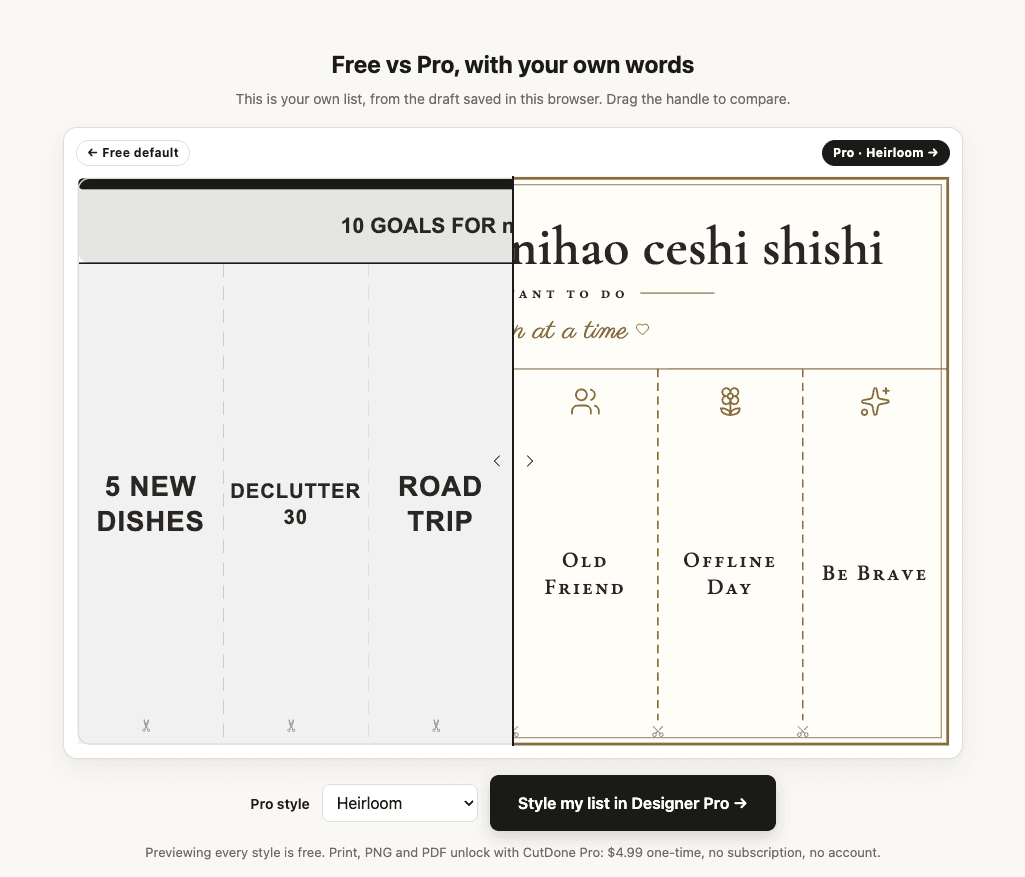
$2.99?
$3.99?
$4.99?
$5.99?
I originally thought pricing was mostly a matter of intuition.
Pick a number that feels reasonable and move on.
But after discussing it with AI and looking at similar products across the web, I realized that pricing is much deeper than I had thought.
And surprisingly mathematical.
First, CutDone Is Not a Zero-Cost Product
It would be wrong to say the product costs me nothing.
There is a real fixed cost.
I spent time developing it.
There is domain cost.
There is infrastructure.
There is maintenance.
There is testing.
There will probably be customer support.
And most importantly, there is my own time.
But once the product is built, the economics change.
The cost of serving one additional customer becomes very small.
Whether 10 people use CutDone or 10,000 people use it, the cost does not increase in the same way it would for a physical product.
So there are really two different costs:
Fixed cost: building and maintaining the product.
Marginal cost: the cost of serving one more customer.
For a digital product like CutDone, the fixed cost is real, but the marginal cost is close to zero.
That changes the pricing question completely.
A restaurant cannot sell food below ingredient cost.
A factory cannot ignore manufacturing cost.
But for a digital product, pricing is often not mainly about cost.
It is about behavior.
The Formula Is Simple
The basic formula is:
Revenue = Price × Number of Buyers
Simple enough.
But the difficult part is that the number of buyers changes when the price changes.
Lower the price, and more people may buy.
Raise the price, and fewer people may buy.
The real goal is not to maximize price.
It is not to maximize the number of buyers either.
It is to maximize:
Price × Buyers
That sounds obvious when written down.
But I realized I had never really thought about pricing this way before.
A Simple Example
Imagine 1,000 people reach the CutDone payment screen.
Here is one possible outcome:
| Price | Conversion Rate | Buyers | Revenue |
|---|---|---|---|
| $2.99 | 4.0% | 40 | $119.60 |
| $3.99 | 3.5% | 35 | $139.65 |
| $4.99 | 3.0% | 30 | $149.70 |
| $5.99 | 2.3% | 23 | $137.77 |
| $7.99 | 1.4% | 14 | $111.86 |
In this scenario, $4.99 is the best price.
Not because it is the cheapest.
Not because it is the most expensive.
Because it produces the highest total revenue.
Now imagine customers are much more price-sensitive:
| Price | Conversion Rate | Buyers | Revenue |
|---|---|---|---|
| $2.99 | 5.0% | 50 | $149.50 |
| $3.99 | 4.3% | 43 | $171.57 |
| $4.99 | 3.2% | 32 | $159.68 |
| $5.99 | 2.3% | 23 | $137.77 |
Now $3.99 wins.
Same product.
Same number of visitors.
Different customer behavior.
Completely different optimal price.
That was the first important lesson.
There is no universally correct price.
There is only a price that works best for a specific audience.
The Most Useful Calculation I Learned
One calculation became immediately useful.
Suppose I am charging $4.99 and I consider lowering the price to $3.99.
How many more customers do I need just to make the same revenue?
The answer is about 25%.
That means:
If 100 people buy at $4.99, I need roughly 125 people to buy at $3.99 just to stay even.
This changes the way you think about discounts.
People often say:
“Lower the price and you will sell more.”
Of course.
The real question is:
Will you sell enough more?
Here is the same idea:
| Price Change | Extra Buyers Needed to Match $4.99 Revenue |
|---|---|
| $4.99 → $3.99 | about 25% more |
| $4.99 → $2.99 | about 67% more |
| $4.99 → $1.99 | about 151% more |
| $4.99 → $5.99 | you can lose about 17% of buyers and still make similar revenue |
That table changed how I think about low pricing.
Cheap does not automatically mean smart.
Sometimes you are simply giving away revenue.
Then I Looked at the Market
I did not want to rely only on theory, so I looked at comparable products across Etsy and Gumroad.
The market was interesting.
Simple printable trackers and planning sheets often sell around:
$2.99 to $3.99
More polished planners and goal systems often sit around:
$4.99 to $5.99
Some larger bundles go higher.
But there was another pattern.
Many products with a listed price of $5.99 or higher are almost permanently discounted into the $2 to $4 range.
That tells me something important.
The market is competitive.
There is a lot of price pressure.
But most of those products are static PDFs.
That matters.
CutDone is different.
The user does not buy a fixed file.
The user first creates something personal.
They type their own goals.
They choose the style.
They preview the result.
They see their own finished design.
Only then do they decide whether to pay.
That creates a different kind of value.
The buyer is not really paying for “a PDF.”
They are paying to take something they already created and turn it into a finished product.
That is a stronger moment of purchase.
Why $4.99 Started to Make Sense
After looking at the market, $4.99 became more interesting to me.
Not because $4.99 is mathematically proven.
It is not.
I do not have enough real customer data yet.
But $4.99 has several advantages.
It is still within the normal range for digital printable products.
It is low enough to remain an impulse purchase.
It is high enough that the product does not feel cheap.
And it gives me room to learn.
If I start at $2.99, I may never know whether people would have happily paid $4.99.
But if I start at $4.99 and conversion is poor, I can always test $3.99 later.
That feels like a better experiment.
AI Can Help Find the Best Price
This was the part I found most interesting.
AI can actually help calculate the best price.
But only after real users generate real data.
If I test:
$2.99
$3.99
$4.99
$5.99
and collect enough data, I can measure:
- paywall views
- checkout starts
- completed purchases
- conversion rate
- revenue per 1,000 visitors
Then AI can estimate a demand curve.
In simple terms, it can model:
How much does conversion fall when price rises?
Once you know that relationship, you can estimate the price that maximizes revenue.
The theoretical best price may not even be a clean number.
The model might say:
$4.37
or
$4.62
Of course, I would probably still choose something like $4.49 or $4.99.
Real pricing is part mathematics and part psychology.
But the important point is this:
AI cannot magically invent the correct price.
It needs real behavior.
Without data, asking AI for “the perfect price” is mostly guesswork.
With data, AI becomes extremely useful.
This Also Changed How I Think About Building Products
The pricing discussion led to a bigger realization.
A lot of small founders spend too much time worrying about price before they have enough users.
Should it be $2.99?
Should it be $3.99?
Should I offer 50% off?
Should I launch at $1.99?
But maybe that is the wrong place to spend energy.
If the product is not useful, lowering the price will not save it.
If the product solves a real problem, a one-dollar difference may matter much less than we imagine.
The better question is:
Is the product good enough that people want it?
That is where most of the work should go.
Price Competition Is a Trap
There is another lesson here.
If your only advantage is being cheaper, someone else can always be cheaper than you.
$4.99 becomes $3.99.
Then $2.99.
Then $1.99.
Eventually everyone is fighting over almost nothing.
That is price exhaustion.
And I do not want CutDone to compete that way.
I would rather improve the product.
Make the design better.
Make the experience simpler.
Make printing smoother.
Make restoration easier.
Make the result feel worth keeping.
If users genuinely like the product, I do not need to win by being the cheapest.
That is probably the healthiest lesson from this entire pricing exercise.
Serve the User, Not the Price War
The more I thought about it, the more I realized that pricing should come after value.
Not before it.
A good product should make the user think:
“This is useful.”
Then:
“This is worth paying for.”
Not:
“This is cheap enough that I guess I will buy it.”
That is a very different relationship.
So for now, my plan is simple.
Build CutDone well.
Keep improving the experience.
Serve the user.
Do not waste too much energy fighting over one dollar.
Start at $4.99.
Collect real data.
Then let the market tell me whether I was right.
What I Learned
This little pricing exercise taught me more than I expected.
Here are the lessons I want to remember:
- Digital products still have real fixed costs.
Time, development, maintenance, infrastructure and attention all matter. - Low marginal cost does not mean the product should be cheap.
Price should reflect value, not just production cost. - Revenue is not about price alone.
It is price multiplied by the number of buyers. - Discounting only works if conversion increases enough.
A lower price can easily reduce total revenue. - AI can help calculate an optimal price, but only after real users create real data.
- The market matters, but copying the market blindly is not enough.
A customizable product is different from a static PDF. - The best long-term strategy is not price competition.
It is making the product better. - Serve the user first.
If the product creates enough value, pricing becomes easier. - Do not let pricing become internal friction.
Founders can spend days arguing with themselves over $1 while ignoring the bigger question: does anyone love the product? - The market will eventually answer the question better than I can.
For now, CutDone Pro will start at $4.99.
Maybe the data will prove me wrong.
I actually hope it does.
Because then I will have learned something real.
Leave a Reply