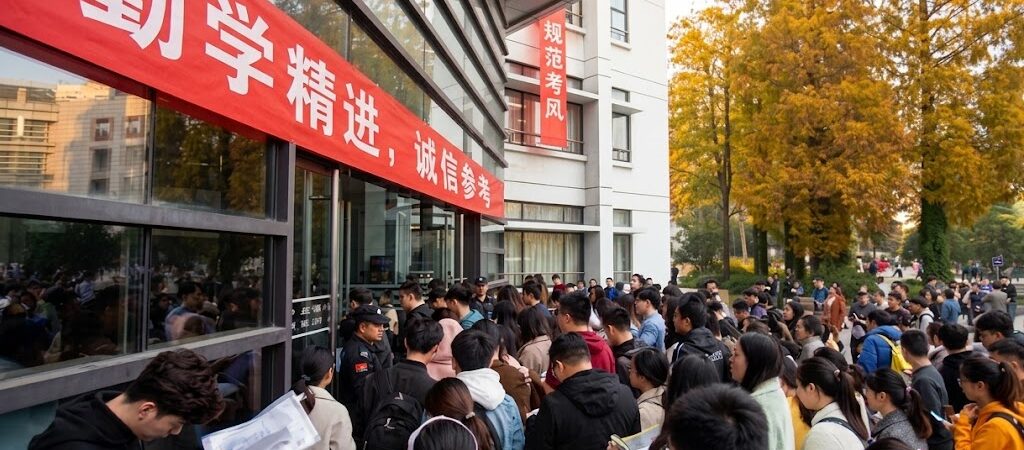
Every year in China, millions of university graduates compete for a limited number of government jobs.
🎯 Challenge — Before You Read
Think you know how hard China’s civil service exam is? Before reading — try the actual 公务员考试 questions yourself. 10 real questions, straight from the exam paper. No signup. Instant score.
The exam that controls access is called the 公务员考试 — the civil service examination. It’s not one exam but a layered system: a national exam in autumn, provincial exams in spring, each with papers tailored to specific positions and regions.
Last year, roughly 3.4 million people registered for the national civil service exam alone. The number of available positions: about 39,000.
That is approximately 87 applicants for every single job.
My Niece Called Me for Advice
My niece is about to graduate from university. She studies Internet of Things engineering, lives in a city in western China, and like most Chinese graduates right now, she’s staring at a difficult choice.
Option A: move to a bigger city, find a tech company, apply her degree in the private sector. Higher upside. Much higher risk. The private tech sector in China right now is not what it was in 2018.
Option B: go home, study for the civil service exam, try to become a government employee. Lower ceiling. Much higher floor. A civil servant in provincial China comes with healthcare, a pension, job security, and enough social status to make family dinners significantly more relaxed.
She asked what I thought.
I didn’t have a confident answer. But I knew a tool that might.
What Happened When I Asked AI
I use Claude almost every day — for this blog, for stock research, for projects around the house. But I had never used it to help someone navigate a real life decision before.
I started the conversation by asking Claude to think through what actually mattered most for her specific situation.
The first thing it flagged surprised me: her graduation year is her biggest strategic asset.
A 2027 graduate holds what Claude called the “golden card” — fresh graduate status (应届生身份). In China’s civil service system, large categories of positions are set aside exclusively for new graduates. These roles only compete against other new graduates, not against experienced candidates who have been preparing for years. The odds for those slots look completely different from the overall statistics.
The AI also spotted something she had missed entirely: the national exam in late 2026 could function as a full practice run before the Qinghai provincial exam in early 2027. Two real attempts instead of one. Most people treat these as separate decisions. The AI suggested treating them as a coordinated two-round strategy.
I had started the conversation looking for a quick summary of advice. But the further we went, the more complete the picture became. At some point I asked Claude to compile everything into a document she could actually use.
What a 30-Page AI Study Guide Looks Like
I asked Claude to build what it called a 备考白皮书 — roughly, a “preparation white paper.” The instruction I gave it: specific, dense, actionable. No filler encouragement. No generic advice that applies to every exam in every province.
What came back covered four areas:
A 12-month study plan divided into four phases. Each phase had a specific start date, a core task, a target daily study time, and a concrete standard for knowing when you had actually finished it. Not “work hard on verbal reasoning” but “complete the last three years of national exam papers at 75%+ accuracy before November 1st, then move to the next phase.” The difference between a vague plan and an actionable one is specificity about what done looks like.
Qinghai-specific exam content. This is where a generic study guide fails and where the AI actually added real value. The Qinghai provincial exam has distinctive topic preferences. Ecological conservation — specifically the 三江源 (Three Rivers Source), the origin point of three of China’s major rivers — appears constantly in the essay component. So does ethnic unity policy and rural development in high-altitude regions. The AI laid out the five official policy frameworks that appear most frequently in Qinghai essay prompts, with the vocabulary that examiners expect to see. That is not something you find in a national-level prep book.
Module prioritization by return on investment. The civil service exam has two main papers: 行测 (aptitude test — logic, math, language, data analysis) and 申论 (policy essay writing). Within 行测, some modules reward intensive drilling; others have a ceiling. For an engineering student, the AI worked out which modules were likely strengths to protect, which were high-value targets to improve, and which were low-priority relative to the time they would consume. Knowing what not to study is as useful as knowing what to study.
A daily schedule for a final-year student. Built around the reality of simultaneously writing a thesis. Morning blocks for memorization and concept review. Evening blocks for timed practice questions. A specific ramp-up schedule for the month before the national exam in November.
The whole document came out to about 30 pages. It read like something from a professional tutoring company — with the difference that it was built specifically for her situation, her province, her major, and her timeline.
How I Sent It
Before I forwarded the document, I typed one sentence that I thought about carefully:
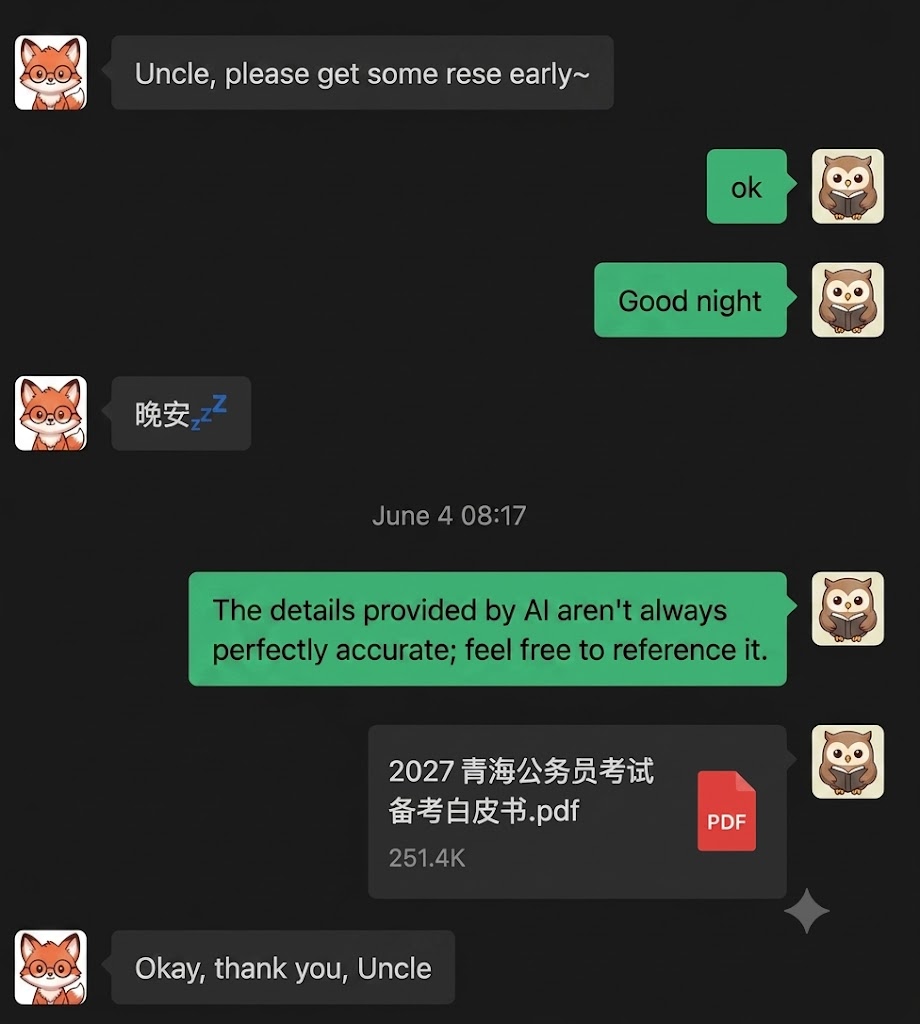
“AI给的细节不一定完全准确,你可以参考一下。”
Translation: “The details AI provided aren’t necessarily perfectly accurate — feel free to use this as a reference.”
Not: “Follow this plan exactly.” Not: “AI knows better than your teachers.” Just: here is a framework, from a tool that makes mistakes, treat it as a starting point.
She replied: “好的,谢谢小叔叔。”
Okay. Thank you, uncle.
What This Actually Tells Me About AI
I’ve read a lot about AI transforming industries. I think about it differently now.
My niece doesn’t have a tutor. She doesn’t have parents who took the civil service exam and can coach her through it. She doesn’t have money to spend on expensive prep courses. She lives far from the cities where exam prep resources are concentrated.
A 20-minute conversation produced a document that addressed her specific situation better than any off-the-shelf prep book could. Her province, her graduation year, her major, her timeline — all of it factored in.
The caveat I included wasn’t false modesty. The AI got some details wrong. Specific historical pass rates, recent changes to exam format, certain policy details — those need to be cross-checked against official sources. I know this. She should know this.
But a solid framework with clear phases and real priorities is most of what someone needs at the start of a year-long preparation. The verification work is a few hours of follow-up research, not months of lost time. You’re not replacing the study — you’re replacing the confusion about where to start.
The photo I used for this article: a crowd of hundreds of candidates queuing outside an exam hall, red banner overhead reading 勤学精进,诚信参考.
Study diligently. Test honestly.
I hope the guide helps.
The exam is in November. I’ll update you.
If you’ve used AI to help someone in your family with a major decision — I’d be curious to hear how that went. What did you caveat when you sent it?
📝 Now Your Turn
You’ve read about the exam that filters 3.4 million applicants down to 39,000 jobs. Now try the actual questions yourself. Could you clear the cut-off?
Share your experience or thoughts below.
Try It Yourself
I built an interactive version of the 行测 with 7 real exam questions — each with a countdown timer, just like the actual test. See if you can beat the clock.
China Civil Service Challenge →
The source code is open and free to fork:
github.com/daligao/china-civil-service-challenge
Or play it directly on GitHub Pages:
daligao.github.io/china-civil-service-challenge
Leave a Reply