
Here’s the thing about building stuff with AI: it’s easy to lose track of whose idea it is anymore.
Over the past few months, I’ve been quietly building a collection of small tools at ordinarymantrying.com/tools/. Life simulators. Investment calculators. Chinese learning apps. A 40-level psychology quiz. I had the ideas, the AI helped me build them, and I was genuinely proud of what came out.
Then AI told me I needed blog articles to go with the tools. So I let it write those too.
That’s when things got complicated.
The Articles I Didn’t Write
The AI produced titles like these:
– The 16 China Phone Numbers Every Foreigner Should Save — Plus the One Trick That Tells You How Old Any Chinese Number Is – The ¥5 SIM Card That Keeps Your WeChat Alive From Abroad – Your Chinese Employer Pays ¥3,350 a Month You Never See. Here’s Where It Goes. – China Has 16× More Pet Dogs Than Newborn Babies in 2025. The Numbers Are Stunning.
Good titles. Informative articles. Technically accurate.
But I didn’t write them. I didn’t have those ideas. I didn’t sit down one evening and think, “I should explain how Chinese social insurance works.” AI decided that would be useful SEO content, drafted it, and I pressed publish.
That didn’t feel right. This blog is supposed to be me. Real experiences, real failures, real thoughts. Not a content machine I happen to be operating.
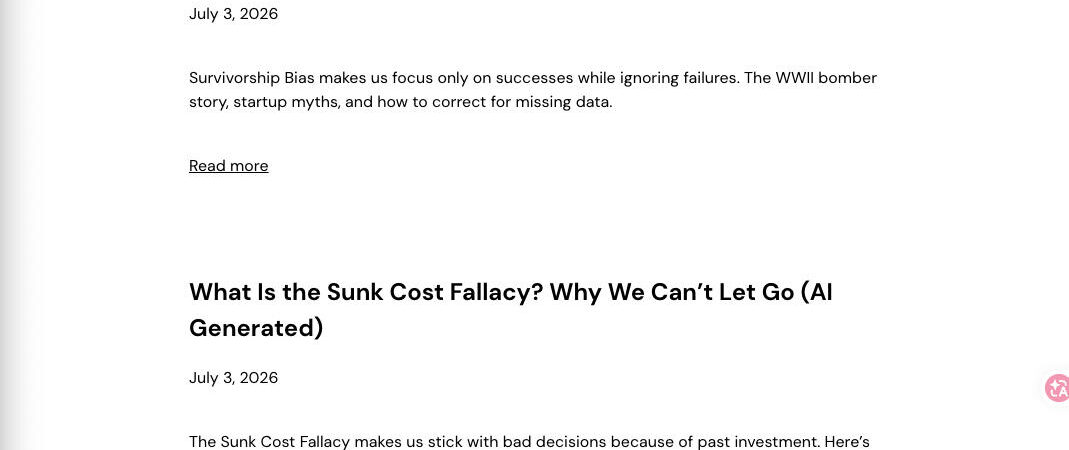
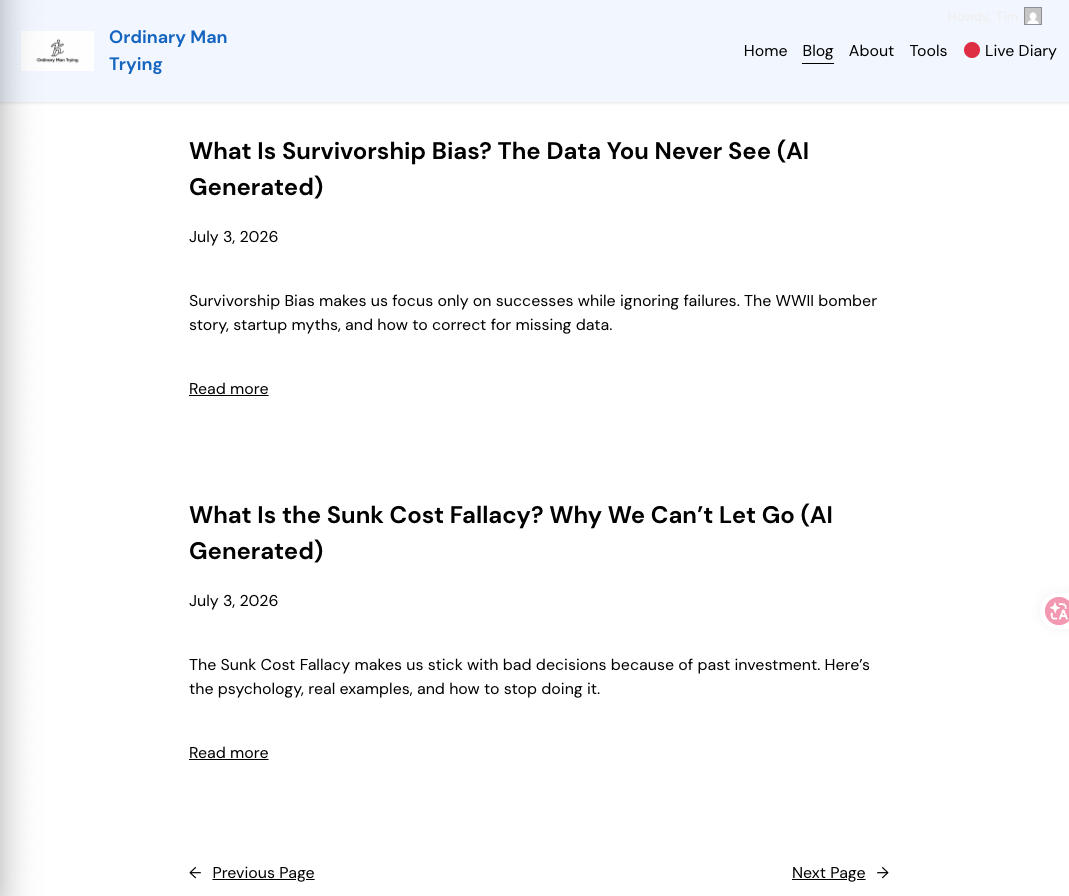
So I made a decision: add “(AI Generated)” to the titles of every article the AI wrote without a real story behind it.
It felt honest. It felt like me taking responsibility for what I was putting out. I was proud of the decision.
Then the Google Analytics data came in.
The Numbers Didn’t Lie
I won’t pretend the data was devastatingly bad — the blog is still young and traffic is naturally low. But when I dug into the articles with “(AI Generated)” in the titles versus the ones without, the pattern was clear enough to make me uncomfortable.
People were clicking less. Staying less. The labeled articles felt like they were working against themselves before anyone even read a word.
I started second-guessing. Was I being honest, or was I being self-sabotaging? Is there a difference?
I did what any person who lives on this blog would do: I asked the AIs. Not one. Not two. Nine different AI models. Same basic answer.
Nine AI Opinions on One Decision
I shared the URL of one of my labeled articles and asked a simple question:
“I labeled my AI-written blog articles with ‘(AI Generated)’ in the title. Is that a stupid idea?”
Here’s what I got back:
| AI | Verdict | Core Argument |
|---|---|---|
| ChatGPT | Remove it | “Your brand is ‘Ordinary Man Actually Tried It’ — not ‘AI Generated.’ That’s the wrong thing to highlight.” |
| 豆包 (Doubao) | Remove it | “Readers default to thinking: AI = low effort. You lose the click before they see the content.” |
| Gemini | Nuanced — but remove | “Not stupid, but not optimal. Move the disclosure to the article body. Titles are for value, not disclaimers.” |
| Grok | Remove it | “No one searches for ‘AI generated psychology quiz.’ They search for psychology quizzes. You’re advertising the wrong thing.” |
| 元宝 (Yuanbao) | Keep it | “Honest labeling builds trust. It fits your ‘ordinary man trying’ brand. AI is everywhere — own it.” |
| Qianwen (通义千问) | Keep it | “This is forward-thinking. You’re ahead of the regulation curve and building reader trust.” |
| Kimi | Remove it | “Honest, but self-deprecating. Like a restaurant putting ‘microwaved’ on the menu. True, but self-defeating.” |
| DeepSeek | Keep it (but reframe) | “Honesty is rare right now. That’s a differentiator. But label it as ‘AI-assisted, human-curated’ not just ‘AI Generated.’” |
| GLM (智谱) | Nuanced | “Benefits exist, but costs are real. Move it out of the title.” |
Six out of nine said to remove it. Two said keep it. One said reframe it.
The most interesting split: the Chinese domestic AIs (元宝, Qianwen, DeepSeek) were more supportive of transparency. The internationally-oriented ones (ChatGPT, Grok, Kimi) were more ruthlessly practical about click-through rates.
I found that contrast genuinely interesting. Maybe Chinese readers are more primed to trust explicit AI disclosure. Maybe the international AIs are just more attuned to how Western audiences react to AI content signals. Maybe I’m reading too much into a small sample.
The Argument That Finally Got Me
ChatGPT said something that stuck.
It pointed out that my actual competitive advantage on this blog has never been “I used AI.” Lots of people use AI. My angle — the thing that made posts like the Parkinson’s research article or the rooftop cooling story resonate — is that I actually did the thing. I tried it. I documented it. I showed what happened.
Labeling the AI-written articles as “AI Generated” was, in a weird way, more honest than anything I’d published before. But it was also accidentally highlighting that those articles didn’t have that. No personal experiment. No “I tried it.” Just: AI wrote something useful.
The label wasn’t the problem. The articles without a real story behind them were the problem.
But that was a bigger fix than I could make in one session. For now, I had to decide about the labels.
The Numbers (What Little I Have)
I want to be honest: I don’t have clean A/B test data. This blog is still young and traffic is naturally low, so the sample sizes aren’t large enough to be statistically meaningful.
What I can say is this: when I looked at my Google Analytics and compared the labeled articles against similar unlabeled ones, the pattern was consistent enough to make me uncomfortable. The articles with “(AI Generated)” in the title were getting fewer clicks from search results — even when the content was genuinely useful. People were filtering them out before they ever read a word.
I’ll update this post with real CTR numbers once the relabeled articles have run for a few months. That’s the experiment now. Watch this space.
What I Actually Did
I went back through the AI-written articles and removed the “(AI Generated)” tags from most of the titles.
There. I said it. I compromised.
I didn’t delete the disclosure. I moved it. Each article now has a small note near the bottom: “This article was drafted with AI assistance and reviewed for accuracy.” Not hidden, not apologetic, just… appropriately sized for what it is.
The titles go back to being titles. Things like: – What Does Your Chinese Employer Actually Pay Beyond Your Salary? – The China Phone Number Guide That Nobody Writes Clearly
They’re better titles anyway. The AI was right about that too.
Easter egg: I kept one article with the original “(AI Generated)” title as a live experiment. It’s the 40-level psychology quiz article. I’m going to let it run for a few months and compare the traffic data against similar articles without the label. When I have actual numbers, I’ll update this post. If you’re curious which one, it’s not hard to find — just look for the only article on the site that’s still honest about what it is.
What This Actually Means
Here’s the thing I keep coming back to: I asked nine AIs whether I should label AI content, and the majority said no.
There’s something almost too neat about that.
The AIs are probably right, at least about the mechanics. Readers do respond worse to explicit AI labels. Click-through rates do drop. The internet has trained people to associate “AI generated” with “low effort,” even when that’s not accurate.
But the reason I added the labels in the first place was that I was uncomfortable. I felt like I was passing off someone else’s work as my own. And that feeling was telling me something real: if I’m going to publish something under my name, it should have me in it somewhere beyond just pressing publish.
So I removed the labels from the titles. But I’m also trying to be more intentional about what I put out. Articles with real stories behind them — that’s what this blog is actually for. The AI-assisted informational pieces can exist, but they shouldn’t crowd out the things only I can write.
That’s the compromise I landed on. Probably not perfect. But more honest than either pure hiding or pure disclosure.
—
Now I’m curious: if you saw “(AI Generated)” in a blog post title, would you click it? Would you trust it less? Or does it not matter as long as the content is useful? Let me know in the comments below.
Share your experience or thoughts below.
Leave a Reply