
It happened on a Friday night.
I was in the middle of building a new tool for the site — a social icebreaker game called the Loneliness Test. I had a working prototype but it felt off. The invite-copy feature wasn’t right. The animations were janky. I kept asking Claude to iterate.
Then this appeared in my terminal:
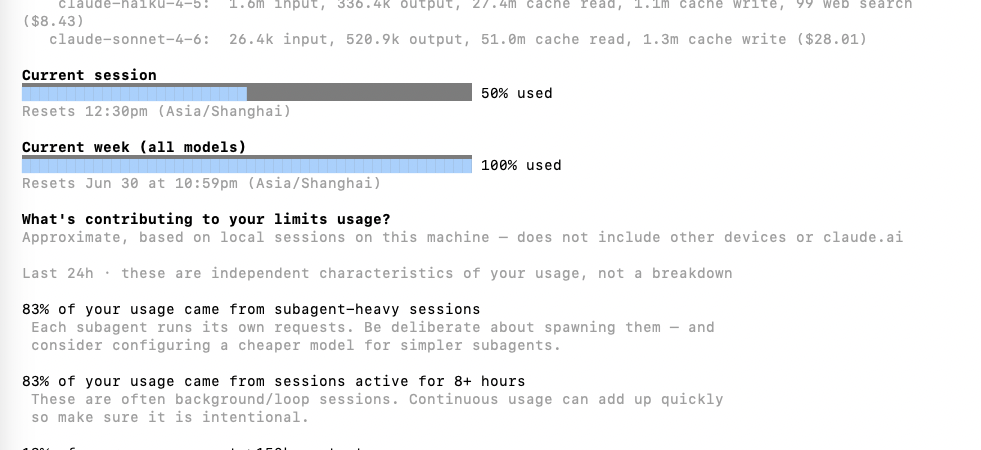
Current week (all models): 100% used.
Not a crash. Not an error. Just a soft wall. Resets Tuesday night. I stared at it for a moment. I had been in the middle of a sentence.
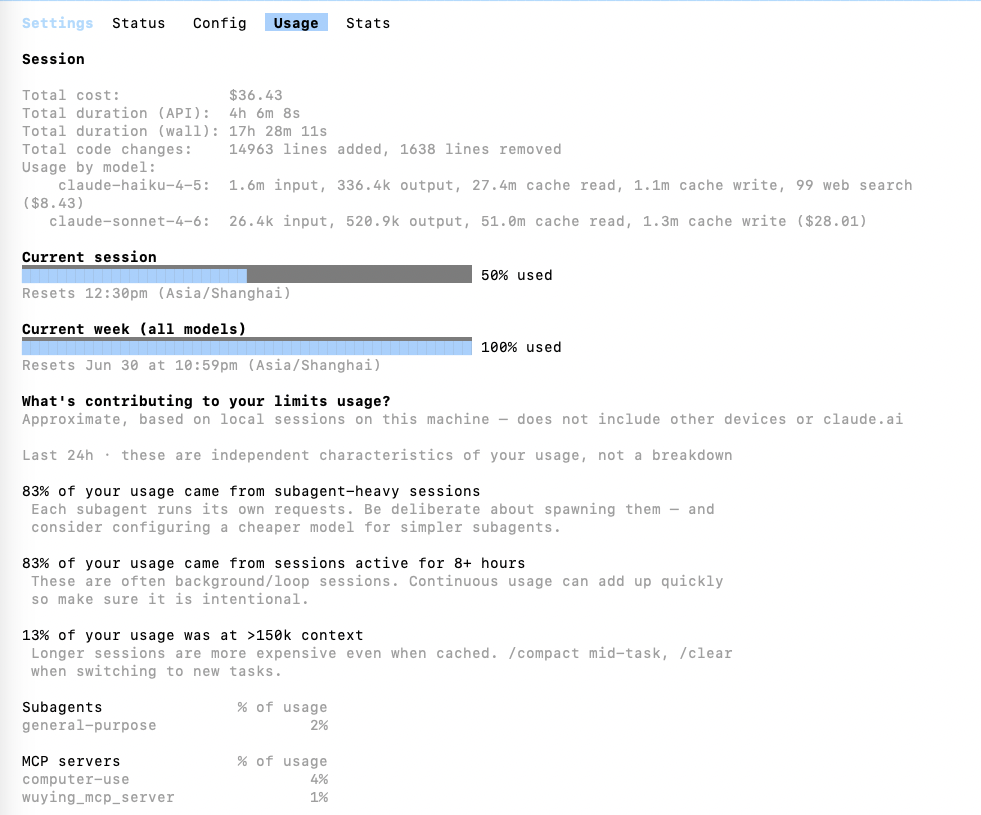
The dashboard told the full story. $36.43 burned in a single 4-hour session. 83% came from subagent-heavy sessions — background workers scanning files, iterating on code, making changes across the project. By Friday night, the entire week’s quota was gone.
I had three days until the reset. The tool was half-finished. I refused to wait.
The Geeky Workaround
I opened Gemini and explained my situation. The advice sounded genuinely clever: bypass Claude’s limits entirely by using Aider — an open-source terminal coding assistant — wired to DeepSeek’s API, which was supposed to offer “95% of Claude’s coding ability at one-tenth the price.”
Within twenty minutes I had it running. I typed a test message: “Hello.”
Tokens: 10k sent, 69 received. Cost: $0.0028 session.
Aider had silently read my entire repository — over 1,000 files — and sent the whole architecture map to DeepSeek before I’d said anything useful. Nearly three cents to say hello. Fine. Let’s get to work.
I gave it a simple task: clean up the invite-copy feature in my HTML file. Fix some text. Update a few strings.
What followed was forty minutes I will not get back.
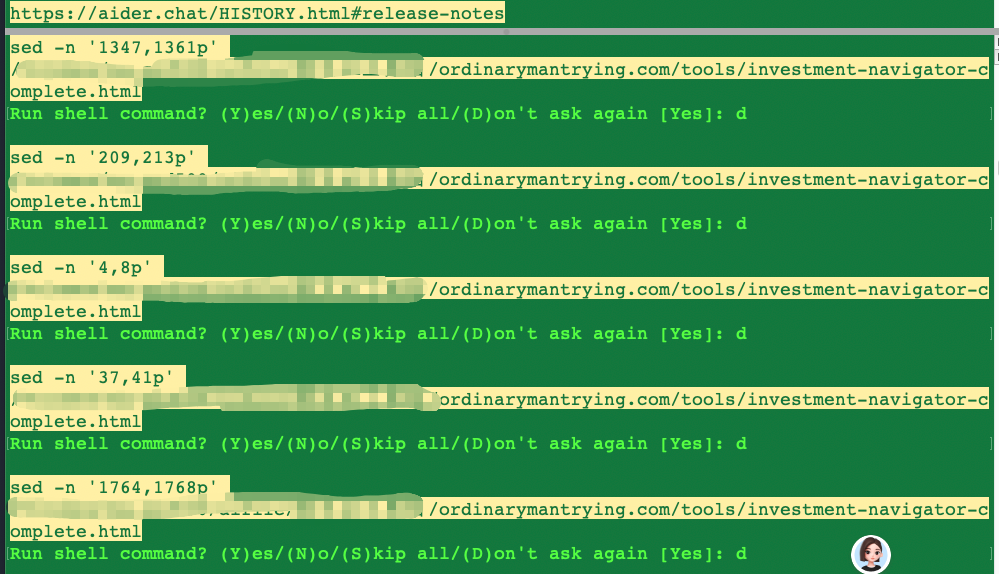
DeepSeek couldn’t find an exact text match because of an HTML whitespace difference. Instead of adjusting its approach, it panicked. It kept modifying its search slightly, failing, then asking: “Try this? (Y/n).”
Y. “Try this? (Y/n).” Y. “Try this? (Y/n).” Y.
I pressed Y seventeen times. The file was completely untouched. I hit Ctrl+C and checked my DeepSeek billing.
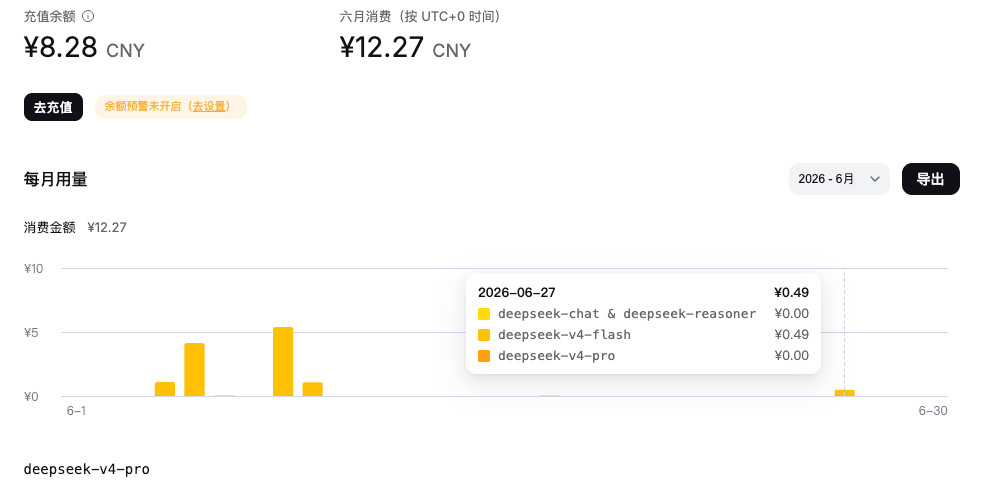
¥0.49. Seven US cents. Forty minutes of an AI fighting HTML whitespace and achieving absolutely nothing. The total DeepSeek bill for all of June was ¥12.27 — about $1.70. Cheap. But I had nothing to show for it.
The Gemini Marathon: 30+ Versions in One Weekend
I gave up on the terminal agent entirely and switched to Gemini’s chat interface. This actually worked — Gemini could hold context, understand what I was describing, and generate complete HTML files from scratch. The problem was the iteration cycle.
Describe what’s wrong → Gemini generates a new file → I download it → open in browser → test it → something’s still off → repeat. No version control. No memory between sessions. Just a growing folder of files and a browser history I’d rather forget.
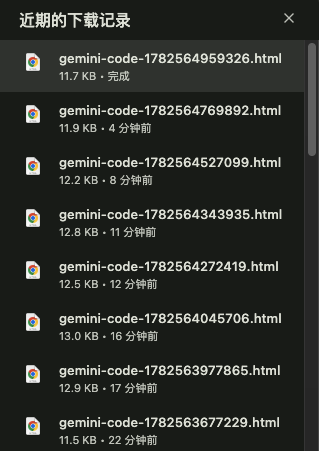
That screenshot is from one twenty-two-minute window. There were more before it and more after it. By the time I had something I was satisfied with, I had gone through more than thirty versions of the same file, each one slightly closer to what I had in my head.
I also pulled in ChatGPT at one point — not to write code, but to review what Gemini had produced. Running one AI’s output through a second AI for critique turned out to be genuinely useful. ChatGPT spotted a logic bug I had missed entirely. Gemini fixed it in the next version.
It took a full weekend.
What Actually Came Out of It
The Loneliness Test has thirteen levels of solo activities — from shopping alone at Level 1 to going to surgery alone at Level 13. At each level you answer honestly: Totally fine or I can’t do this. When you stop, it generates a personalized message you can send to a friend to invite them out.
The idea: turn an awkward social invitation into a low-pressure game. Send your score, challenge them to beat it, mention something you want to do together.
After thirty-plus iterations across three AIs, the final version is genuinely good. I could not have built it without AI. It just wasn’t the AI I expected to use.
The Irony I Noticed at 1am
Somewhere around the fifteenth Gemini download, I noticed something.
I was building a tool about loneliness — about the discomfort of doing things alone — while experiencing the loneliest coding session I’d had in months.
Claude is the AI I’ve worked with long enough to have a shorthand with. I describe something half-finished, it understands what I mean. I say “the animation feels off,” it knows which animation. There’s a fluency that builds up over time, over a project, over shared context.
Gemini didn’t have that context. I had to re-explain everything from scratch each time. DeepSeek didn’t understand my file structure. ChatGPT hadn’t seen the project before.
Losing access to your main AI tool doesn’t feel like losing software. It feels like your experienced colleague went home for the weekend and left you with people who need the entire project explained from the beginning every thirty minutes.
The Honest Verdict
DeepSeek is great for chatting about code and unreliable for autonomously executing changes in a real project. The raw reasoning is impressive. The tool-calling is not there yet — at least not for my workflow.
Gemini’s chat interface works, but iterating without persistent memory is exhausting. You become the memory layer yourself.
The $20-per-month Claude subscription is genuinely one of the best value propositions in AI right now — not because it’s cheap, but because the moment you lose it, you understand what you were actually paying for. The continuity. The context. The ability to say “you know that file we were working on” and have that mean something.
I am not sponsored by Anthropic. I’m just someone who found out the hard way.
Try the Tool I Built With the Scraps
The Loneliness Test is live here. Free, no login, works on mobile. Play through the thirteen levels and see where you stop. If it makes you want to text someone, the invite generator is right there.
And if you make it all the way to Level 13 — going to surgery alone — I genuinely want to know.
What level did you reach?
Related Reading
- I Used AI to Create 60 Social Media Posts in One Day
- I Built This Blog for ¥700 and What I’d Do Differently
- Week 1 of Running This Blog: What I Expected vs. What Actually Happened
- Building in Public: My First Month Running an AI Blog
- Digital Ghosts: What 8 Years of Failed Hustle Taught Me
- Building in Public Diary — All Entries
Leave a Reply