
October 18, 2026
Today, I almost built another website.
It started with a short video.
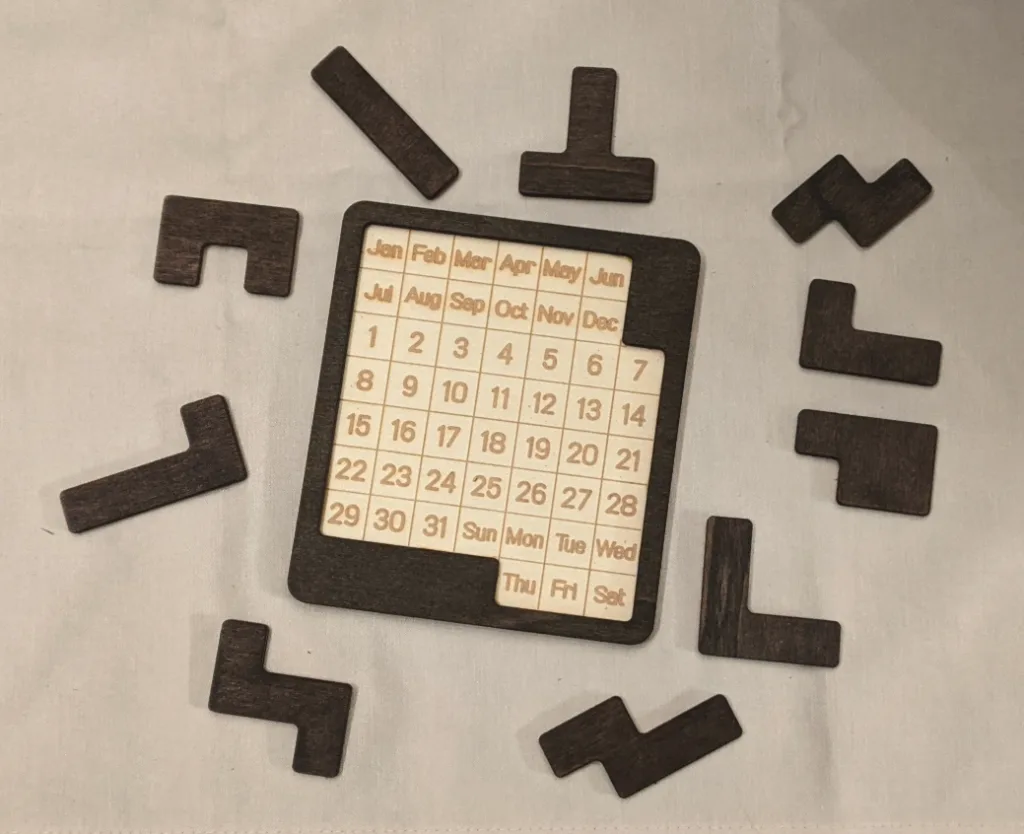
Someone was playing with a wooden calendar puzzle. There were ten oddly shaped pieces and a board filled with months, dates, and weekdays. The challenge was to arrange all ten pieces so that only today’s month, date, and weekday remained visible.
Simple idea. Beautiful execution.
I watched the pieces slide into place and immediately thought:
This would make a great little web game.
And then came the dangerous second thought:
I could probably build this with AI in a day.
A year or two ago, that thought might have ended there. Building a polished browser game would have required serious programming time. Drag-and-drop interactions, rotating pieces, solving algorithms, mobile compatibility, deployment — none of that sounded like a casual weekend project.
But things have changed.
With tools like Codex and Claude Code, the technical barrier feels almost nonexistent.
I no longer ask, “Can I build this?”
I ask, “How quickly can I build this?”
And sometimes, that is a problem.
From a 30-Second Video to a Software Project
I took screenshots of the puzzle and showed them to ChatGPT.
We discussed how to turn the wooden game into a browser game.
The board contained 50 cells: 12 months, 31 dates, and 7 weekdays. Ten puzzle pieces would cover 47 cells, leaving the three corresponding to a particular day uncovered.
The plan came together quickly.
The game would automatically select today’s date. Players could drag, rotate, and flip pieces. A solver would find valid arrangements. There would be hints, a timer, and perhaps a daily challenge.
Then I started thinking about protecting the software.
Instead of a purely static website, I wanted to use Cloudflare Workers. The solving algorithm and complete answer data could stay on the server, making them harder to copy directly.
We even had a technical architecture.
Cloudflare Workers. TypeScript. A puzzle-solving algorithm. A mobile-friendly interface.
I was already close to asking Codex to start writing the code.
And that was when I asked another AI a simple question:
Does a website like this already exist?
Five Minutes of Research Changed Everything
Grok found several websites offering almost exactly what I had imagined.
One was Daydoku.
It wasn’t just a rough prototype. It already had multiple calendar puzzle variations, interactive gameplay, and features similar to what I was planning.
Another was Date Blocker.
There were also existing puzzle solvers and open-source implementations.
For a moment, I felt disappointed.
Someone had already built my exciting new idea.
Of course, having competitors isn’t necessarily bad. Competition can demonstrate that a market exists.
So instead of giving up immediately, I decided to investigate the numbers.
I opened Semrush and researched Daydoku.
What I found was more important than the existence of competitors.
The Numbers Were Surprisingly Small
According to Semrush’s October 2026 estimates, Daydoku had approximately:
- 92 monthly organic search visits worldwide
- 15 monthly organic search visits from the United States
- 47 ranking keywords globally
- An Authority Score of 8
The website also had roughly 3,000 backlinks from 912 referring domains.
Those figures caught my attention.
Daydoku wasn’t invisible on Google. It was ranking reasonably well for some relevant searches.
For example, in the United States:
| Keyword | Monthly searches | Daydoku position |
|---|---|---|
| daily calendar puzzle | 170 | 5 |
| daily calendar puzzle solutions | 110 | 6 |
| calendar puzzle today | 70 | 7 |
| daily puzzle calendar | 40 | 5 |
These were Semrush estimates, not actual analytics from Daydoku. Search volume estimates can be imperfect, and keyword audiences overlap.
More importantly, organic search traffic isn’t total website traffic. Daydoku might receive many visitors through bookmarks, game directories, social media, or people returning directly every day.
I couldn’t know its real audience size or revenue from these numbers.
But I could see something relevant to my goal.
I wasn’t planning to build this game purely for fun.
I wanted to create another website that could attract visitors from Google.
And the available evidence suggested that the search opportunity might be quite small.
Even an established, functional product with decent rankings wasn’t getting much estimated Google traffic.
Would another nearly identical website really be a good use of my time?
AI Has Made Building Cheap. It Hasn’t Made Attention Cheap.
This was the most interesting part of the whole experience.
The puzzle wasn’t too difficult to build.
That was no longer the issue.
With AI, I could probably produce a working version quickly, then spend another few days improving the design, testing the mobile experience, and deploying it.
The hosting cost would be tiny. Cloudflare’s infrastructure could handle a small game without much expense.
But none of that would guarantee visitors.
AI can dramatically reduce the cost of creating a product. It cannot guarantee that anyone wants to use it.
And it certainly cannot guarantee that Google will send people to it.
I already operate several small websites. Some have useful tools, original content, and months of development behind them.
Yet attracting consistent search traffic remains difficult.
I know what it feels like to build something, launch it, check Google Search Console every morning, and see almost nothing happen.
That’s why this little calendar puzzle was such a useful reminder.
I didn’t need another technically successful project with an uncertain audience.
I needed to become better at choosing which projects deserve to exist.
The Most Valuable AI Output Today Wasn’t Code
Usually, when people discuss AI productivity, they talk about how much work AI can produce.
How many lines of code?
How many articles?
How many websites?
How many tasks completed in an afternoon?
I understand the excitement. I experience it myself almost every day.
But today, AI helped me accomplish something different.
It helped me stop.
One AI helped me understand how to build the game.
Another helped me find existing competitors.
Then I used SEO data to examine whether there was enough search demand to justify creating another website.
By the end of the process, my conclusion was simple:
Don’t build it. At least not as another SEO-driven website.
I still think the calendar puzzle is a wonderful idea.
I might even build a personal version someday, simply because I enjoy it.
But that’s a different decision from launching another website and expecting it to attract meaningful Google traffic.
There is nothing wrong with building something for fun.
The mistake is confusing a fun project with a promising business opportunity.
A New Rule for My Future Projects
I want to change the order in which I approach new ideas.
My old process was often:
Discover an interesting idea → Build it with AI → Launch it → Hope people find it.
My new process should be:
Discover an idea → Find existing solutions → Research demand → Identify what’s missing → Decide whether to build.
The difference seems small.
But it could save hundreds of hours over the next few years.
I don’t need to stop experimenting. In fact, experimenting is one of the things I enjoy most.
I just need to remember that finishing a project and creating something valuable are not always the same thing.
AI has made it easier than ever to start.
Maybe the next important skill is knowing when not to.
Today, I watched a short video, imagined an entire product, researched the competition, checked the numbers, and walked away.
No code written.
No domain purchased.
No new website added to my growing collection.
And strangely enough, I feel that I made progress.
Sometimes the best project is the one you decide not to build.
This is a personal note from an ordinary man trying to build useful things, learn from his mistakes, and make better decisions in the age of AI.
Leave a Reply