Wondering why I suddenly started building websites? Check out this article — it’s because Hostinger’s hosting is just too cheap.
You can read hundreds of articles about China and still make a very simple mistake when you actually interact with Chinese people.
You can know what a Chinese New Year red envelope is.
You can know what “guanxi” means.
You can know that Chinese people often exchange gifts.
And then someone gives you a gift and you have absolutely no idea what you are supposed to do.
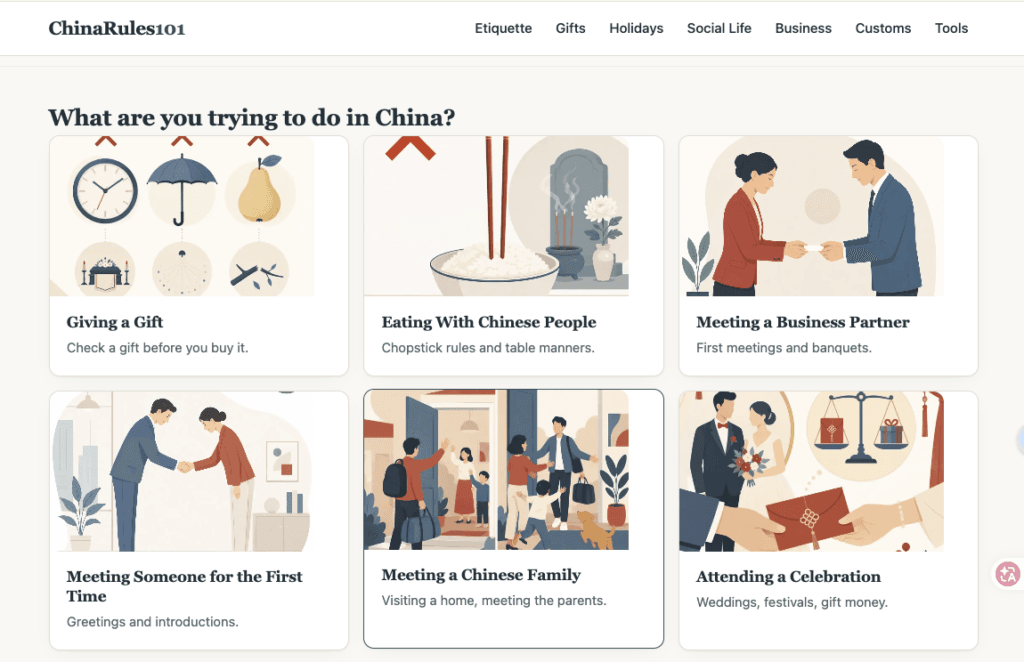
That gap between knowing information and knowing what to do is what made me build ChinaRules101.
China is full of unwritten rules
Every society has unwritten rules.
China has plenty of them.
Some are obvious.
Others are subtle.
For example:
- How should you respond when someone gives you a gift?
- When should you refuse something?
- What does it mean when someone says “maybe”?
- How should you behave at a Chinese banquet?
- What should you do when meeting someone’s parents?
- What topics should you avoid?
- How do Chinese people express disagreement?
- When does politeness become indirectness?
- How important is hierarchy in a workplace?
These aren’t always questions that can be answered with a dictionary.
They require context.
That’s what I’m interested in.
Information isn’t enough
One of the problems I noticed with many cultural websites is that they explain Chinese culture from a distance.
They tell you:
“Chinese people value relationships.”
Okay.
But what should I actually do at dinner?
They tell you:
“Gift giving is important.”
But what gift should I bring?
They tell you:
“Chinese communication can be indirect.”
But what does that mean when my Chinese colleague says something that sounds positive but I’m not sure whether they actually agree?
These are practical problems.
And practical problems are exactly where I think AI can become interesting.
Building tools instead of just articles
ChinaRules101 is therefore becoming more tool-oriented.
Instead of only publishing explanations, I want to experiment with tools that help people deal with specific situations.
For example:
What should I bring as a gift?
How risky is this gift?
How should I respond in this social situation?
What might this Chinese message really mean?
How should I behave at a banquet?
These are situations where a person doesn’t necessarily want another 2,000-word article.
They want an answer.
Maybe even a simulation.
That’s why I have been experimenting with AI-powered tools for China-related situations.
This is where the business model gets interesting
A general article about Chinese culture can attract a lot of curious visitors.
But a person who is facing an actual social problem has a different level of urgency.
Imagine someone working in China who needs to attend a business dinner tomorrow.
Or someone dating a Chinese person who wants to understand a family situation.
Or an overseas employee who doesn’t understand why a Chinese colleague reacted in a particular way.
Those people aren’t necessarily looking for entertainment.
They are trying to solve a problem.
That creates the possibility of higher-value tools and paid products.
And that’s what I’m testing.
I don’t want ChinaRules101 to tell people that “Chinese people are like this”
That’s another important principle.
Culture is complicated.
There are regional differences.
Generational differences.
Personality differences.
Professional differences.
Urban and rural differences.
And individual differences.
So I don’t want to build a website that reduces 1.4 billion people to a collection of stereotypes.
The goal is to provide context.
Not judgment.
Not “China is better.”
Not “the West is better.”
Just:
Here is a situation. Here are some cultural factors that may help you understand it.
That is much more useful.
Another experiment in the same larger journey
My websites are gradually starting to fit together.
ChineseFortuneTools explores Chinese culture from a more traditional and curiosity-driven angle.
ChineseNameCraft explores personal identity.
ChinaRules101 explores everyday interaction.
They are different websites because the user needs are different.
But they are connected by a common question:
What happens when someone outside China wants to understand China better?
I don’t know yet how large this business can become.
I’m not trying to pretend that I do.
I’m simply building the tools, watching what people use, studying the search data, and seeing whether anyone is willing to pay for a better answer.
That’s another experiment by one ordinary man trying to build something on the internet.
Leave a Reply