View Wayback Machine snapshot (August 16, 2026) →
The Hostinger deal was $114.82 for 4 years. My existing plan — the one I bought without thinking — is going to cost $263 to renew in 2 years. The math doesn’t care about feelings.
So I bought it. New plan. Four years. Before I had a single idea of what to put on it.
The Problem With Buying First
My current Hostinger plan hosts three sites. I’m using all three slots. The new plan also supports three sites — and I had zero sites planned for it.
That’s the moment most people would have buyer’s remorse. I had a different reaction: I opened a conversation with Claude and typed something like, “I just bought four years of hosting with no plan. What should I build?”
What followed was one of those AI conversations I actually screenshot and save.
The Research Rabbit Hole
I wanted something low-maintenance. Not another blog. Not another site I had to update every week. Something that could sit there, get search traffic, maybe earn ad revenue, without me feeding it constantly.
The AI pointed me toward tool sites. Sites like wheelpage.com — a dead-simple random spin-the-wheel tool. No content calendar. No author bio. Just a useful utility that people search for, land on, use, and come back to.
The general idea: SEO brings traffic, ads or a freemium tier convert it, and the tool keeps running whether you touch it or not. I had no proof this model would work for me specifically. I was simply curious whether a small, useful website could eventually attract enough visitors to make something — anything — back. I didn’t need a business case. I needed a direction.
From Wheelpage to Chinese Fortune Tools
The honest version of how this went:
I thought about copying wheelpage. Just building a cleaner spin-the-wheel and targeting the same keywords. Then I thought: what do I actually know? What’s a space where I have some background, and where I’m not just competing against people who have been doing it for years?
Chinese culture. Ba Zi. Zodiac. Feng Shui. Lunar calendar. I’m Chinese. These things aren’t exotic to me — they’re just the culture I grew up with. The zodiac was how my family talked about personalities. The lunar calendar marked every festival. Folk sayings were how older relatives gave advice. I had never thought of any of that as an asset. It was simply background noise from childhood.
Then I looked at what actually existed in English for this space. Most of it looked like it was built in 2009 and hadn’t been touched since. Cluttered layouts, machine-translated text, tools that barely worked on mobile. I thought: I could probably make something cleaner than this. I didn’t have a validated opportunity. I had a vague feeling that I could do better, and some spare server space.
Two days later, ChineseFortuneTools.com was live.
The Part That Still Surprises Me
Here’s the thing I keep coming back to.
I had an idea for a card-based interface for Chinese wisdom — something where you scroll through one saying at a time, on your phone, the way you might scroll through short videos. Not because I wanted to build a dopamine product. Because I had a different problem in mind.
Most Chinese proverb sites are databases. You search, you find a list, you scroll past fifty things you don’t need. That’s not how wisdom actually works. Wisdom is useful when it meets a specific moment.
A couple is arguing. Someone sends them 退一步海阔天空 — “step back and the sea and sky open wide.” A friend is rushing a decision. You send them 欲速则不达 — “haste doesn’t get you there faster.” Someone takes a loss. They stumble on 塞翁失马 — the old man’s horse — and it reframes everything. Someone keeps getting too close too fast with people they barely know. They read 交浅不可言深 and suddenly understand something about themselves.
That’s the product idea: one thought, one situation, one possible action. Discover it, understand it, save it, or send it to someone who needs it right now. Not a database. A moment of recognition.
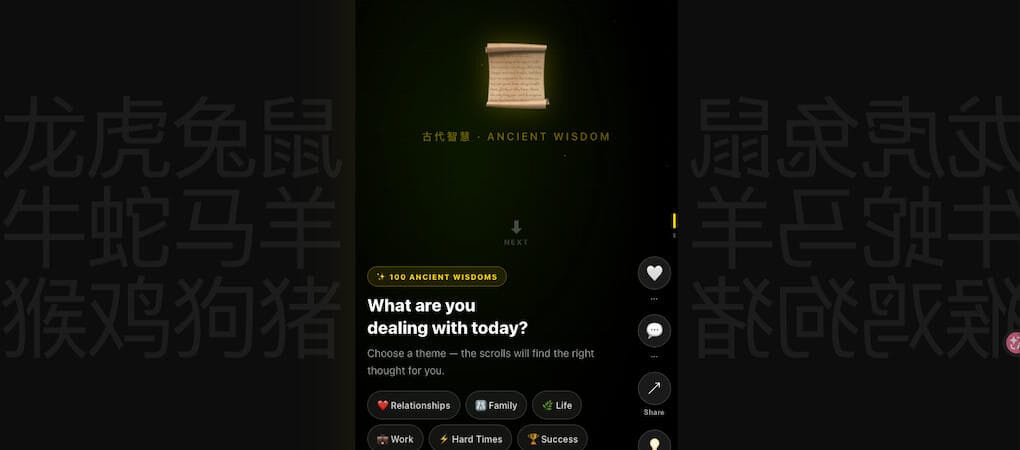
I described the interface to Claude: full-screen cards, swipe to move forward, image-forward, one saying per card. It built it.
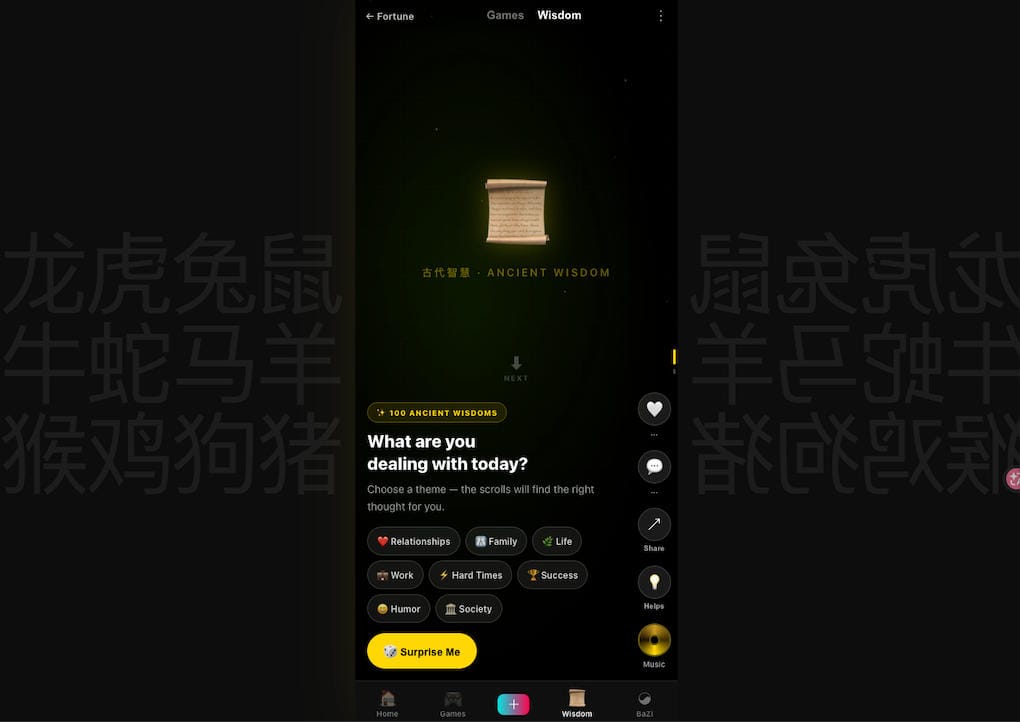
That’s the Chinese Wisdom card interface — live, on mobile, built in an afternoon.
A year ago I would have looked at something like that and assumed it took a real developer. Now I describe the idea and it exists. That’s the shift that’s hard to explain to people who haven’t experienced it.
I’m not a better programmer than I was. I just have access to something that removes the gap between I have an idea and the idea exists.
What This Is, Actually
I don’t know whether ChineseFortuneTools will make money, or whether Google will ever send meaningful traffic to a brand-new site about Chinese culture. These are real open questions. But the hosting cost less than a weekend trip, the domain was cheap, and I had time and curiosity. If it earns something, great. If it doesn’t, I spent a few months building in a space I actually know something about.
That’s precisely why I’m doing it — not because I have a plan, but because I want to find out what happens when you build anyway.
The original plan for the new hosting was “I’ll figure it out.”
Still figuring.
⚡ Zero to Live in Under 24 Hours — This Is What AI Speed Feels Like
I want to record something that I think is easy to miss when you’re inside it.
The idea for ChineseFortuneTools didn’t exist before I bought the hosting. I bought the hosting on impulse. I had a conversation with AI about what to build. I registered the domain. And within 24 hours of the domain existing, the site was live — with tools, pages, and content already submitted to Google Search Console.
Four years of hosting. $131.88 total. That’s $2.75 a month — less than a single milk tea. That used to be months of work for a solo developer. Now it’s an afternoon.
Here’s the paper trail.
Step 1 — I bought the hosting.
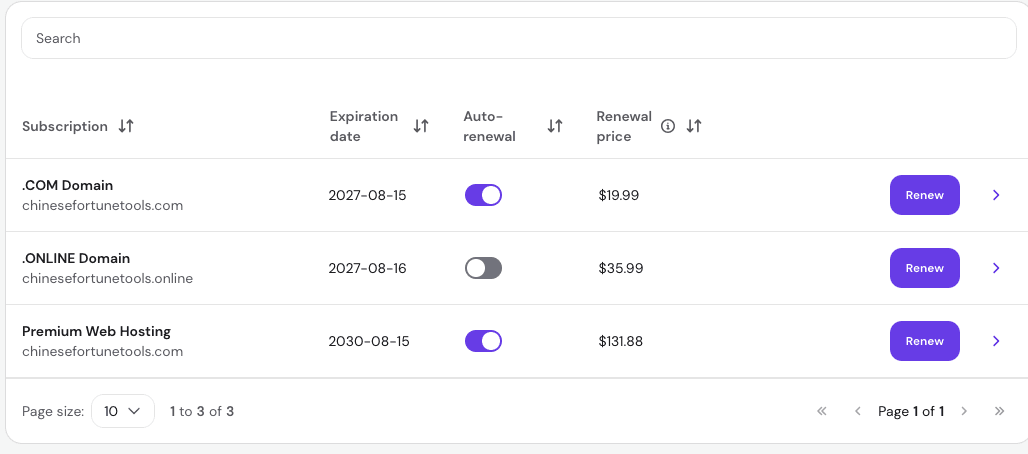
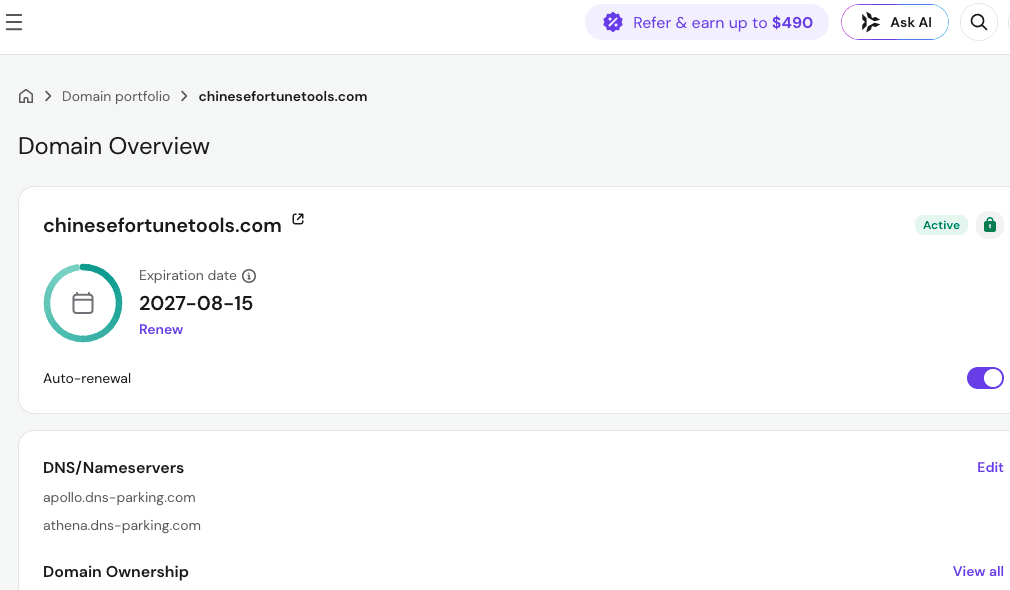
Step 2 — Less than 24 hours later, the domain was registered and the site was already running.
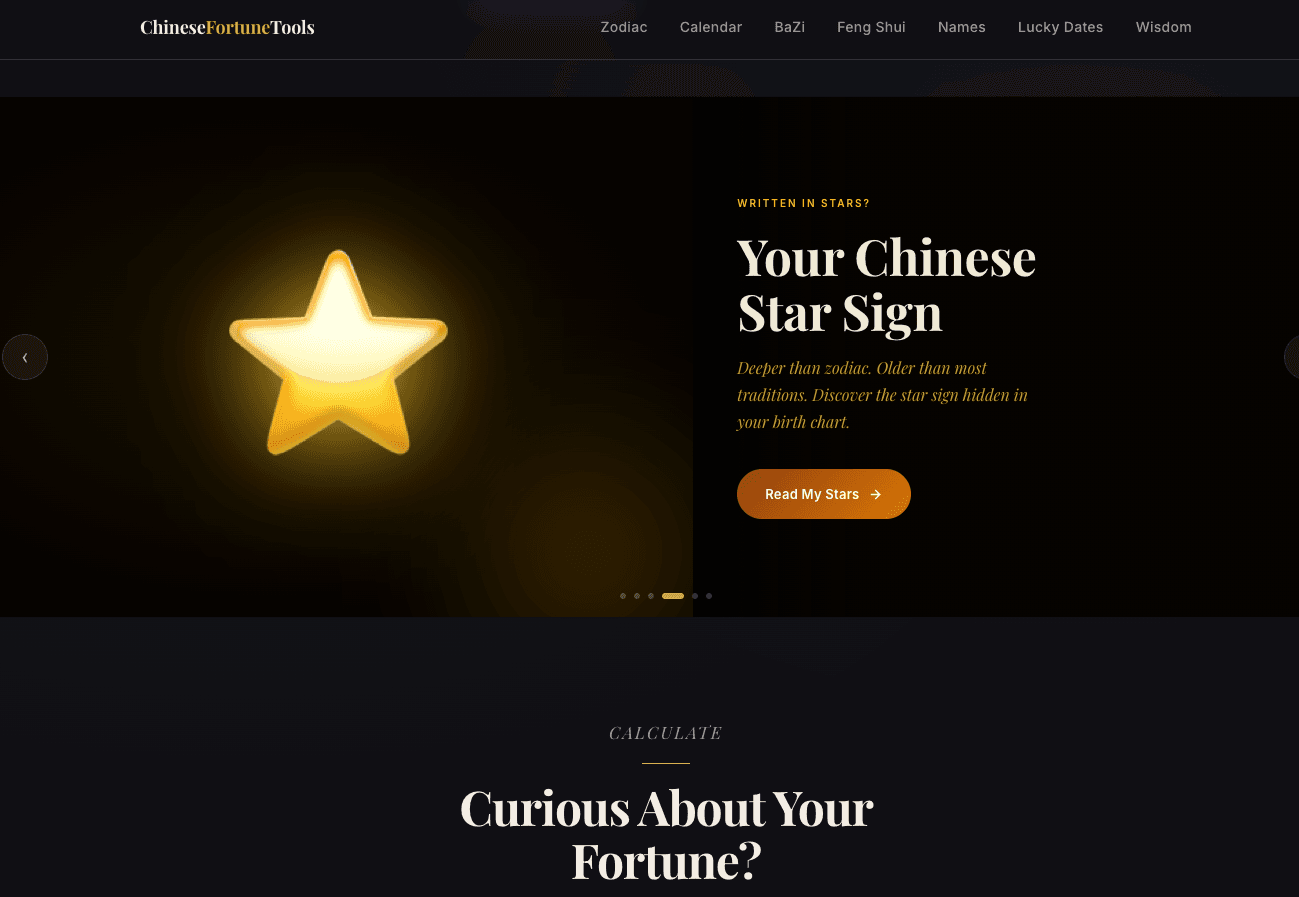
Step 3 — The homepage was up with real content and real tools.
Step 4 — 41 pages already submitted to Google Search Console.
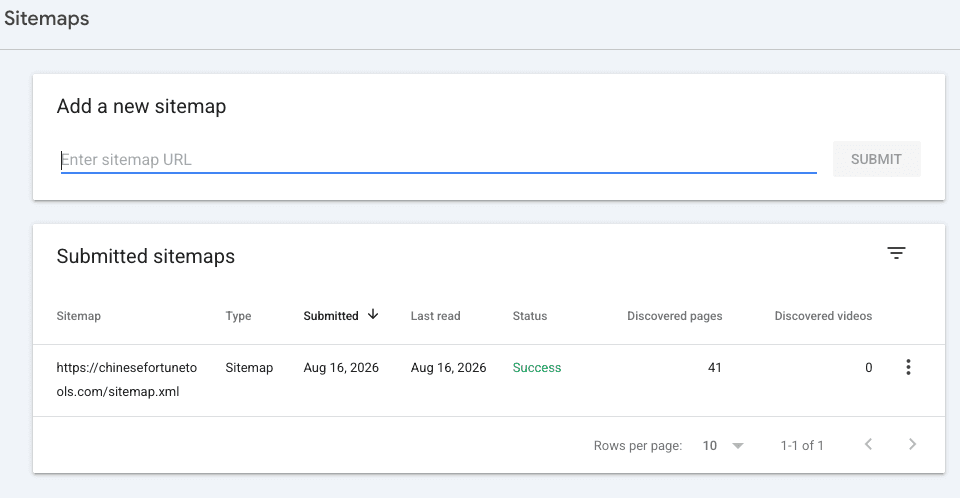
41 pages. Indexed and waiting for Google to crawl. Within 48 hours of the idea existing.
I keep thinking about what this would have looked like five years ago. Buying hosting, setting up a server, designing pages, writing content, building tools, submitting to search engines — that’s weeks of work, minimum. You’d need to know PHP, CSS, server configuration, SEO basics, and have enough motivation to push through every step before seeing anything real.
Now the gap between I have an idea and the idea exists on the internet is measured in hours.
I’m not saying the hard work is gone. Getting traffic, building an audience, making something people actually care about — that’s still the same slow grind it always was. But the starting line has moved. A lot.
For someone like me — ordinary person, limited technical background, no team, no budget — that change is not small. It’s the whole thing.
🔮 An AI Prediction, Recorded August 2026
After deciding to build ChineseFortuneTools instead of a wheelpage-style utility site, I did something I want to preserve for later: I asked AI to compare the two models honestly and make a 5-year prediction.
Not to tell me what I wanted to hear. To make the most accurate prediction it could.
The prediction is below. I’m publishing it now so I — and anyone else — can come back in 2031 and see whether it was right.
The Two Models
Model A — WheelPage-style utility site (what I originally wanted to build)
Simple, high-search-volume tools: spin the wheel, random name picker, dice roller, coin flip, yes/no, hundreds of variations. Business model: Google search → free tool → lots of traffic → ads.
Model B — ChineseFortuneTools (what AI recommended instead)
Chinese zodiac, folk wisdom, traditional culture, interactive discovery, shareable experiences. Instead of asking “what tool do you need?” it asks “what piece of Chinese wisdom might be useful to you right now?”
The 5-Year Scorecard (1–10)
| Factor | WheelPage-style | ChineseFortuneTools |
|---|---|---|
| SEO potential | 9 | 7 |
| Search demand | 10 | 5 |
| Competition level (lower = better moat) | 3 | 8 |
| Resilience to AI search disruption | 4 | 7 |
| Repeat visits | 9 | 8 |
| Social sharing potential | 6 | 10 |
| Content scalability | 10 | 9 |
| Advertising potential | 10 | 6 |
| Affiliate potential | 7 | 5 |
| Premium product potential | 8 | 8 |
| Defensibility / moat | 4 | 8 |
| Difficulty for a solo creator | 7 | 5 |
| Chance of becoming a real business | 8 | 7 |
| Overall average | 7.2 | 7.1 |
Suspiciously close. But the numbers hide an important difference in what kind of business each becomes.
Come back in August 2031. We’ll see whether these scores held up.
The Key Differences
SEO and traffic: WheelPage wins. “Spin the wheel” and “random name picker” are searches with clear, immediate intent. The user needs the tool right now. Chinese cultural wisdom doesn’t have that same search pull — it’s more of a discovery product than a search product.
Social sharing: ChineseFortuneTools wins, decisively. A random number generator isn’t meaningful after you use it. But consider: a couple argues → someone sees 退一步海阔天空 (“step back and the sky opens wide”) → sends it to their partner. A friend is rushing a decision → you send 欲速则不达. Someone takes a loss → they find 塞翁失马 and it reframes everything. That’s not a search query. That’s a social object — something people use to communicate with each other. Utility sites almost never produce that.
Defensibility: ChineseFortuneTools wins. A random wheel is software. Software can be copied in an afternoon, especially now that AI can generate code. A Chinese cultural experience is software + content + curation + translation + design + brand + accumulated user behavior. The moat isn’t “my JavaScript is better.” It’s “this is the place where people discover Chinese wisdom.” That’s a harder position to dislodge.
AI disruption risk: A website whose product is information (what does this proverb mean?) is vulnerable to AI answering the question without sending the user anywhere. A website whose product is experience (swipe, encounter a piece of wisdom at the right moment, decide who needs to hear it today) is harder to replace. ChineseFortuneTools wins this, but only if it stays an experience rather than becoming a database.
The 2031 Revenue Prediction
| Monthly revenue by 2031 | WheelPage-style | ChineseFortuneTools |
|---|---|---|
| $100/month | High probability | Medium-high |
| $1,000/month | Medium-high | Medium |
| $10,000/month | Medium | Low-medium |
WheelPage wins on raw probability — it’s a well-understood path: rank → traffic → ads. ChineseFortuneTools has a wider range of outcomes, from “earned nothing” to “built a real brand,” but lower base probability. One is more like a business. The other is more like a brand.
What Could Make This Prediction Wrong
- AI kills SEO for utility sites. If AI agents handle random selections without opening a browser, the utility-site model loses its traffic source. WheelPage-style sites might end up less defensible than they look right now.
- Chinese culture becomes dramatically more popular internationally. If Chinese language learning, travel, or cultural content grows significantly outside China, ChineseFortuneTools’ audience expands — possibly a lot.
- Social/short-video platforms become the main discovery channel. If people increasingly find cultural ideas through TikTok or Instagram rather than Google, a visual card-based wisdom experience could outperform a traditional SEO site.
- Nobody cares. I could build 5,000 pieces of Chinese wisdom, make beautiful animations, add sharing mechanics — and almost nobody visits. That’s a completely legitimate outcome, and I should name it.
⏱ Time Capsule — Sealed August 2026
I’m publishing this prediction now, without knowing whether it’s correct.
The AI gave WheelPage a slightly higher probability of making money. It gave ChineseFortuneTools a higher probability of becoming something with a real identity. I chose to build ChineseFortuneTools anyway — partly because I’m Chinese, these things aren’t foreign to me, and partly because I’d rather spend five years on something I find genuinely interesting than something I built by copying a market that already works.
Maybe that’s a mistake. I don’t know yet.
Prediction recorded: August 2026.
Verification date: August 2031.I’ll come back to this page. We’ll see who was right.
If You Have an Idea, Try This
Everything above started with cheap hosting and a conversation with AI. If you’ve been sitting on an idea and haven’t built it because it felt too technical or too expensive, it’s probably neither.
Buy a hosting plan. Get a domain for $1. Tell AI what you want to build. See what exists by tomorrow.
That’s literally how ChineseFortuneTools started. If you want the same deal I used: You get 20% off; I earn a small commission.
👉 Get Hostinger Hosting (my affiliate link)
I get a small commission; you pay the same price. No obligation.
Related: Building in Public — the weekly data log where I track all of this with real numbers.
Leave a Reply